
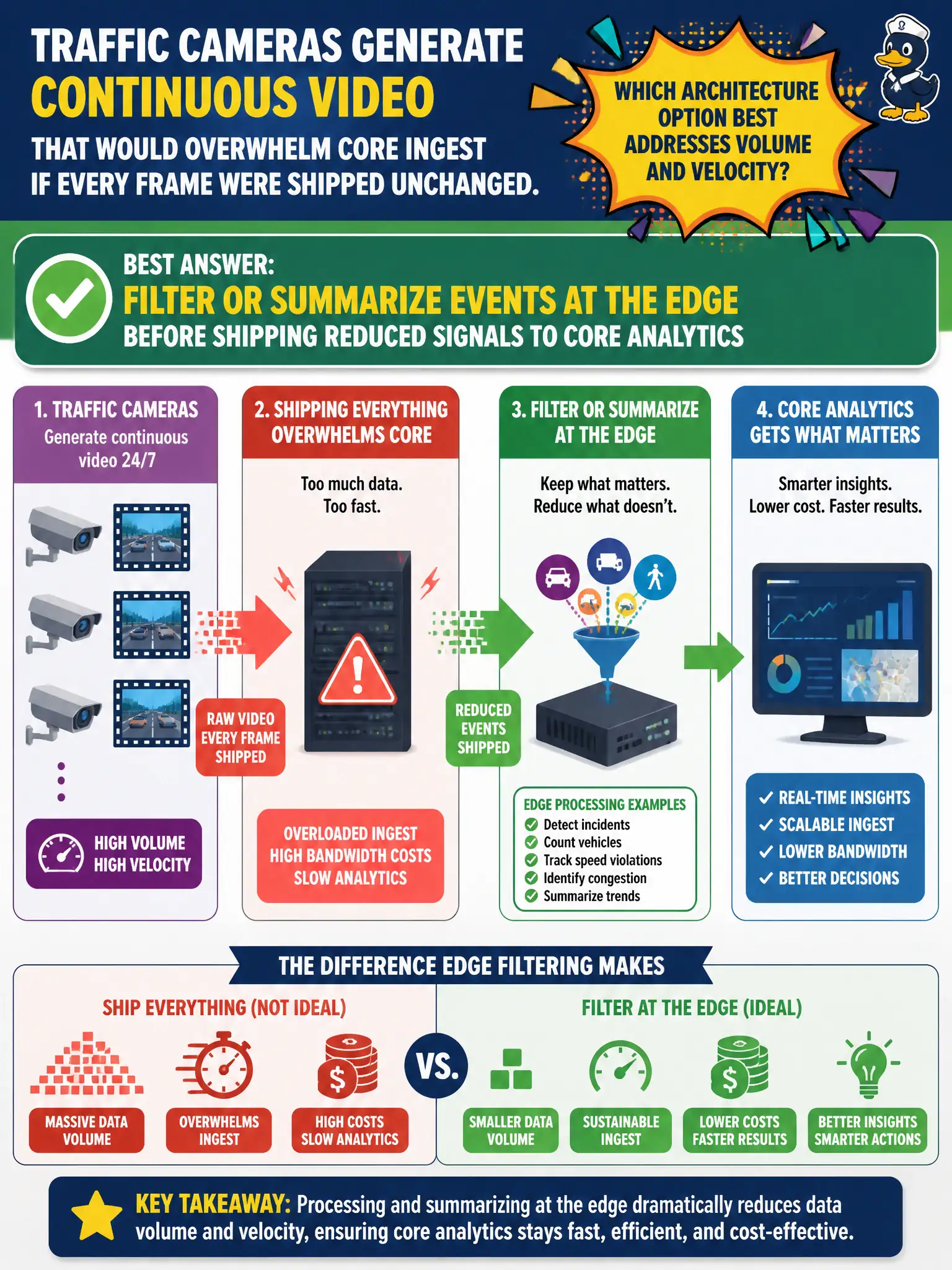
Traffic cameras generate continuous video that would overwhelm core ingest if every frame were shipped unchanged. Which architecture option best addresses volume and velocity?
Select an answer to reveal the explanation.
Short Explanation
Cameras can do a little homework on-site and spot the interesting events. That way the core platform is not buried under every unused frame.
Full Explanation
Continuous traffic-camera video can overwhelm core ingest if every raw frame ships unchanged into the municipal cluster. The architecture that best addresses volume and velocity is edge filter or summarization—detect events, plate-free motion features, or congestion markers on-site—then ship reduced signals to core analytics. Edge reduction preserves insight for signals and incidents without drowning the central platform in unused pixels. Disabling cameras during peak hours discards the moments most needed for traffic management, enforcement support, and after-action review. Storing all raw frames only on removable USB drives mailed weekly to IT fails velocity, physical security, and chain-of-custody expectations for civic evidence. Requiring analysts to watch live feeds instead of building a data platform does not scale citywide and creates no durable analytical corpus for planning. Exam caveat: edge processing is a legitimate Big Data pattern for high-volume sensors; it protects the core platform rather than replacing the need for governed analytics. Operational check: deploy on-camera or roadside summarization for event markers, measure ingest bandwidth before and after, retain selective raw clips under retention and privacy policy, and confirm core jobs consume events rather than full unfiltered video streams during a peak-hour drill.