
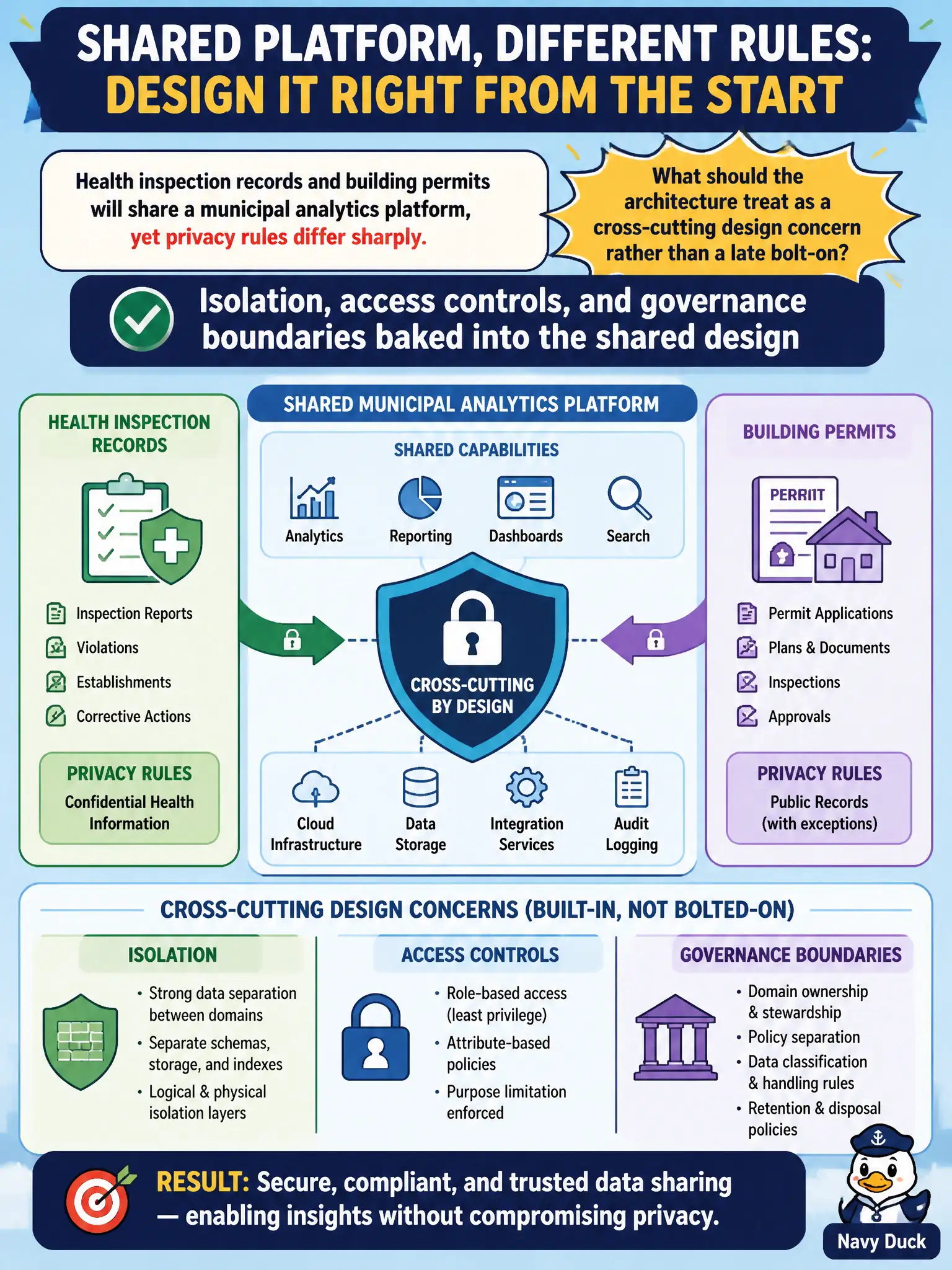
Health inspection records and building permits will share a municipal analytics platform, yet privacy rules differ sharply. What should the architecture treat as a cross-cutting design concern rather than a late bolt-on?
Select an answer to reveal the explanation.
Short Explanation
Sharing a platform is fine—sharing every row with everyone is not. Bake isolation and governance into the blueprint so health data and permits stay in their lanes from day one.
Full Explanation
When health inspection records and building permits share a municipal analytics platform, isolation, access controls, and governance boundaries must be treated as cross-cutting design concerns from day one—not bolted on after datasets are mixed. Shared platforms amplify blast radius unless row-, column-, or domain-level controls, audit logging, and clear data-classification boundaries are baked into the blueprint. Choosing MapReduce versus Spark solely for nightly job speed is a processing-engine detail; it does not substitute for privacy architecture across agencies. Replacing all source systems with a single public open-data portal would discard authoritative operational systems and over-expose regulated health content. Storing every dataset in one unpartitioned file to simplify backups destroys isolation and makes least-privilege nearly impossible. Exam caveat: multi-domain municipal platforms fail governance exams when candidates treat security as an afterthought or equate open data with unrestricted internal sharing. Operational check: map each dataset to classification and owner, verify separate ACLs or row filters for health versus permits, run an access review before go-live, and confirm that open-data extracts are curated subsets rather than full operational dumps.