
A day-shift pipefitter obtains a hot-work permit to weld pipe hangers in a mechanical room, and at shift change a night-shift welder arrives while painters have just stacked cardboard boxes of solvents nearby. What must the night-shift supervisor do before welding resumes?
Select an answer to reveal the explanation.
Short Explanation
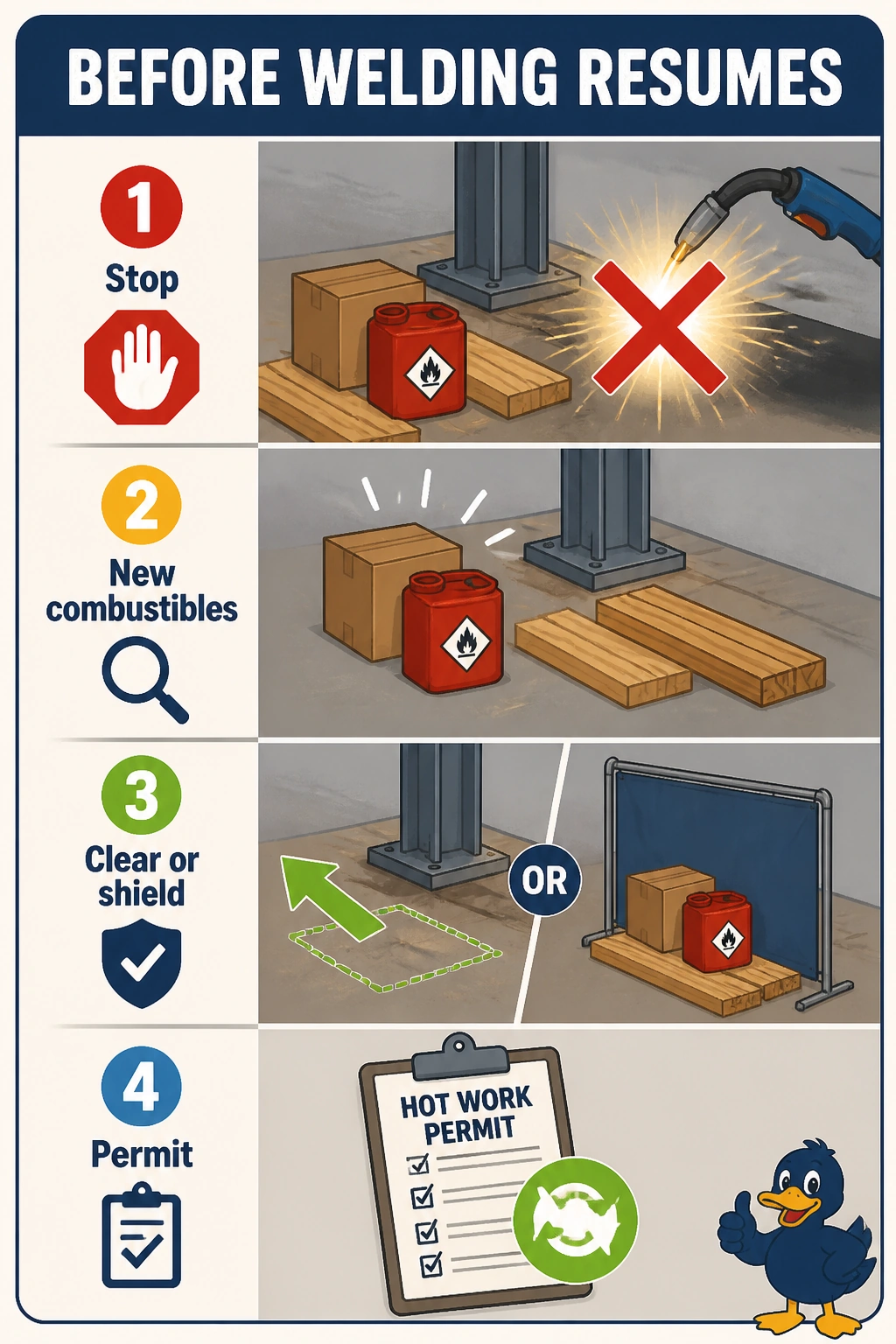
A hot-work permit is a snapshot of safe conditions at a specific moment—when a new crew arrives and flammable boxes move in, that snapshot is expired. You must pause the work, clear the combustibles, and reissue the permit rather than coasting on the morning sign-off.
Full Explanation
Hot-work permits authorize welding or cutting only under the specific personnel, fire-watch, and hazard conditions verified when the permit was issued. Choosing to Stop welding, clear or shield the new combustibles, and reissue the permit ensures that sparks and slag cannot ignite the newly introduced cardboard and solvent containers and that the incoming welder and fire watch understand current hazards. Deciding to Have the night welder continue under the morning permit until the end of the shift ignores a major change in fire load and leaves an unbriefed crew working around flammable vapors. Choosing to Tell the night welder to wear a respirator and keep welding without changing the permit addresses inhalation rather than the immediate fire and explosion hazard posed by solvents near welding arcs. Telling the supervisor to Ask the painters to finish stacking the boxes and then sign the morning permit leaves flammable materials inside the hot-work radius and fails to re-verify fire-watch readiness. One caveat is that solvent vapors may linger even after boxes are moved, requiring ventilation and gas checks. Confirm combustibles in the vicinity are moved or shielded, verify the extinguisher and fire watch, and post the new permit. If a 35-foot distance is used, label it NFPA 51B, not 1926.352.
Prefer to study offline? Printable PDF study book + test engine ($7.50, unofficial). These questions stay free here.