
During an interior framing walk, a carpenter foreman notices a framer has wedged a wooden shim into the lower blade guard of a corded circular saw so the guard stays retracted. What should the foreman do?
Select an answer to reveal the explanation.
Short Explanation
A wedged blade guard is like disabling the safety on a nail gun—one slip and the spinning teeth meet flesh. The trap is treating a binding guard as a minor annoyance you can fix after the wall is done, instead of stopping the cut right away.
Full Explanation
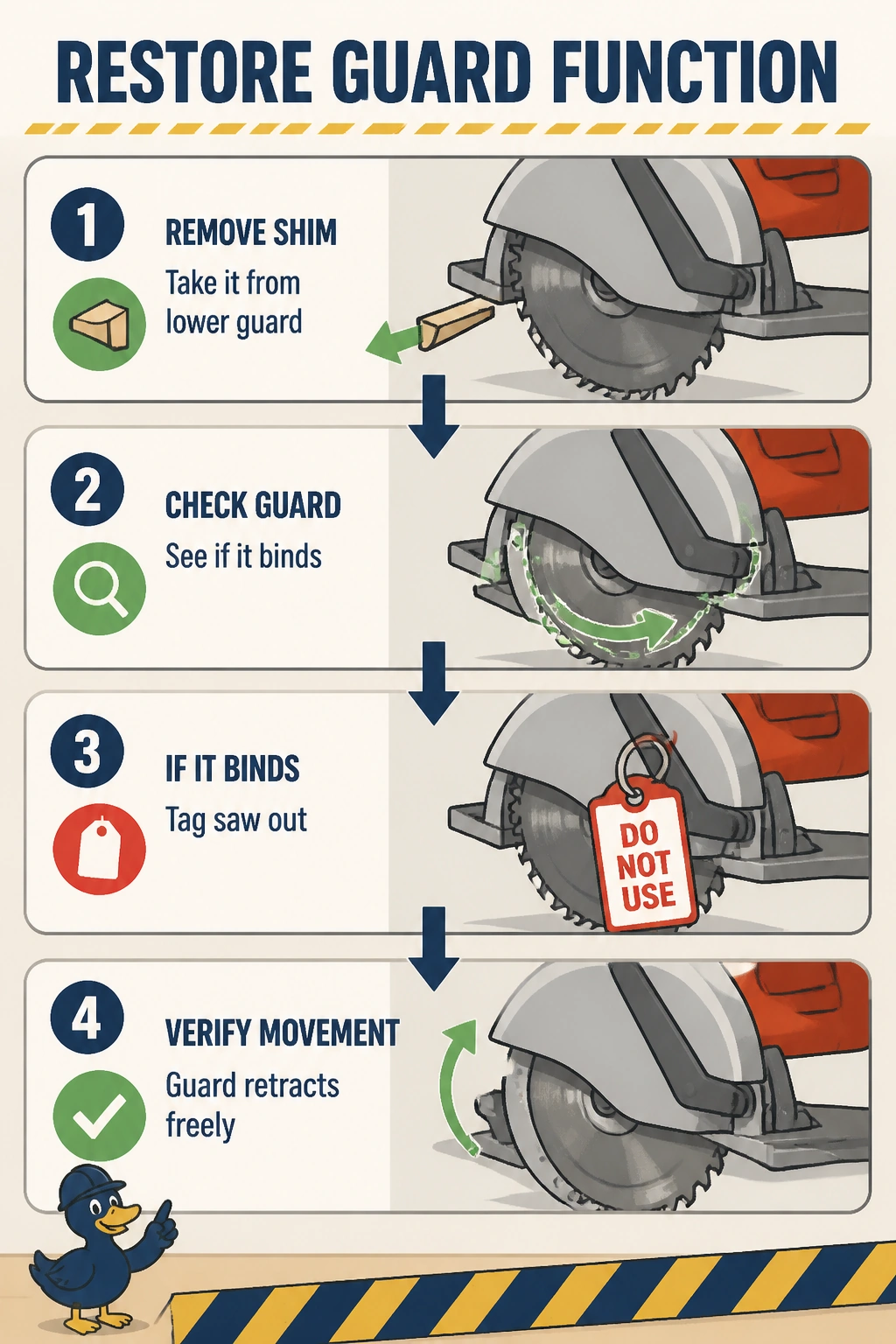
Under 29 CFR 1926.304, portable circular saws must have a lower guard that automatically and instantly returns to cover the blade when the tool is withdrawn from the work, so you must Remove the shim, tag the saw out if the guard binds, and verify it retracts freely before another cut is made. Choosing to Remind the framer to wear cut-resistant gloves while making angled cuts fails because gloves do not stop a high-speed rotating saw blade and can even increase entanglement hazards. Choosing to Allow the framer to finish the current wall layout before clearing the shim at break leaves an unguarded rotating blade in active use, creating an immediate severe laceration or amputation hazard. Choosing to Switch the saw to a finer-tooth blade so the guard does not catch on lumber does not address a bent, dirty, or intentionally defeated guard mechanism. Keep in mind that if a guard sticks due to pitch buildup or a bent housing, field crews must never prop it open to keep production moving. Perform a quick pre-use check by retracting the lower guard manually and releasing it to confirm it snaps shut smoothly without binding.
Prefer to study offline? Printable PDF study book + test engine ($7.50, unofficial). These questions stay free here.