
Over one calendar year, a mechanical contractor's crews worked 100,000 total hours and logged 5 OSHA-recordable injuries: 2 cases with days away from work, 1 case with restricted duty only, and 2 cases requiring medical treatment without lost or restricted time. What is the contractor's DART rate?
Select an answer to reveal the explanation.
Short Explanation
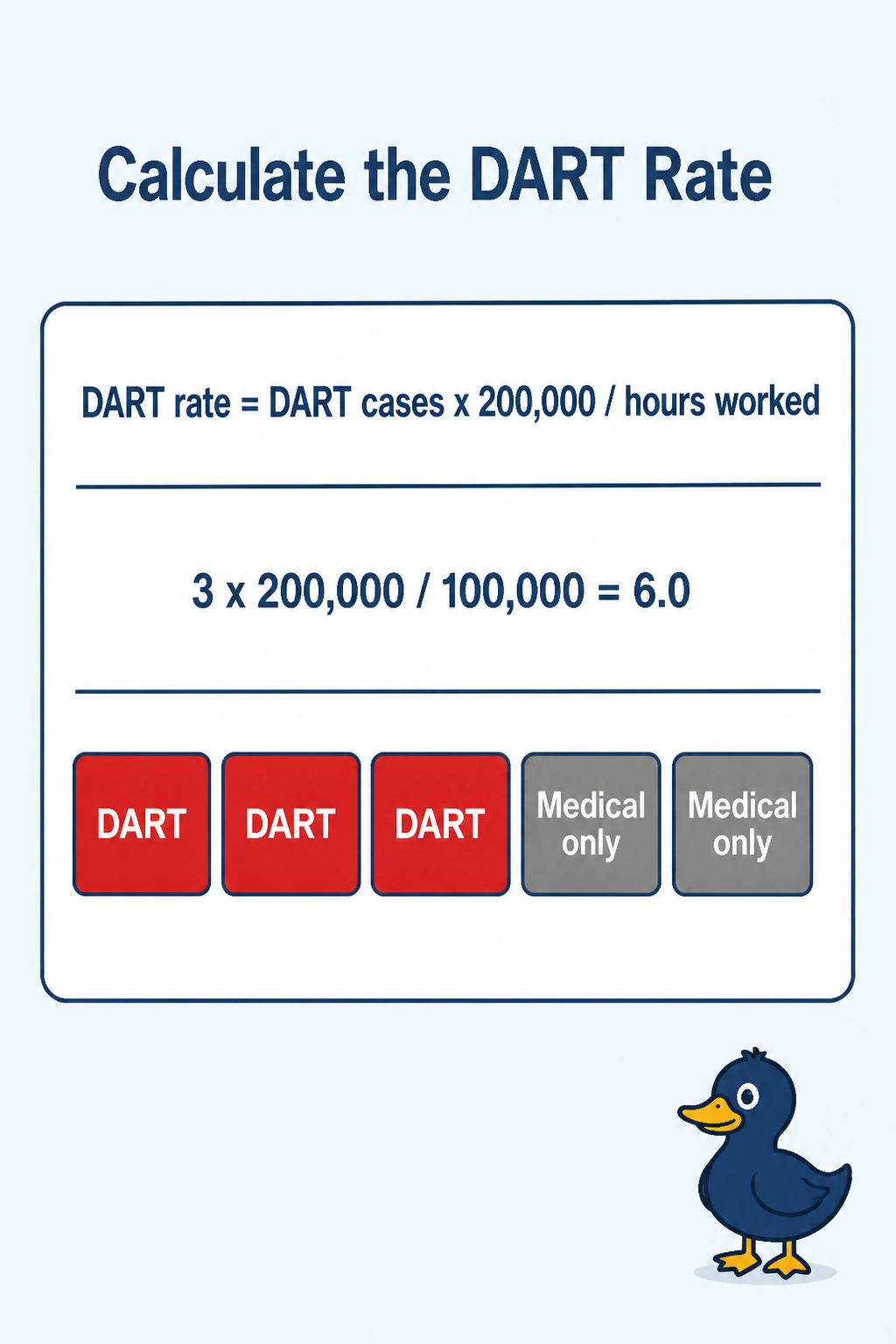
The DART rate zooms in on the more severe injuries that actually disrupt a worker's normal job, leaving out minor medical-treatment-only cases. The trap is grabbing all five recordable cases, which gives you the Total Recordable Incident Rate instead of DART. Count only the three days-away and restricted cases, multiply by 200,000, and divide by 100,000 hours.
Full Explanation
The OSHA Days Away, Restricted, or Transferred (DART) rate measures the frequency of more serious recordable cases per 100 full-time equivalent workers (200,000 hours), making 6.0 using the three days-away and restricted-duty cases the correct result. Adding the 2 days-away cases and 1 restricted-duty case gives 3 DART cases; multiplying 3 by 200,000 and dividing by 100,000 hours worked equals 6.0. Selecting 2.0 using only the days-away-from-work cases omits both the restricted-duty case and the 200,000-hour normalization multiplier. Choosing 4.0 using the two days-away cases and 100,000 hours correctly applies the 200,000-hour formula but forgets to include the 1 restricted-duty case in the DART numerator. Picking 10.0 using all five recordable cases on the log calculates the Total Recordable Incident Rate (TRIR) rather than DART, because the 2 medical-treatment-only cases did not involve days away, job transfer, or restriction. Caveat: verify that cases involving both days away and restricted duty are counted only once as a single DART case. Operational check: reconcile your Form 300 columns for days away and job transfer or restriction against payroll hours each quarter before publishing safety scorecards.
Prefer to study offline? Printable PDF study book + test engine ($7.50, unofficial). These questions stay free here.