
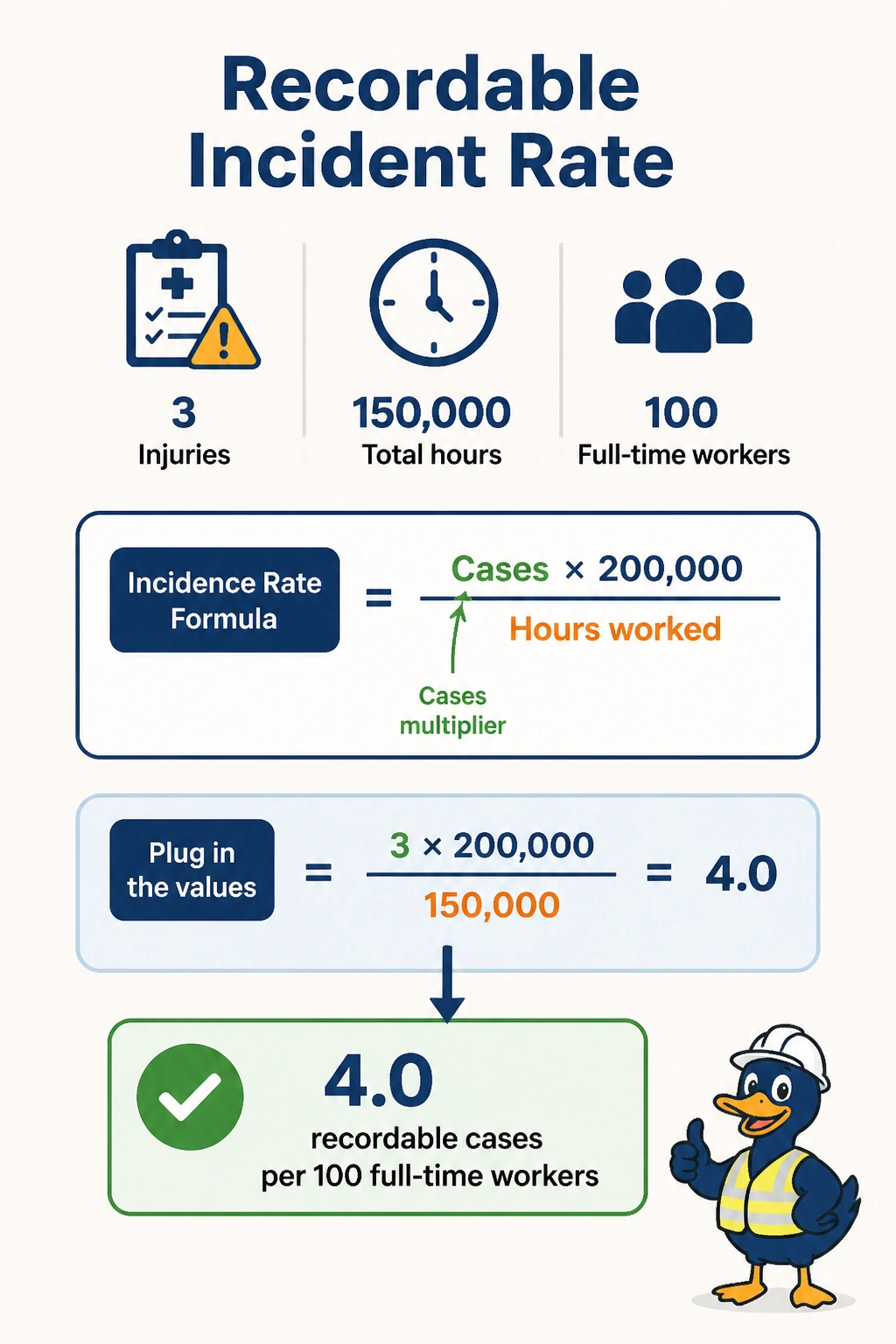
A mechanical contractor recorded 3 OSHA-recordable injuries over a year in which its crews worked 150,000 total hours. Using the standard OSHA incidence rate formula based on 200,000 hours, what is the contractor's Total Recordable Incident Rate?
Select an answer to reveal the explanation.
Short Explanation
OSHA incidence rates level the playing field so you can compare a small crew to a massive contractor fairly! The trap is forgetting to multiply by the 200,000-hour base before dividing by actual hours worked. Multiply 3 cases by 200,000 and divide by 150,000 so your trend math comes out right.
Full Explanation
The OSHA Total Recordable Incident Rate (TRIR) normalizes injury counts to a standard baseline of 100 full-time employees working 40 hours per week for 50 weeks per year (200,000 hours). Applying the formula—recordable cases multiplied by 200,000, divided by total hours worked—gives 3 multiplied by 200,000 equals 600,000, divided by 150,000 equals 4.0, which confirms 4.0 recordable cases per 100 full-time workers. Choosing 2.0 recordable cases per 100 full-time workers results from dividing 3 by 1.5 instead of multiplying by the 200,000-hour ratio. Choosing 3.0 recordable cases per 100 full-time workers simply repeats the raw injury count without normalizing for actual exposure hours. Choosing 6.0 recordable cases per 100 full-time workers based on annual payroll applies the wrong multiplier and improperly ties the calculation to payroll dollars rather than hours worked. As a caveat, TRIR is a lagging indicator that treats a minor recordable laceration the same as a severe injury, so it should be paired with severity metrics and leading indicators. As an operational check, verify that total hours worked on the Form 300A match actual payroll timecards—excluding vacation and sick leave—before publishing quarterly rates.
Prefer to study offline? Printable PDF study book + test engine ($7.50, unofficial). These questions stay free here.