
A newly hired safety technician reviewing fall protection rules for a commercial roofing job pulls up 29 CFR 1910 general industry walking-working surfaces standards instead of 29 CFR 1926 Subpart M. How do OSHA's construction and general industry standards interact when both address a hazard?
Select an answer to reveal the explanation.
Short Explanation
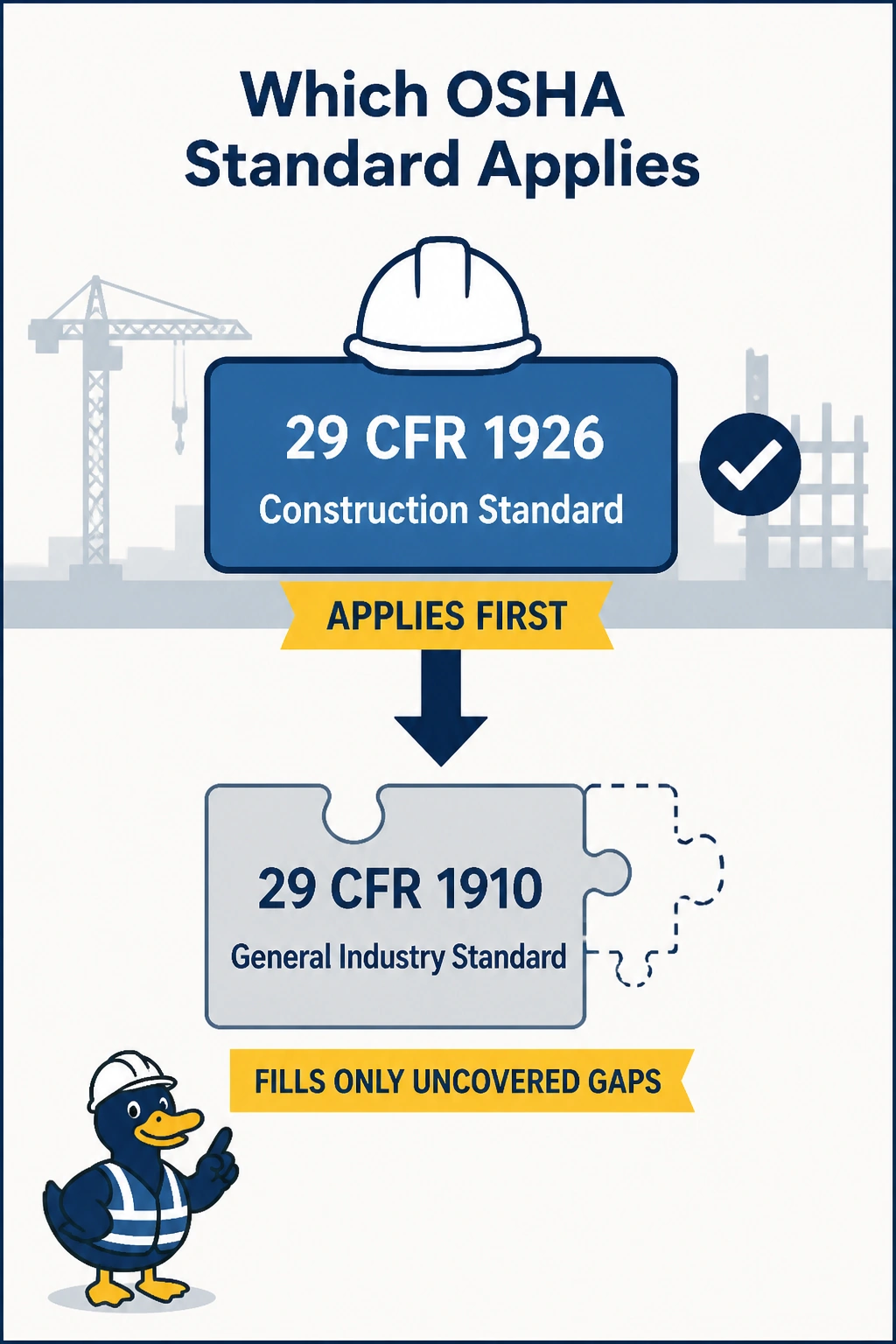
Think of 29 CFR 1926 as the specialist built for construction jobsites, while 29 CFR 1910 is the generalist waiting in reserve. The trap is assuming general industry rules apply everywhere or letting crews pick whichever rule feels easier. When construction work is underway, you follow the specific 29 CFR 1926 construction standard first.
Full Explanation
In OSHA's regulatory framework, The specific 29 CFR 1926 construction standard applies first, with 1910 filling only uncovered gaps. Construction activities such as roofing, framing, and excavation are governed by vertical standards in 29 CFR 1926, while horizontal general industry rules in 29 CFR 1910 apply only when no specific construction provision addresses the hazard or when 1926 explicitly incorporates a 1910 rule. Believing that Employers may choose whichever standard has the less restrictive trigger height for the crew is wrong because employers cannot opt out of an applicable construction requirement in favor of a different industry standard. Claiming that General industry 29 CFR 1910 rules automatically override 29 CFR 1926 on commercial building sites reverses OSHA's precedence rule. Suggesting that Both standards must be averaged together into a site-specific variance approved by the local fire marshal invents a nonexistent regulatory process and misidentifies the enforcing authority. As a caveat, certain 29 CFR 1910 standards, such as Hazard Communication in 1910.1200, are explicitly cross-referenced and identical in 29 CFR 1926.59. As an operational check, verify that every citation in the site-specific safety plan references 29 CFR 1926 first before consulting 29 CFR 1910 for any uncovered shop or warehouse task.
Prefer to study offline? Printable PDF study book + test engine ($7.50, unofficial). These questions stay free here.