
Six weeks after all site carpenters complete a classroom refresher on table saw guarding and push-stick use, the safety technician wants to verify whether the training actually improved jobsite safety. Which evaluation method provides the strongest evidence of training transfer?
Select an answer to reveal the explanation.
Short Explanation
A signed attendance sheet proves a carpenter sat in a chair, not that they kept their fingers safe on the saw. You measure real training success out on the floor by watching how people actually work. Don't get tricked into treating paperwork or class ratings as proof of skill transfer.
Full Explanation
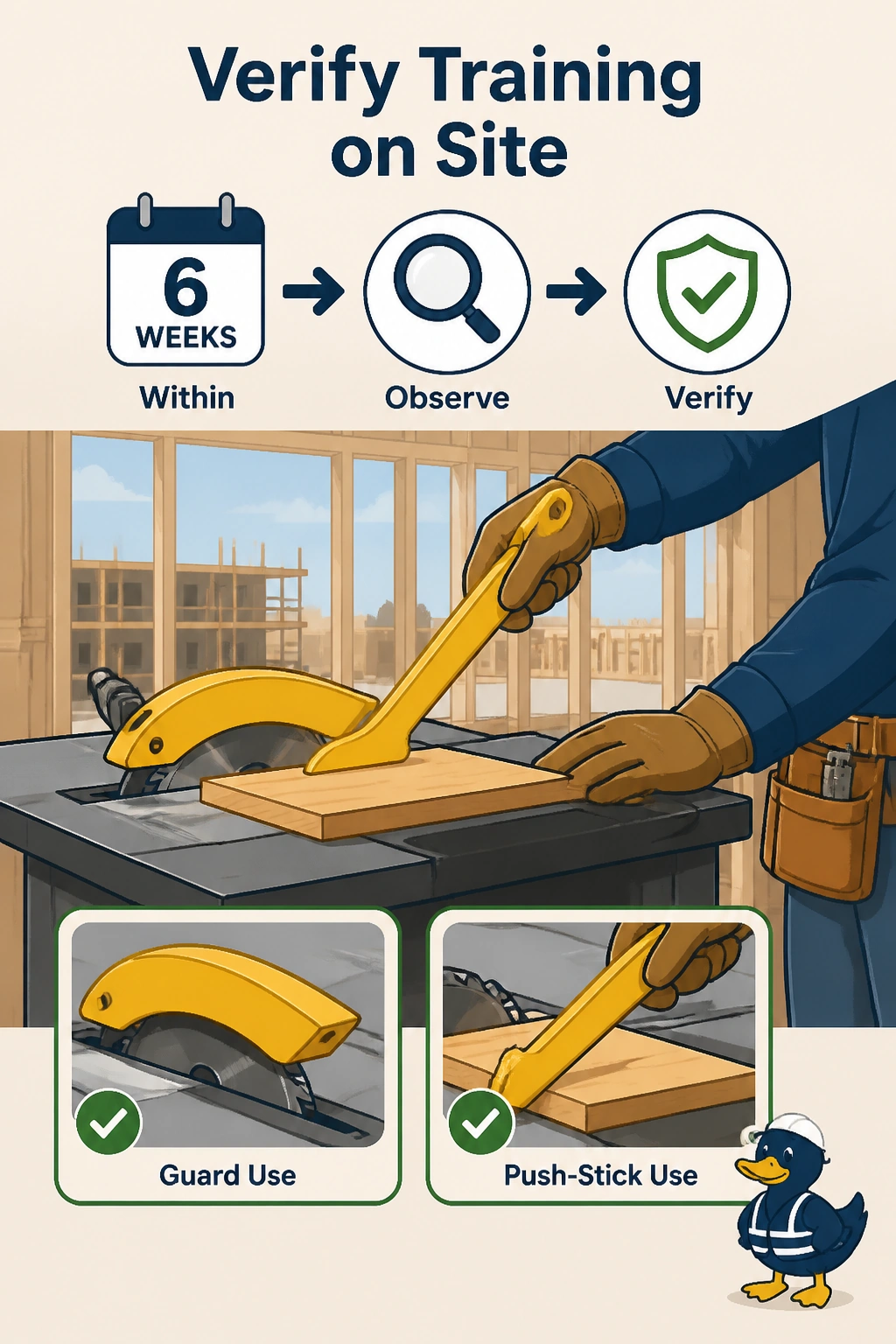
Evaluating whether training changed daily work habits requires checking real-world performance, making Observing carpenters at work to verify consistent guard and push-stick use the strongest evidence of training transfer. Direct workplace observation corresponds to behavioral evaluation in training models, showing whether workers apply safe procedures under actual production pressures. Reviewing signed training rosters to confirm every carpenter attended the class only documents participation and provides zero evidence of skill retention or safe tool use. Tabulating post-class satisfaction scores from the end-of-session survey forms measures reaction to the instructor or room comfort rather than jobsite behavior. Checking whether the instructor distributed all printed handbook copies tracks training materials inventory, not whether carpenters understood or followed the guarding rules. A practical caveat is to conduct observations openly as supportive coaching so workers do not just put on guards when they spot a safety vest approaching. As an operational check, log structured field observations of saw guard alignment and push-stick availability over several shifts and retrain immediately if gaps appear.
Prefer to study offline? Printable PDF study book + test engine ($7.50, unofficial). These questions stay free here.