
A concrete demolition laborer operates a pneumatic breaker in the morning, assists a skid-steer operator at midday, and works near a portable generator in the afternoon. Which monitoring instrument should the safety technician select to accurately determine the worker's full-shift time-weighted average noise exposure?
Select an answer to reveal the explanation.
Short Explanation
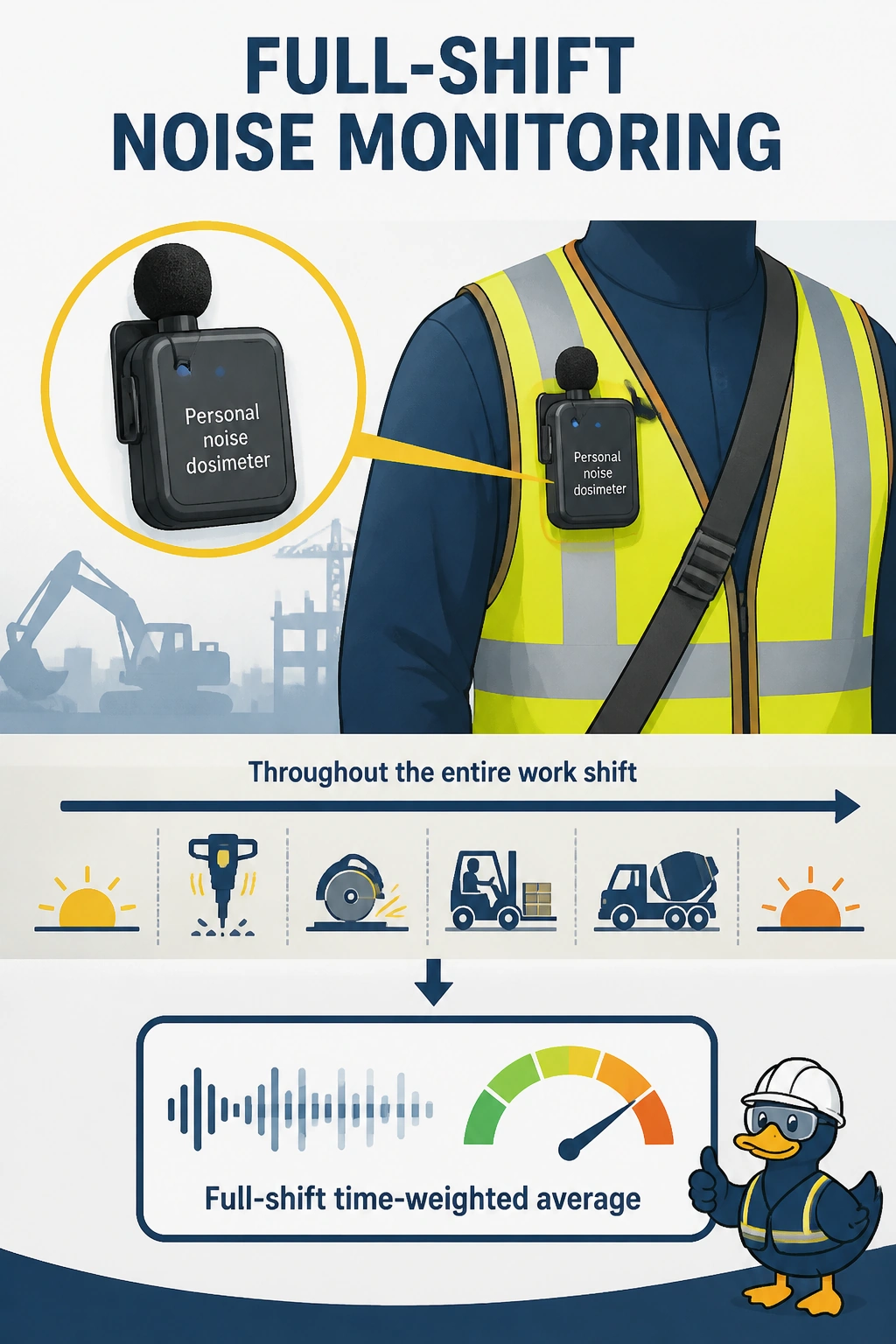
Measuring shifting noise exposure with a spot meter is like judging a rainstorm from one puddle—you miss the full picture. A personal noise dosimeter worn in the worker's hearing zone captures every peak and lull across the shift to calculate an accurate time-weighted average. The trap is assuming a single loud reading or perimeter monitor represents what the laborer actually hears all day.
Full Explanation
A personal noise dosimeter worn by the laborer throughout the entire work shift is the right instrument because construction workers move between tasks, tools, and noise sources constantly. A dosimeter clips near the worker's ear and integrates varying sound levels over time to compute an accurate 8-hour time-weighted average and noise dose under 29 CFR 1926.52. Choosing A handheld Type 2 sound level meter held at arm's length during the loudest demolition task fails because instantaneous spot checks cannot integrate changing exposures across different tools and break periods. Selecting A calibrated octave-band analyzer placed on a tripod beside the portable generator for one hour fails because stationary frequency analysis measures only one machine for a short window, not the worker's full-shift exposure. Using A continuous area noise logger mounted on the jobsite perimeter fence near the main gate fails because boundary monitoring tracks community noise rather than personal exposure inside the worker's hearing zone. As a caveat, dosimetry results remain valid only when the microphone sits within the hearing zone without rubbing against clothing or hard hats. For an operational check, verify battery charge and run a pre- and post-shift acoustic calibrator check on the dosimeter.
Prefer to study offline? Printable PDF study book + test engine ($7.50, unofficial). These questions stay free here.