
While reviewing Safety Data Sheets and container labels for two concrete curing compounds on site, a safety technician sees that one product carries the signal word 'Danger' while the other carries 'Warning.' What does this distinction indicate under OSHA's Hazard Communication standard?
Select an answer to reveal the explanation.
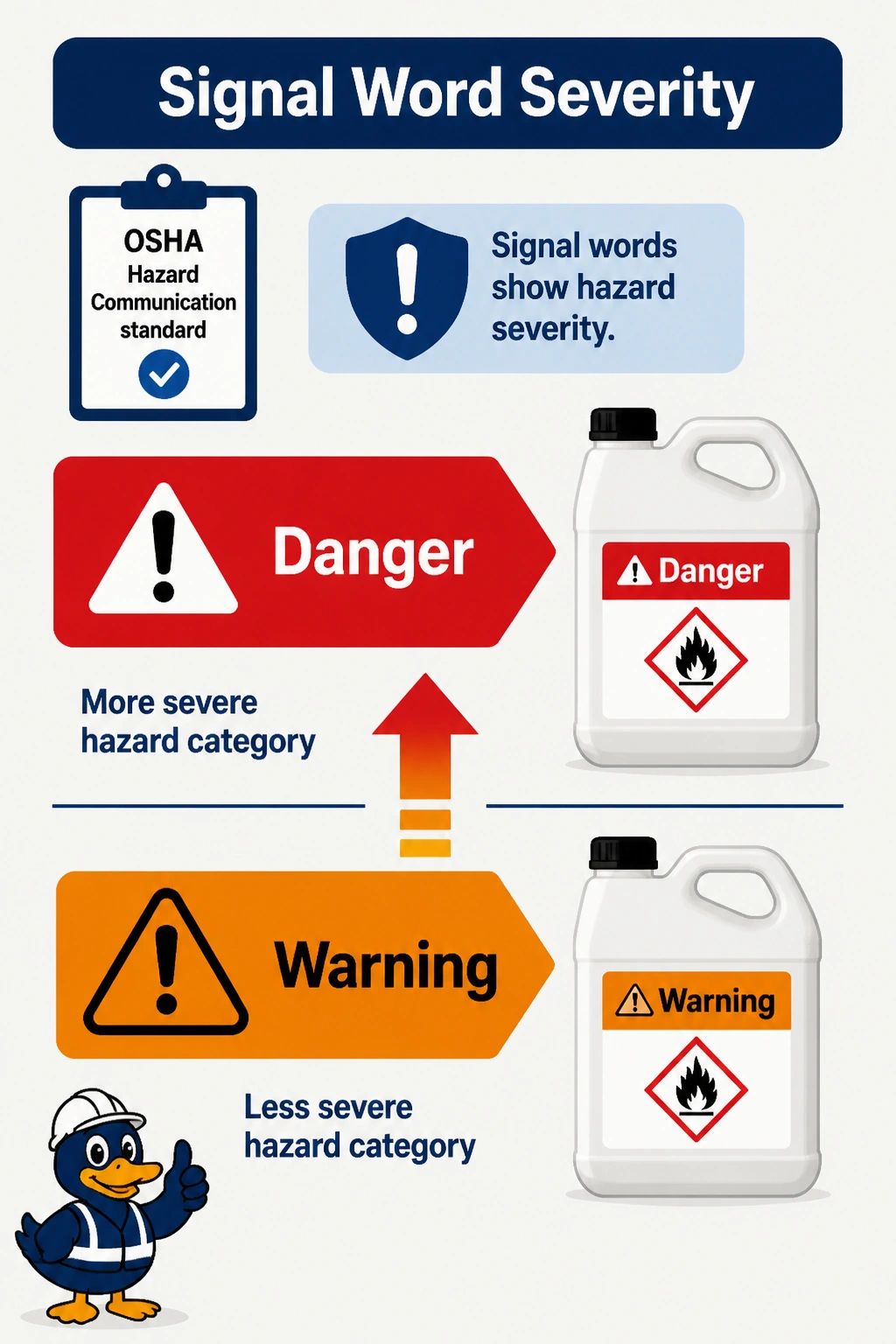
Short Explanation
Think of GHS signal words like storm alerts—one signals a stronger punch than the other! The trap is assuming 'Warning' means harmless or that 'Danger' means banned from the jobsite. You need to recognize that 'Danger' flags the higher-severity hazard category so your crew matches controls to the actual risk.
Full Explanation
Under OSHA's Hazard Communication standard (29 CFR 1910.1200), Globally Harmonized System (GHS) labels use a single standardized signal word to alert workers to the relative severity of a chemical's hazards. Choosing The product marked 'Danger' represents a more severe hazard category than the one marked 'Warning' accurately reflects the GHS classification system, where 'Danger' is reserved for higher-severity categories and 'Warning' is used for less severe categories. Choosing The product marked 'Danger' is banned from indoor construction use is incorrect because signal words communicate hazard severity, not a blanket prohibition; many lawful construction products carry 'Danger' when used with proper ventilation and PPE. Choosing The product marked 'Warning' requires no personal protective equipment is a dangerous misconception, as 'Warning' products still pose real health or physical hazards that require protective measures. Choosing Both signal words indicate identical toxicity levels for different trades misunderstands GHS, which assigns signal words based on chemical hazard class rather than trade. As a caveat, a product with 'Warning' can still cause serious injury if misused in an enclosed space, and some low-category hazards carry no signal word at all. As an operational check, review Section 2 and Section 8 of each product's Safety Data Sheet before briefing crews on ventilation and PPE.
Prefer to study offline? Printable PDF study book + test engine ($7.50, unofficial). These questions stay free here.