
A utility crew prepares to enter a deep concrete manhole to inspect a sewer tie-in, and the safety technician sets up a calibrated multi-gas meter to test the atmosphere from outside the space. In what order must the atmospheric hazards be evaluated?
Select an answer to reveal the explanation.
Short Explanation
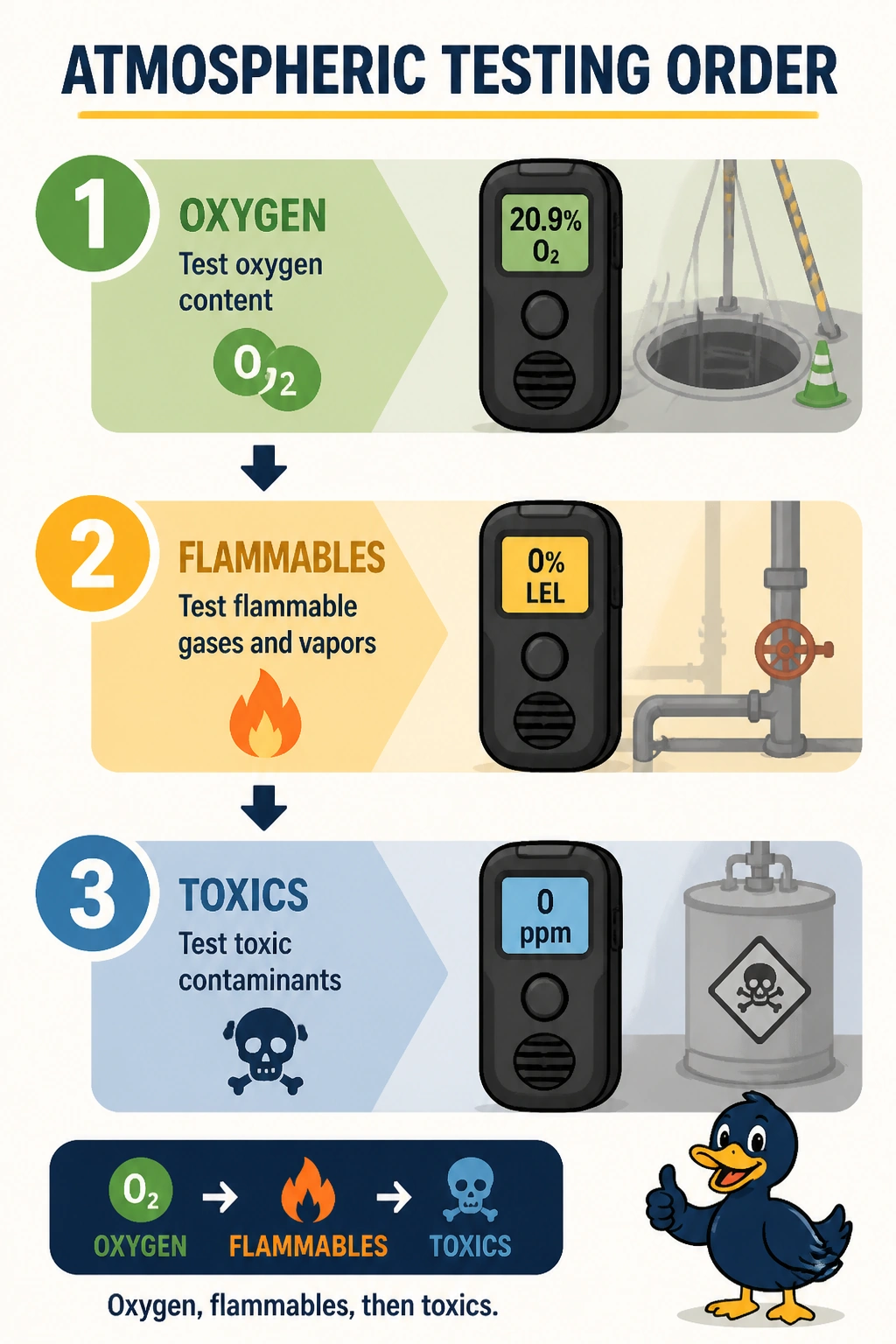
Testing confined space air out of order can blind your meter before you even know it. The trap is checking toxic or flammable gases first, when you must verify oxygen levels first so the catalytic sensor can actually read accurately.
Full Explanation
Under 29 CFR 1926.1204(e)(3), when testing for atmospheric hazards, test first for oxygen, then for combustible gases and vapors, and then for toxic gases and vapors. Oxygen is checked first because standard catalytic-bead combustible gas sensors require sufficient oxygen to oxidize flammable vapors and will give falsely low readings in an oxygen-deficient atmosphere. Flammable gases are tested second because an explosive atmosphere poses an immediate catastrophic risk, followed by toxic gases such as hydrogen sulfide or carbon monoxide. Choosing to Test toxic contaminants first, oxygen content second, and flammable gases third ignores sensor physics and delays detection of immediately life-threatening oxygen deficiency. Choosing to Test flammable gases first, toxic contaminants second, and oxygen content third risks a false-safe combustible reading if oxygen is depleted. Choosing to Test carbon monoxide first, hydrogen sulfide second, and oxygen levels last reverses the entire safety sequence and leaves oxygen verification for the end. Caveat: always test at multiple elevations—top, middle, and bottom—because gases stratify by vapor density. Operational check: perform a fresh-air zero and bump test on the meter before sampling, and allow adequate pump draw time for the tubing length.
Prefer to study offline? Printable PDF study book + test engine ($7.50, unofficial). These questions stay free here.