
A safety technician is laying out fire protection for a 9,000-square-foot single-story commercial framing project under 29 CFR 1926.150. What minimum portable fire extinguisher rating and maximum travel distance must be maintained across the protected building area?
Select an answer to reveal the explanation.
Short Explanation
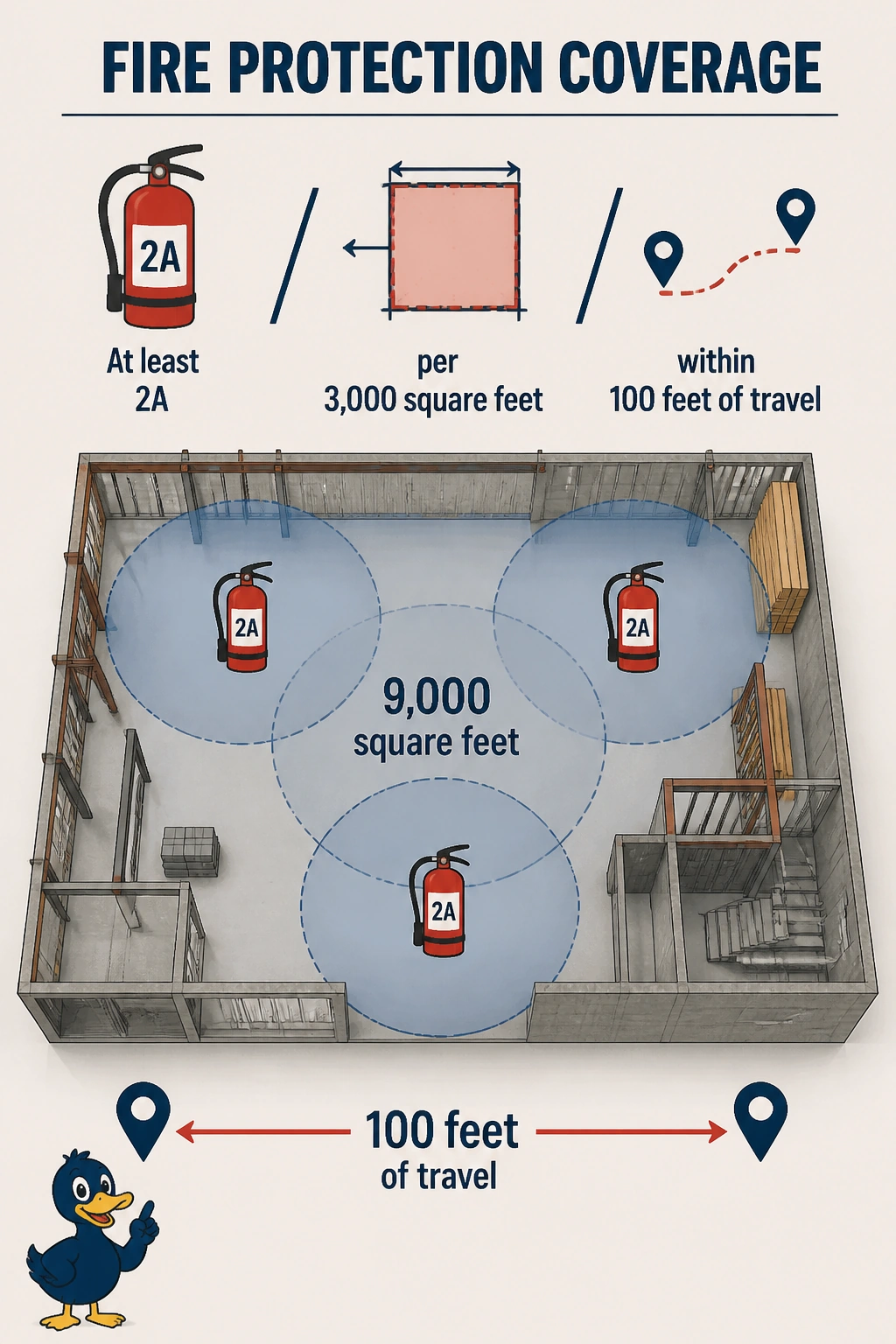
When wood framing catches fire, every extra step to reach an extinguisher can feel like a mile. You need enough firefighting capacity close by: at least a 2A rating per 3,000 square feet, with no more than 100 feet of travel; a 1A rating with 150 feet of travel falls short, and one 10B extinguisher at the trailer does not protect the building.
Full Explanation
Under OSHA 29 CFR 1926.150, provide an extinguisher rated not less than 2A for each 3,000 square feet of protected building area, or major fraction thereof, and limit travel from any point in the protected area to the nearest extinguisher to 100 feet. For 9,000 square feet, this means at least three 2A-rated units positioned for access within that travel limit. A 1A rating with a maximum travel distance of 150 feet falls short of both the minimum capacity and the travel-distance requirement. A 4A rating with a maximum travel distance of 75 feet exceeds the baseline requirements for general building areas; it is more stringent, not the minimum asked for. A 10B rating placed only at the main site trailer exit is unsuitable because Class B ratings address flammable-liquid fires rather than Class A wood framing, and a single unit at the trailer leaves the building area unprotected. Exam caveat: under certain conditions, a 55-gallon open drum of water with two fire pails may substitute for a 2A extinguisher, although ABC dry chemical units are standard. For a practical check, walk the floor plan with a measuring wheel and confirm that no work zone is more than 100 feet from a tagged, charged extinguisher.
Prefer to study offline? Printable PDF study book + test engine ($7.50, unofficial). These questions stay free here.