
A carpenter sustains a deep forearm laceration from a circular saw, and a trained first-aid responder arrives with a kit while blood pools on the floor. Which principle should guide the responder's immediate approach to bloodborne pathogen exposure?
Select an answer to reveal the explanation.
Short Explanation
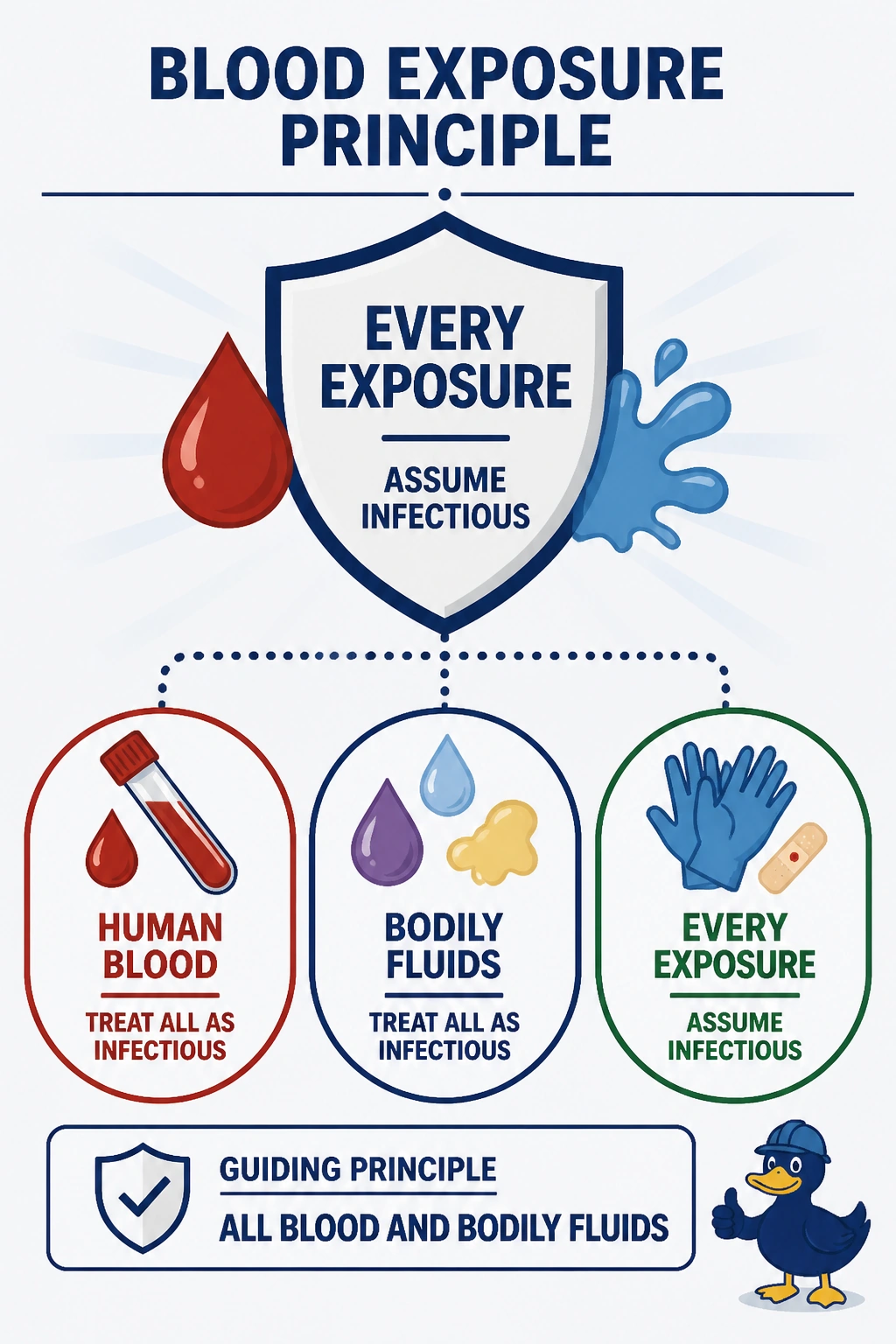
In the rush to help an injured coworker, you cannot afford to guess who carries a bloodborne pathogen. The trap is skipping gloves or screening the victim first, when Universal Precautions require you to treat every drop of blood as infectious.
Full Explanation
29 CFR 1910.1030 does not apply to construction work. OSHA's May 13, 1994 letter states the bloodborne pathogens standard was not adopted for construction. For this carpenter first-aid response, treat human blood and other potentially infectious body fluids as infectious under 29 CFR 1926.50 and the General Duty Clause, using standard precautions. Do not cite 1910.1030 as the binding construction rule. Where 1910.1030 defines Universal Precautions, it covers human blood and certain body fluids; when fluid types cannot be distinguished, all body fluids are treated as infectious. Because carriers of hepatitis B, hepatitis C, or HIV often show no outward symptoms and may not know their own status, consistent barrier protection is the only reliable defense. Choosing to Ask the injured carpenter about medical history before putting on gloves wastes critical bleeding-control time and relies on unverified self-reporting during a medical emergency. Choosing to Wear nitrile gloves only when visible wounds appear on the responder's hands ignores microscopic skin breaks, hangnails, and mucous membrane risks that allow pathogen transmission. Choosing to Apply direct pressure with bare hands first to stop bleeding faster exposes the responder unnecessarily when disposable gloves and sterile gauze in the kit take only seconds to don. Caveat: if accidental exposure still occurs through a splash or skin break, wash the area immediately with soap and water and initiate post-exposure medical evaluation. Operational check: inspect jobsite first-aid kits weekly to verify multiple sizes of intact nitrile gloves, resuscitation masks, and biohazard disposal bags are stocked at the top of the kit.
Prefer to study offline? Printable PDF study book + test engine ($7.50, unofficial). These questions stay free here.