
A manufacturing plant plans to deploy a collaborative robot (cobot) to load small metal parts alongside human assemblers without perimeter fencing. Which safety measure is essential before placing the cobot into production?
Select an answer to reveal the explanation.
Short Explanation
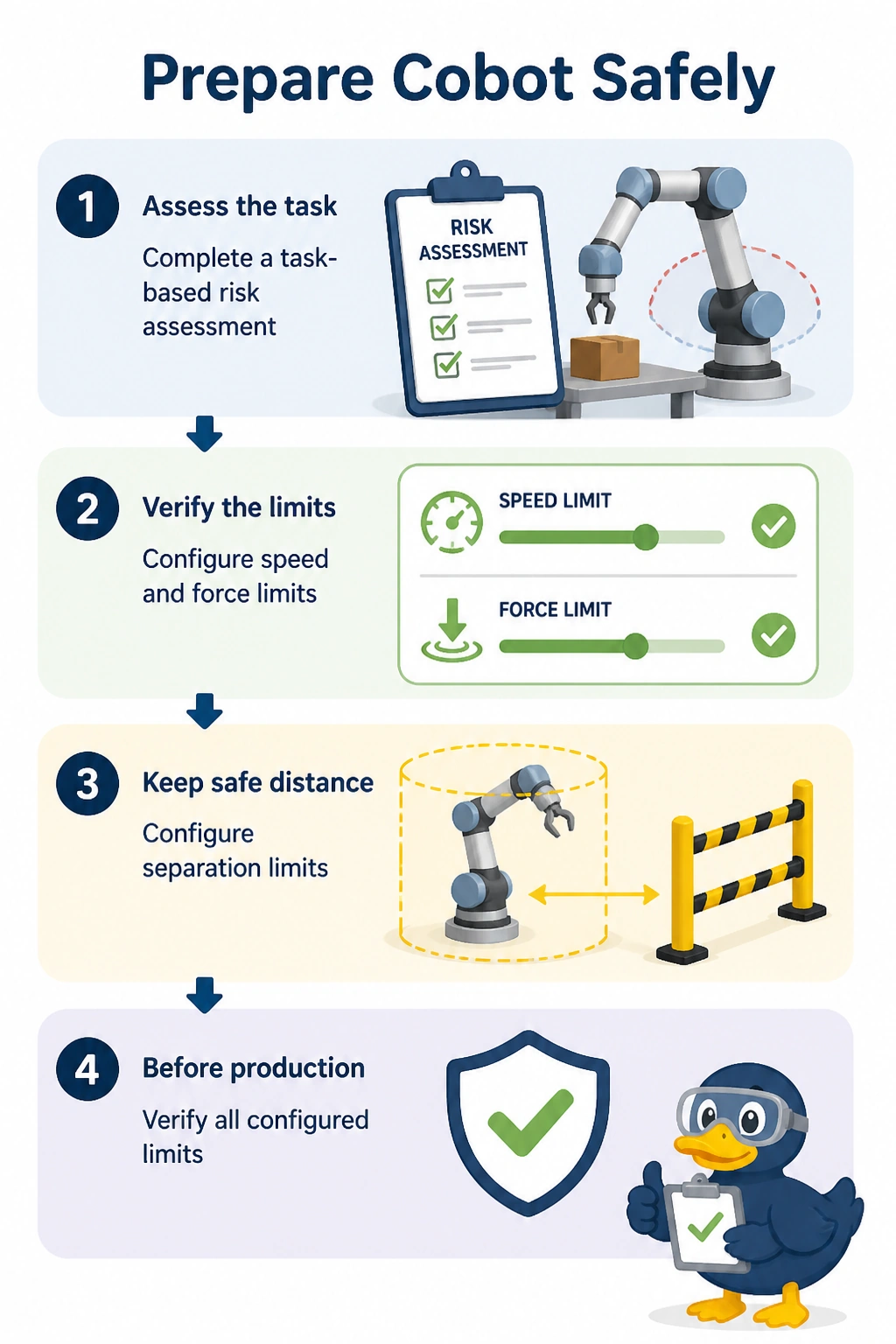
Just because a robot is labeled collaborative does not mean it is automatically harmless out of the box. The trap is skipping a formal risk assessment; you must evaluate pinch points and tooling hazards and verify safe speed and force limits before workers share the space.
Full Explanation
Before deploying a fenceless collaborative application, the plant must Perform a task-based risk assessment and configure verified speed, force, and separation limits. A collaborative robot system includes not just the arm, but also the end-of-arm tooling, sharp workpieces, and surrounding fixtures that can create crushing, pinching, or impact hazards; safety relies on engineered speed-and-separation monitoring or power-and-force limiting matched to the specific task. Choosing to Paint a yellow warning line on the floor around the cobot base provides only a visual cue without physical protection when an assembler reaches into the shared workspace. Choosing to Assume the cobot cannot injure workers because it is marketed as collaborative overlooks the fact that a sharp gripper or heavy part mounted on a cobot can still cause serious injury. Choosing to Install a standard emergency stop button only in the remote supervisor office prevents operators working beside the cell from stopping the machine immediately during an emergency. As a caveat, any change to payload, speed settings, or end-of-arm tooling requires re-evaluating the risk assessment. Operationally, validate safety-rated speed and force limits during commissioning and verify that emergency stops are within immediate reach of the operator.
Prefer to study offline? Printable PDF study book + test engine ($7.50, unofficial). These questions stay free here.