
During a safety equipment audit at a commercial roofing project, a safety specialist finds several workers wearing waist-mounted body belts attached to shock-absorbing lanyards for fall arrest. Why must the specialist remove these body belts from fall arrest service immediately?
Select an answer to reveal the explanation.
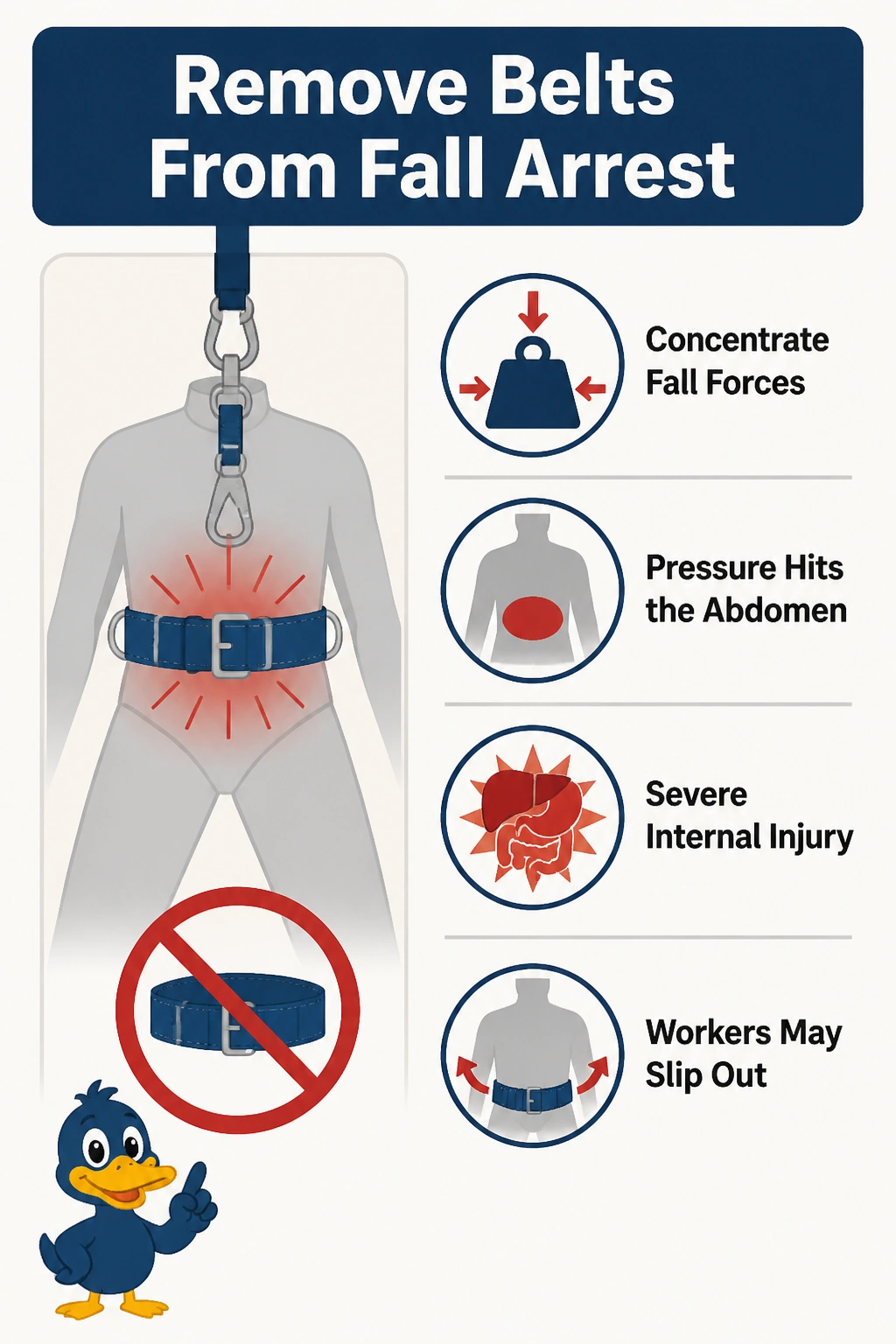
Short Explanation
Catching a falling worker by the waist is like cinching a tight rope around your midsection mid-drop—the stop itself can cause life-threatening trauma. That is why you must require full-body harnesses that spread arrest forces across the thighs, pelvis, and shoulders. The trap is thinking a sturdy anchorage makes a body belt acceptable for fall arrest.
Full Explanation
Under OSHA fall protection standards (29 CFR 1910.140 and 29 CFR 1926.502), body belts are prohibited as part of a personal fall arrest system. Body belts concentrate fall forces on the abdomen and risk severe internal injury or slip-out, whereas a full-body harness distributes arresting forces across the upper thighs, pelvis, chest, and shoulders while keeping the worker upright. Body belts cannot be inspected for frayed webbing without specialized laboratory load-testing equipment is incorrect because textile fall protection gear undergoes routine visual and tactile pre-use checks for cuts, burns, and broken stitching. OSHA permits body belts for fall arrest only when workers connect to a certified structural steel beam is wrong because no anchorage strength makes a body belt legal for fall arrest. Body belts are banned from all workplace applications, including positioning and travel restraint overstates the rule, as OSHA still permits body belts in positioning systems and travel restraint systems where a free fall is prevented. As a caveat, even a full-body harness requires a rescue plan to prevent suspension trauma after an arrested fall. As an operational check, inspect every worker's harness D-ring, leg straps, and lanyard compatibility before elevated work begins.
Prefer to study offline? Printable PDF study book + test engine ($7.50, unofficial). These questions stay free here.