
A fulfillment center deploys autonomous mobile robots (AMRs) that share main travel aisles with order pickers, and several near-misses occur when workers step around blind pallet racks into a robot's path. Which control most reliably prevents pedestrian-AMR collisions?
Select an answer to reveal the explanation.
Short Explanation
Floor stickers and handbooks cannot step in front of a moving robot when a worker rounds a blind corner. The trap is relying on administrative reminders or personal buzzers when you can physically separate people from automated traffic.
Full Explanation
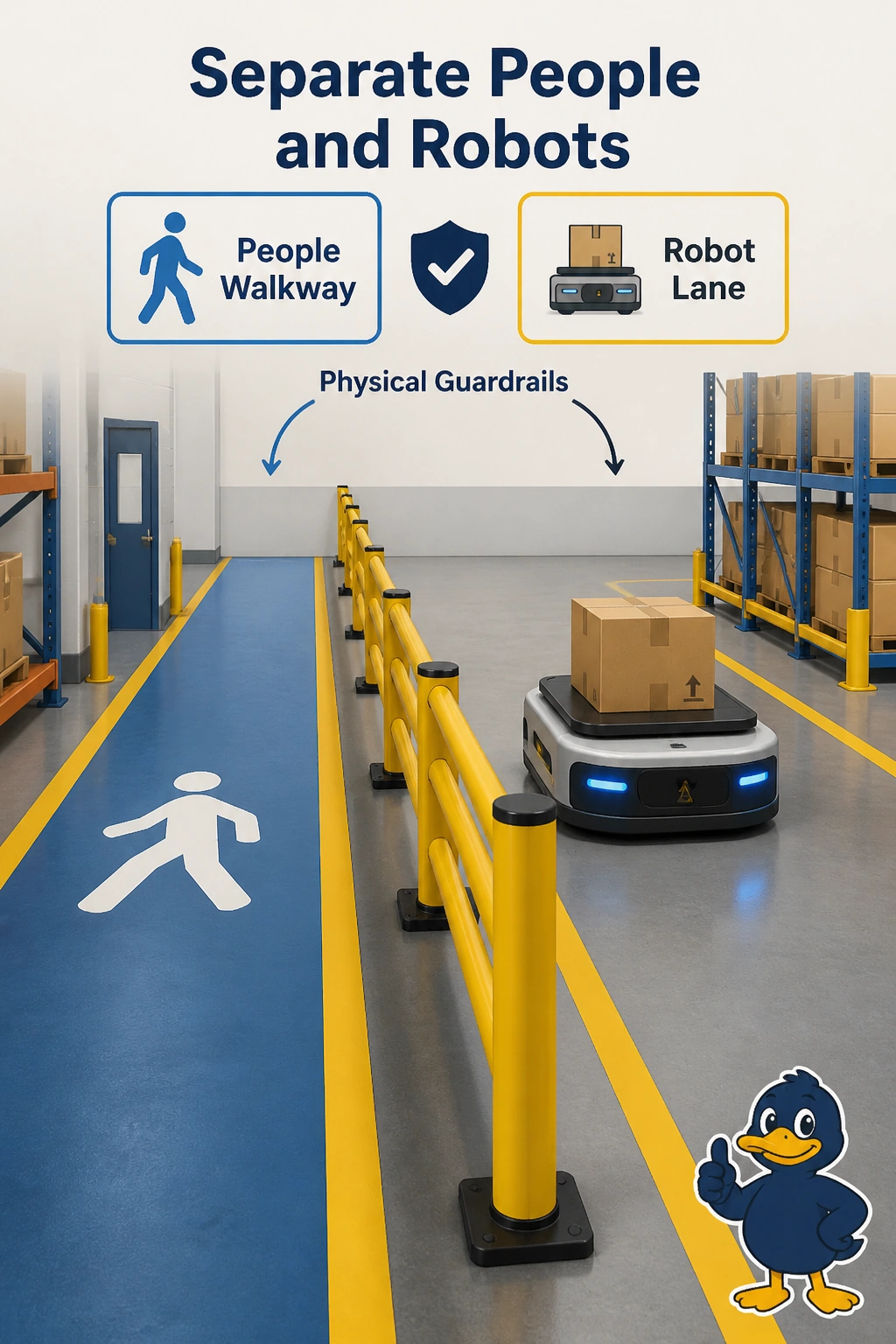
Separating pedestrian walkways from robot travel lanes using physical guardrails applies an engineering control high in the hierarchy of controls by removing the physical intersection between workers and moving equipment. Even if an operator is distracted or an onboard obstacle sensor experiences a blind spot behind racking, a rigid barrier prevents foot traffic from entering the robot's path. Posting bright yellow floor decals instructing workers to yield to approaching robots relies purely on visual compliance and fails when workers are rushed or carrying bulky cartons. Requiring order pickers to carry handheld buzzers that chime whenever a robot passes nearby only warns of proximity; in a noisy warehouse, workers can miss alerts or become desensitized to constant chimes. Adding a warning paragraph about robot right-of-way to the annual safety handbook is a weak administrative measure that does nothing to control physical exposure at blind corners. As a caveat, emergency exit routes must remain unobstructed when designing guardrail layouts, with marked, interlocked gates where crossing is unavoidable. As an operational check, walk all intersections to verify guardrails cover blind rack ends and that crosswalks have clear sightlines.
Prefer to study offline? Printable PDF study book + test engine ($7.50, unofficial). These questions stay free here.