
A packaging-line repair requires two consecutive shifts of maintenance technicians, and the outgoing technician must leave at 3:00 p.m. while the equipment remains de-energized. Under OSHA's Control of Hazardous Energy standard (29 CFR 1910.147), how must the plant manage lockout during the shift change?
Select an answer to reveal the explanation.
Short Explanation
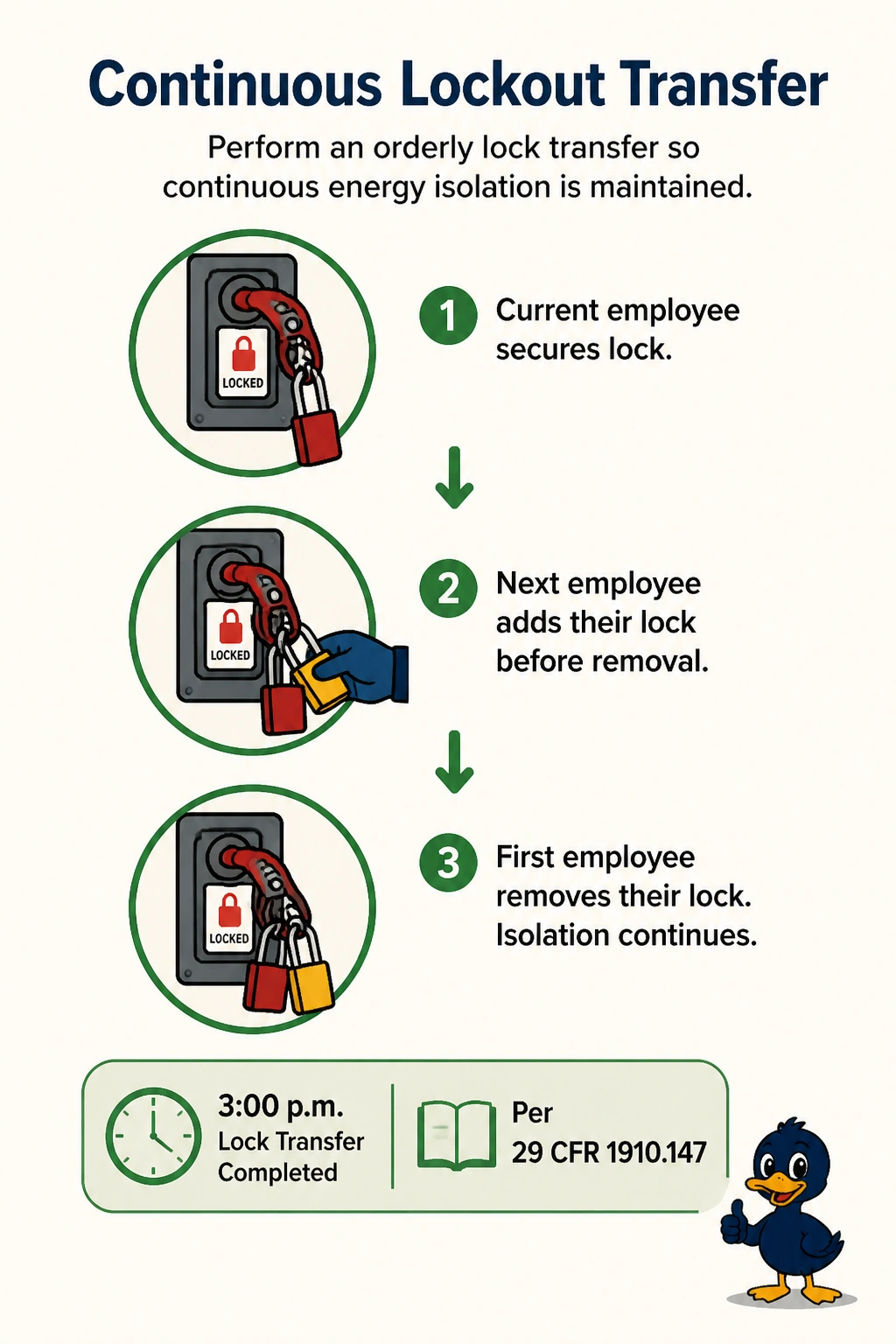
Think of lockout protection as a relay baton: you keep the handoff continuous, with the incoming technician applying a personal lock before or as the outgoing technician removes theirs. Leaving a lock behind, relying on a log entry, or using an emergency stop does not give your incoming crew continuous energy isolation.
Full Explanation
Under OSHA’s Control of Hazardous Energy standard (29 CFR 1910.147(f)(4)), employers must establish procedures for shift or personnel changes that maintain continuity of lockout or tagout protection. An orderly lock transfer meets this requirement: the incoming authorized technician applies a personal lock before or as the outgoing technician removes theirs, so physical energy isolation has no gap. Leaving the outgoing technician’s personal padlock in place until the next day’s crew arrives fails individual lock accountability because the incoming crew cannot control a lock whose key has left the plant. Removing that padlock and relying on a signed shift-turnover log leaves the energy-isolating device unlocked; documentation does not replace physical lockout. Shutting down the control circuit with an emergency stop button is also inadequate because a control-circuit device does not provide true energy isolation. As an exam caveat, if an absent employee’s lock must be removed, the employer must follow its documented verification and removal procedure. In practice, audit shift-change lockboxes and verify face-to-face or documented lock-swap sign-offs.
Prefer to study offline? Printable PDF study book + test engine ($7.50, unofficial). These questions stay free here.