
A warehouse forklift operator picks up a heavy palletized load whose center of gravity sits much farther forward on the forks than the truck's rated load center, even though the total weight matches the nameplate rating. How does this forward shift affect the forklift's stability triangle?
Select an answer to reveal the explanation.
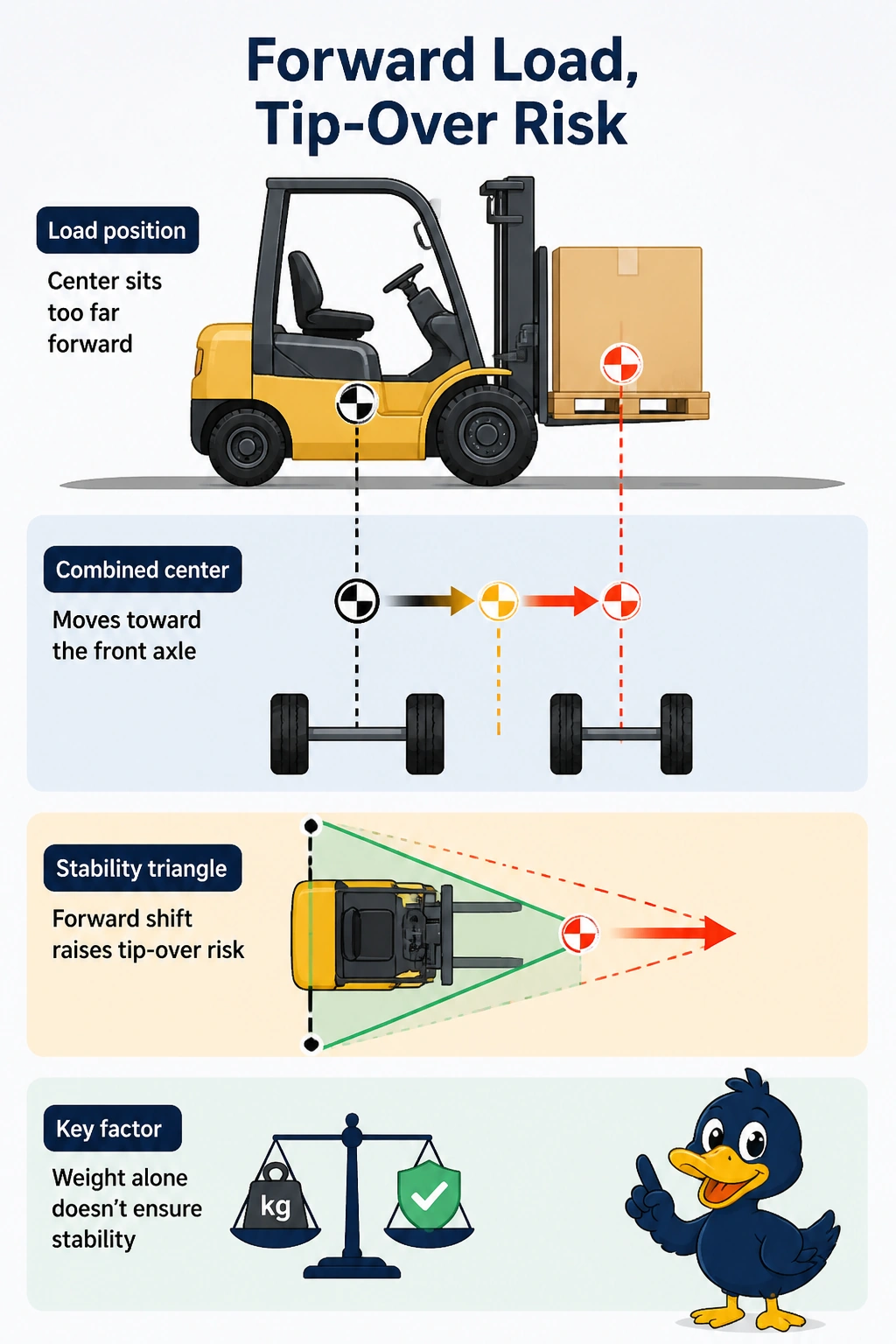
Short Explanation
A forklift's nameplate capacity only holds true when the load sits at the rated load center—treat that rating like a seesaw! The trap is assuming weight alone determines safety, when extending the load forward multiplies tipping torque toward your front wheels.
Full Explanation
A counterbalanced forklift rests on a three-point stability triangle formed by the two front drive wheels and the pivot point of the rear steer axle. When a load's center of gravity sits farther forward than the rated load center, "It moves the combined center of gravity toward the front axle, risking a tip-over" because the longer horizontal moment arm overcomes the rear counterweight and pushes the combined center of gravity toward or beyond the front-axle fulcrum. Choosing "It shifts the combined center of gravity rearward toward the counterweight and steer axle" reverses the physics, as only reducing the load or pulling it closer to the mast moves the balance point rearward. Selecting "It widens the base of the stability triangle because the front tires carry greater load" is incorrect because the stability triangle's geometry is fixed by the wheelbase and track width, not by load weight. Choosing "It lowers the vertical center of gravity and increases lateral stability during sharp turns" confuses longitudinal load-center distance with mast height, and forward overhang actually degrades steering traction and stability. As a caveat, raising the mast or traveling on a ramp further shifts the combined center of gravity and compounds longitudinal and lateral tip-over risk. For an operational check, verify load dimensions against the truck's capacity plate and require operators to seat pallets fully against the fork heels before lifting.
Prefer to study offline? Printable PDF study book + test engine ($7.50, unofficial). These questions stay free here.