
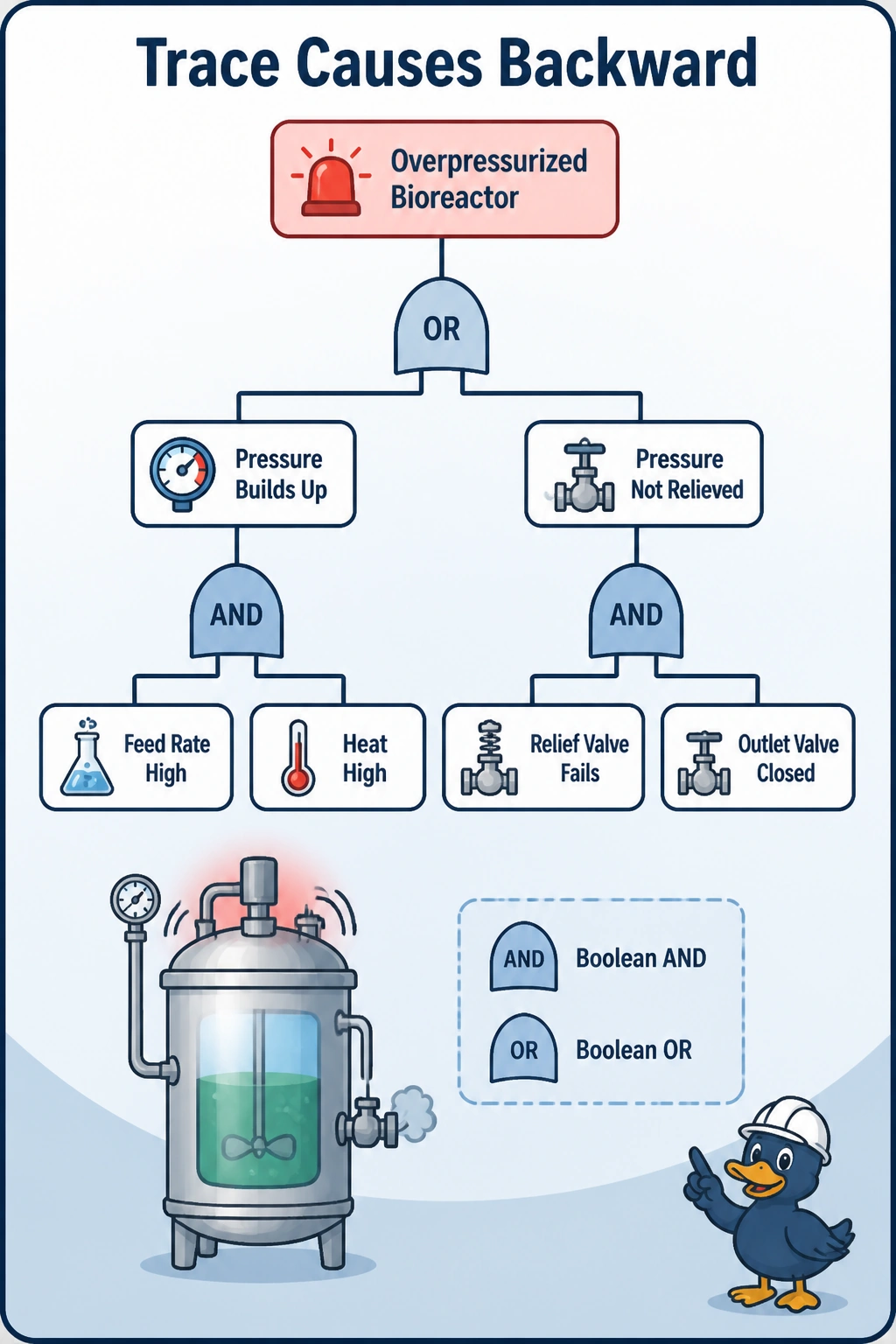
A reliability and safety team at a pharmaceutical plant wants to start with a single catastrophic event—an overpressurized bioreactor—and trace backward using Boolean AND and OR logic gates to identify every combination of valve and sensor failures that could cause it. Which hazard analysis method should the team use?
Select an answer to reveal the explanation.
Short Explanation
When you start with a single catastrophic event and work backward to see what combinations could trigger it, you are thinking top-down. The trap is picking a bottom-up component list when the problem calls for Boolean logic gates.
Full Explanation
Tracing backward from a single overpressurized bioreactor through AND and OR logic gates requires Fault Tree Analysis to model deductive combinations leading to the top event. Fault Tree Analysis begins with one defined undesired outcome and uses Boolean logic to map how multiple hardware failures, software faults, or human errors must combine or act independently to cause it. By contrast, Failure Modes and Effects Analysis to catalog individual component failure paths works inductively from the bottom up, examining one part at a time rather than multi-fault combinations. Preliminary Hazard Analysis to screen broad system risks during early design provides a high-level qualitative inventory before detailed logic modeling is practical. Job Safety Analysis to break down operator tasks into sequential hazard steps evaluates routine worker procedures rather than complex engineered control logic. As a caveat, quantitative fault trees are only as accurate as the underlying failure-rate data and assumptions about common-cause failures. For an operational check, verify each gate's logic with process engineers and confirm that single-point failures identified by OR gates have independent safeguards.
Prefer to study offline? Printable PDF study book + test engine ($7.50, unofficial). These questions stay free here.