
A maintenance shop plugs a 2,400-watt portable electric heater into a dedicated 120-volt branch circuit protected by a 20-ampere circuit breaker. Using the power relationship I = P / V, what is the heater's current draw and how does it compare to the 80% continuous-load guideline?
Select an answer to reveal the explanation.
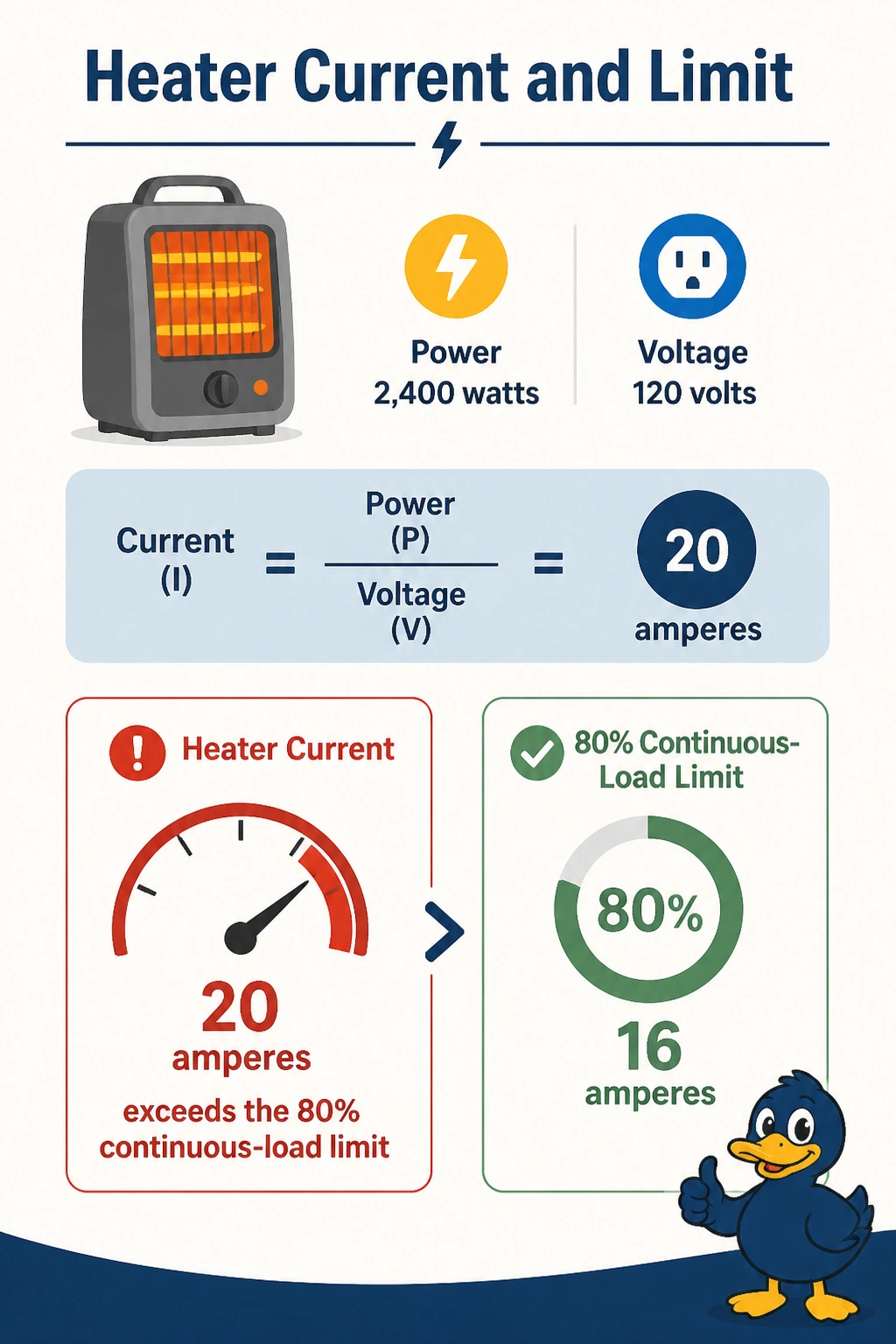
Short Explanation
Checking nameplate wattage against breaker size is a quick math check that prevents overheated cords and nuisance trips in your shop. The trap is forgetting that standard breakers are not meant to run at 100% capacity continuously. Dividing 2,400 watts by 120 volts gives 20 amperes, blowing past the 16-ampere continuous limit.
Full Explanation
To find electrical current draw in a resistive single-phase load, divide power in watts by voltage in volts (I = P / V). Here, 2,400 watts divided by 120 volts equals 20 amperes, and 80% of a 20-ampere breaker is 16 amperes (0.80 x 20 A = 16 A). Therefore, the correct result is 20 amperes, which exceeds the 80% continuous-load limit of 16 amperes and leaves zero margin for sustained heating operation. Calculating 10 amperes, which stays safely below the 80% continuous-load limit results from mistakenly assuming a 240-volt supply instead of the stated 120-volt circuit. Selecting 15 amperes, which stays within the 80% continuous-load limit reflects an arithmetic error in dividing 2,400 by 120. Choosing 24 amperes, which trips a 20-ampere breaker only on startup miscalculates the current by dividing by 100 volts and underestimates the thermal hazard of overloading a 20-ampere branch circuit. Caveat: any additional lights or tools sharing that circuit will push total draw above 20 amperes and trip the breaker or overheat conductors. Operational check: verify equipment nameplate amperage and voltage before plugging in high-wattage heaters, and dedicate a properly sized circuit if continuous operation is needed.
Prefer to study offline? Printable PDF study book + test engine ($7.50, unofficial). These questions stay free here.