
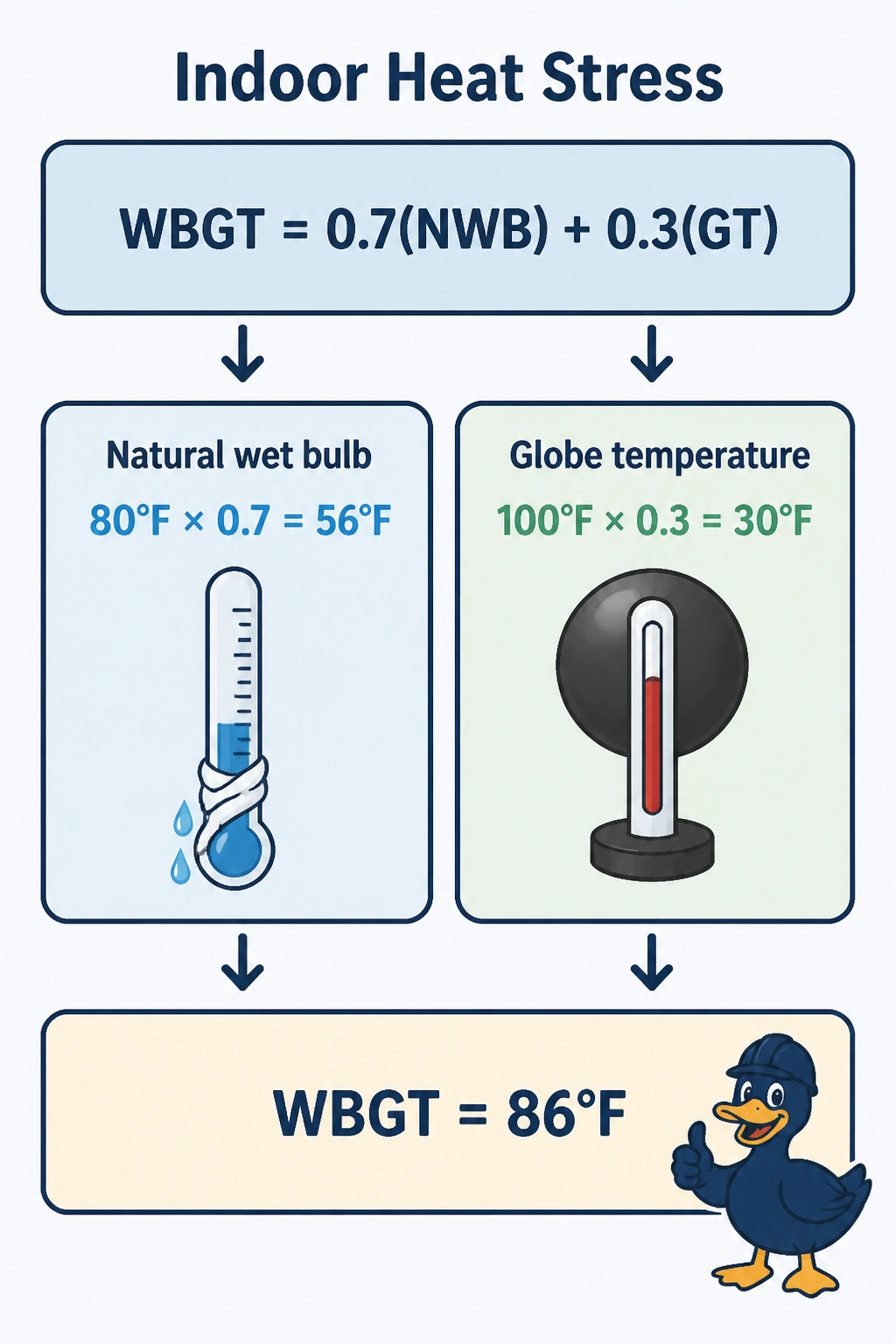
An industrial hygienist measures heat stress inside a glass-molding plant with no solar load using the indoor Wet Bulb Globe Temperature formula WBGT = 0.7(NWB) + 0.3(GT). If the natural wet-bulb temperature (NWB) is 80 degrees Fahrenheit and the globe temperature (GT) is 100 degrees Fahrenheit, what is the resulting WBGT?
Select an answer to reveal the explanation.
Short Explanation
Indoor WBGT gives 70 percent of the vote to evaporation and 30 percent to radiant heat, so your answer sits closer to the wet-bulb reading than the globe thermometer. The trap is flipping those weights or simply averaging the two numbers down the middle.
Full Explanation
For an indoor environment without solar load, the Wet Bulb Globe Temperature weights natural wet-bulb temperature at 70 percent and globe temperature at 30 percent, yielding 86 degrees Fahrenheit. Substituting the measured values into WBGT = 0.7(NWB) + 0.3(GT) gives 0.7(80) + 0.3(100) = 56 + 30 = 86 degrees Fahrenheit, reflecting how evaporative cooling potential dominates heat strain indoors while radiant heat from hot glass still contributes substantially. Selecting 94 degrees Fahrenheit results from reversing the two weights by multiplying 0.3 by 80 and 0.7 by 100, which overstates radiant heat relative to humidity. Choosing 90 degrees Fahrenheit treats both readings as a simple unweighted average, ignoring the physiological importance of sweat evaporation captured by the natural wet-bulb thermometer. Picking 82 degrees Fahrenheit undercalculates the radiant contribution from the 100-degree globe reading, which would underestimate worker heat strain near the furnaces. As a caveat, outdoor tasks exposed to direct sunlight require the outdoor three-term formula that incorporates dry-bulb air temperature alongside natural wet-bulb and globe readings. As an operational check, verify the wet-bulb wick stays clean and saturated with distilled water and allow the globe thermometer to stabilize before recording readings.
Prefer to study offline? Printable PDF study book + test engine ($7.50, unofficial). These questions stay free here.