
A warehouse invests $20,000 in automated palletizers that eliminate $32,000 in annual manual-lifting workers' compensation and turnover costs during the first year. Using the standard Return on Investment formula [(Net Benefit / Cost) x 100], what is the first-year ROI?
Select an answer to reveal the explanation.
Short Explanation
When you pitch a safety upgrade to finance, subtracting the project cost before dividing keeps your numbers honest. The trap is plugging gross savings straight into the numerator; always compute net benefit first so you do not overstate the return.
Full Explanation
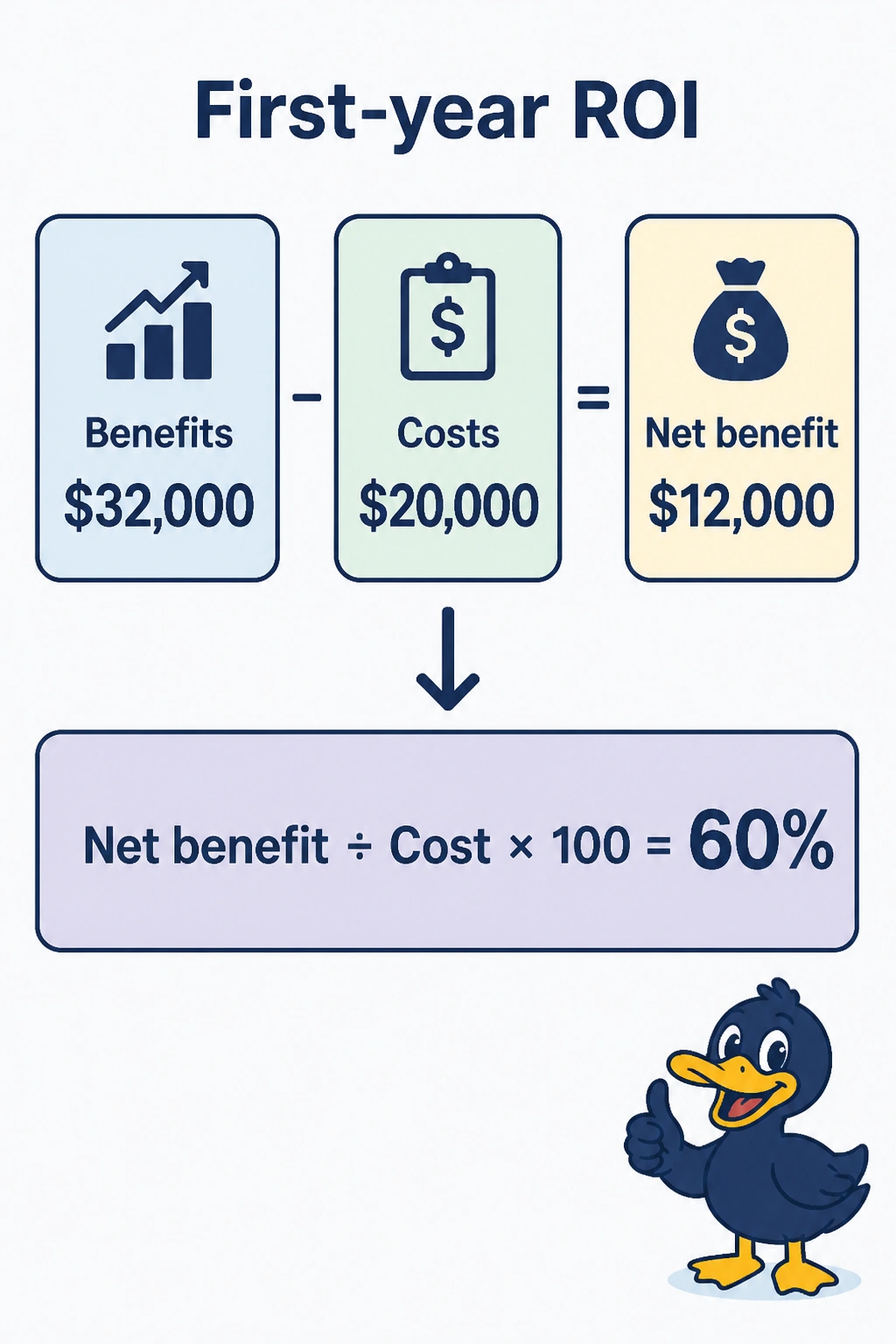
Return on Investment compares the net financial gain against the capital spent, giving 60%, calculated by dividing the $12,000 net savings by the $20,000 investment. First subtract the $20,000 equipment cost from the $32,000 gross annual savings to find the $12,000 net benefit, then divide $12,000 by $20,000 to get 0.60, or 60%. Reporting 160%, calculated by dividing total savings by the investment skips subtracting the initial $20,000 outlay and therefore states a benefit-to-cost ratio percentage rather than true ROI. Choosing 37.5%, calculated by dividing net savings by gross savings uses the $32,000 total savings as the denominator instead of the $20,000 investment cost. Selecting 62.5%, calculated by dividing cost by the annual savings inverts the ratio and yields the payback period in years (0.625 years, or roughly 7.5 months) rather than a percentage return. As a caveat, first-year ROI excludes ongoing maintenance or multi-year depreciation unless specified in the project scope. Before presenting safety budgets to leadership, verify whether gross or net savings are used and cross-check the arithmetic with a simple payback calculation.
Prefer to study offline? Printable PDF study book + test engine ($7.50, unofficial). These questions stay free here.