
On a commercial construction site, an electrical subcontractor removes guardrail sections to hoist conduit onto a third-floor deck and leaves the edge unprotected while a general contractor's superintendent walks past without intervening. Under OSHA's multi-employer worksite policy, why can the general contractor be cited?
Select an answer to reveal the explanation.
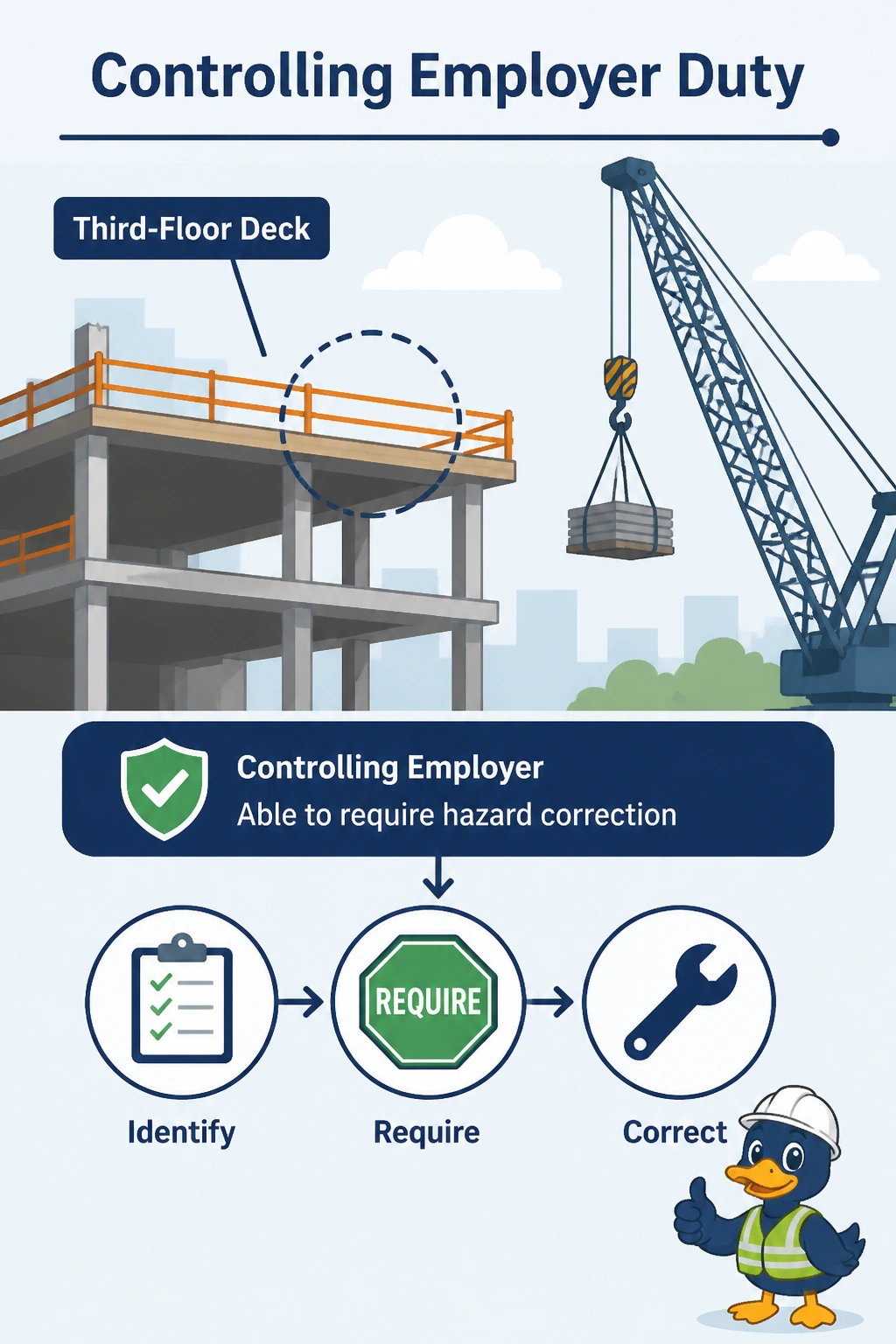
Short Explanation
Think of a general contractor as the head coach on the field: if you see an unguarded drop-off and have the whistle to stop play, looking away puts you on the hook. The trap is assuming only the trade that created the hazard or has workers at the edge can be cited.
Full Explanation
Under OSHA's multi-employer citation policy, a general contractor with general supervisory authority over a worksite—including the power to correct safety violations or require others to correct them—qualifies as a controlling employer. Because the general contractor is a controlling employer able to require hazard correction, OSHA can issue a citation if it failed to exercise reasonable care to prevent or detect and correct the fall hazard. The claim Because every general contractor automatically assumes strict liability for all subcontractor violations fails because OSHA evaluates reasonable care rather than imposing automatic strict liability. Saying Because the general contractor became the creating employer by scheduling the electrical work misidentifies the roles, since the electrical subcontractor physically removed the guardrails. Claiming Because the general contractor can only be cited if its own employees step near the open floor edge confuses an exposing employer with a controlling employer. One caveat is that a controlling employer's duty of reasonable care is less frequent and less detailed than a direct employer's duty over its own crew. As an operational check, document regular site walkthroughs and issue written stop-work or correction notices to subcontractors whenever fall protection is compromised.
Prefer to study offline? Printable PDF study book + test engine ($7.50, unofficial). These questions stay free here.