
A fabrication shop installs a new high-powered fiber laser cutter alongside an existing industrial X-ray weld-inspection booth, and new technicians ask how the biological hazards differ. Which statement accurately distinguishes the laser's non-ionizing radiation from the X-ray booth's ionizing radiation?
Select an answer to reveal the explanation.
Short Explanation
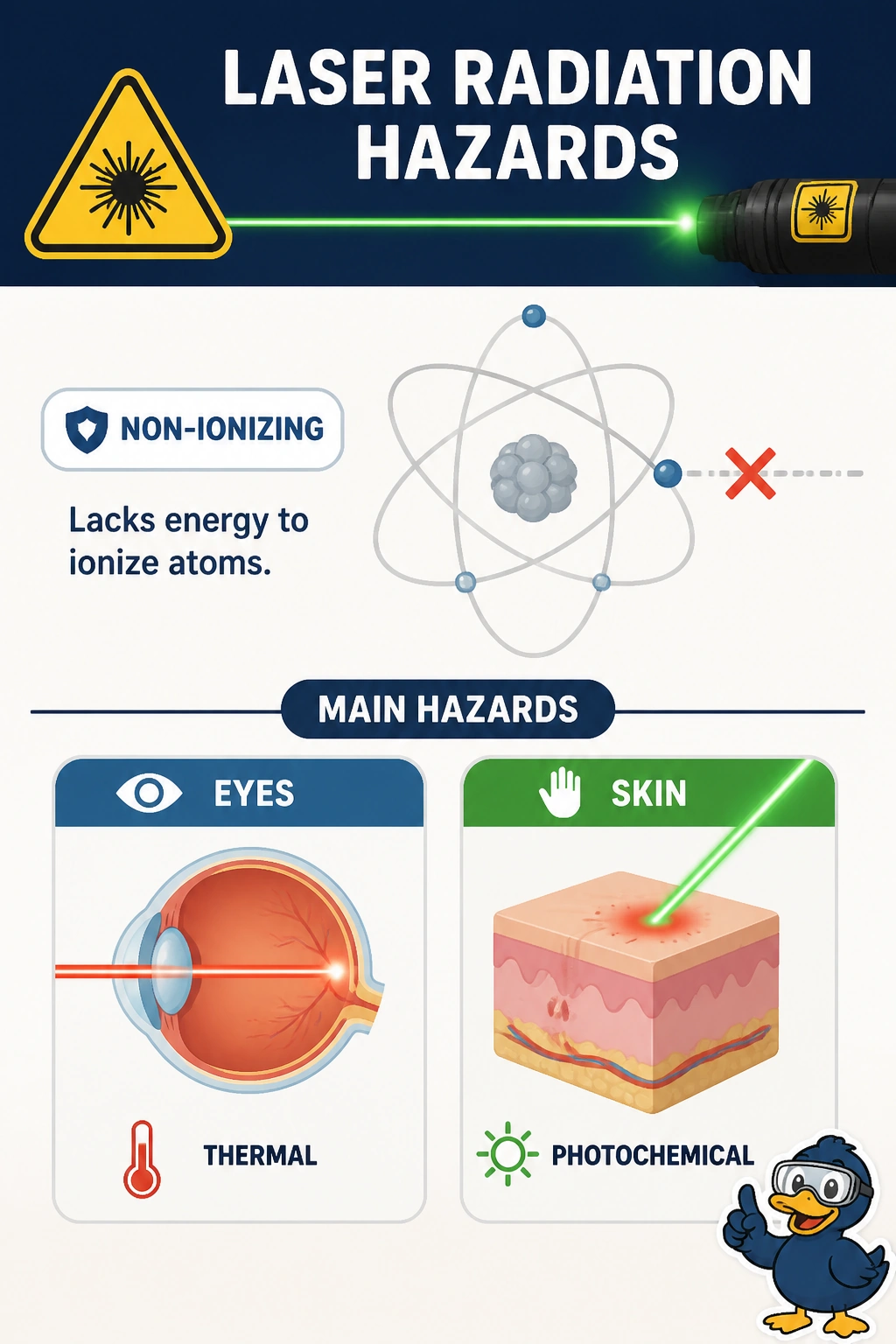
Think of ionizing radiation as a wrecking ball that knocks electrons right off atoms, while non-ionizing radiation is a focused heat lamp that cooks or burns surface tissues. The trap is mixing up their energy levels, when your real concern with lasers is protecting eyes and skin from thermal or photochemical damage.
Full Explanation
Non-ionizing radiation lacks energy to ionize atoms, mainly harming eyes and skin thermally or photochemically accurately describes the mechanism of lasers, ultraviolet arcs, and infrared sources. Because laser energy focuses intensely on the cornea or retina and heats exposed skin, controls rely on interlocked enclosures and wavelength-specific eyewear rather than atomic shielding. Non-ionizing radiation strips electrons from atoms to cause deep-tissue DNA breaks describes ionizing radiation such as X-rays and gamma rays, which carry enough photon energy to break molecular bonds. Non-ionizing radiation requires thick lead-lined walls to stop deep-body penetration also confuses laser barriers with high-density X-ray shielding; opaque, non-reflective enclosures matched to the laser's beam power stop stray reflections. Non-ionizing laser beams are controlled with the same lead aprons and dosimetry badges used at the X-ray booth is incorrect because lead aprons and personnel dosimetry monitor penetrating ionizing exposure, while laser safety depends on beam containment and optical-density-rated eyewear for the specific wavelength. As a caveat, high-powered laser cutting also generates secondary airborne metal fumes that require local exhaust ventilation. As an operational check, inspect the laser enclosure interlocks and confirm eyewear optical density ratings match the specific fiber-laser wavelength.
Prefer to study offline? Printable PDF study book + test engine ($7.50, unofficial). These questions stay free here.