
In a battery-manufacturing plant where air-monitoring results for lead dust are below the Action Level, an industrial hygienist suspects workers are still ingesting lead from contaminated breakroom tables and tool handles. Which sampling method directly evaluates this settled surface hazard?
Select an answer to reveal the explanation.
Short Explanation
Air monitoring only tells you what is floating in the room, not what settled onto lunch tables and coffee mugs. When non-volatile dusts like lead pose a hand-to-mouth ingestion risk, you need surface wipe sampling to catch the contamination that air pumps completely miss.
Full Explanation
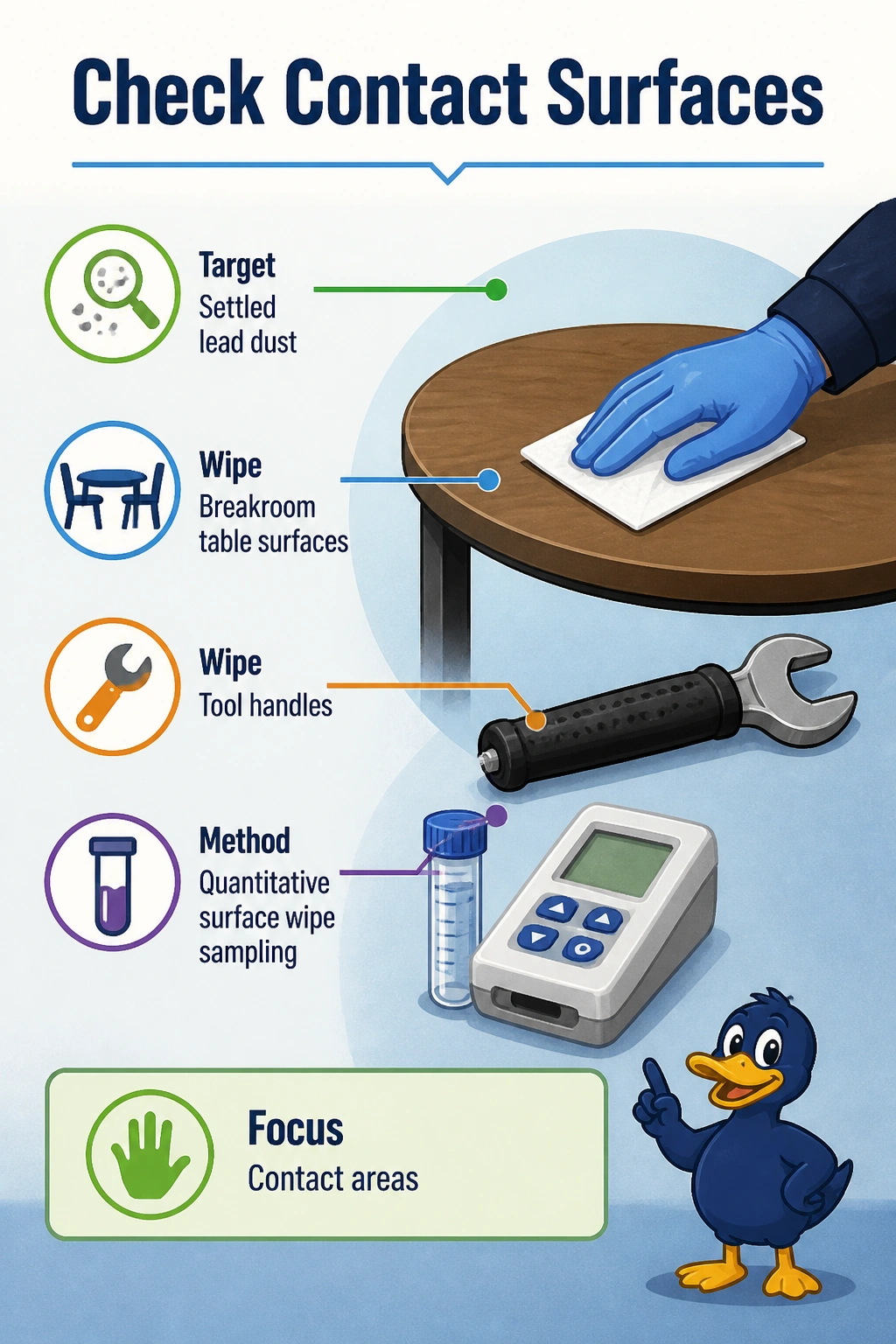
Non-volatile particulates such as lead, beryllium, and heavy metals can settle onto workbenches, PPE lockers, and breakroom surfaces, creating significant ingestion and dermal absorption hazards even when airborne levels are low. Conducting Quantitative surface wipe sampling on contact areas measures the mass of contaminant per unit area (such as micrograms per 100 square centimeters) to pinpoint housekeeping failures and cross-contamination pathways. Relying on Personal breathing-zone cyclone air sampling pumps only captures respirable airborne particles during the shift and cannot detect settled dust on tables or handles. Deploying Passive diffusive vapor badges clipped to worker collars is ineffective because diffusive badges measure gases and vapors, not solid metal particulates. Taking Real-time photoionization detector area readings also fails because PIDs detect volatile organic vapors rather than inorganic lead dust on surfaces. As a caveat, OSHA does not set a universal numeric wipe-sampling PEL for all surfaces, so hygienists compare results against agency housekeeping benchmarks and clean-area baselines. For an operational check, sample both production surfaces and clean breakroom tables, and verify HEPA vacuuming and handwashing stations are used.
Prefer to study offline? Printable PDF study book + test engine ($7.50, unofficial). These questions stay free here.