
A printing facility uses an organic solvent whose vapor density is 3.2 relative to air (air = 1.0) during open-vat parts cleaning. Where should the industrial hygienist recommend placing local exhaust ventilation hood pickups to capture vapors most effectively?
Select an answer to reveal the explanation.
Short Explanation
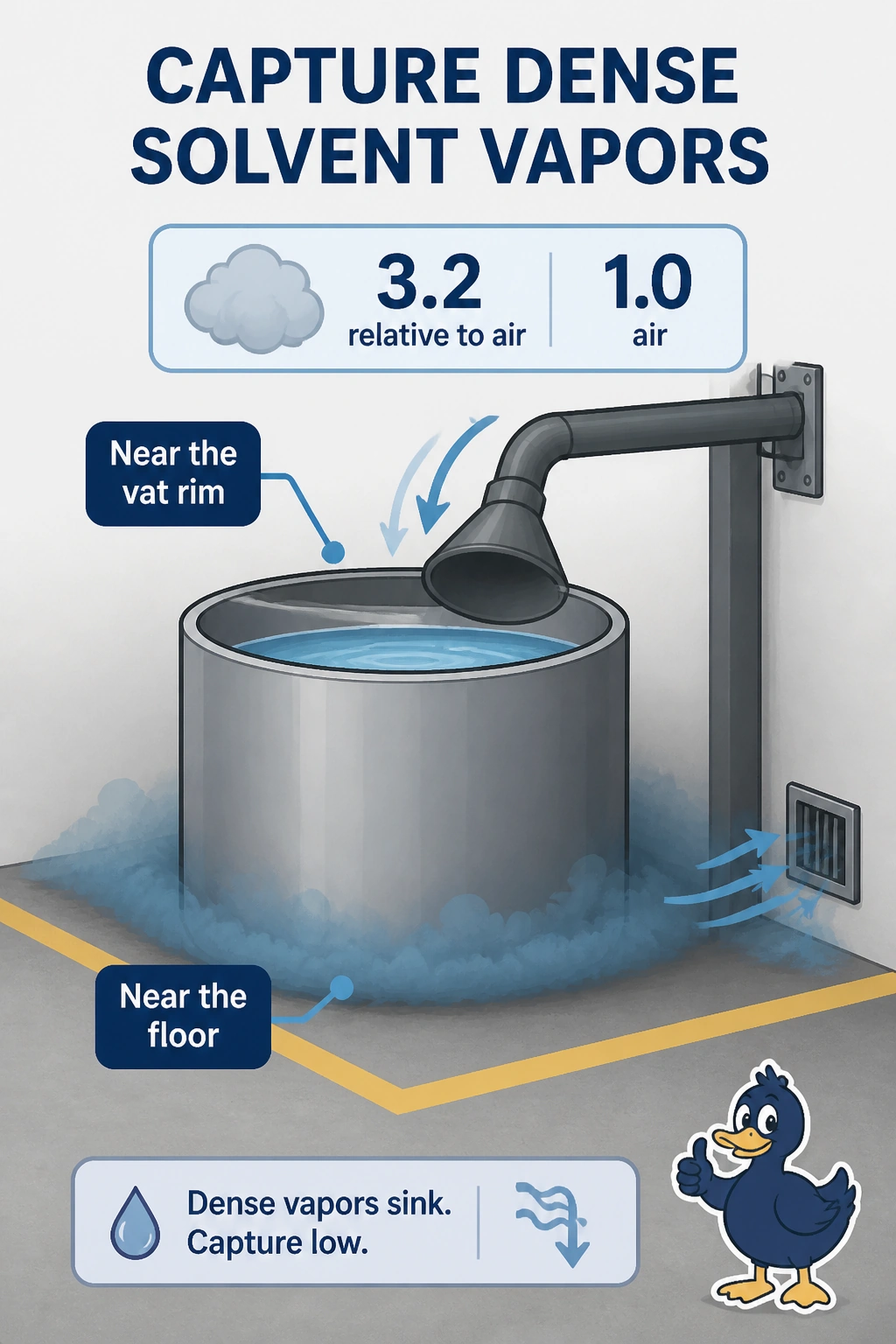
With a vapor density above 1.0, those solvent vapors are heavier than air and hug the floor like cold fog instead of floating to the ceiling. Putting your exhaust pickup low near the source captures them before they pool in pits or drift past workers. The trap is assuming all warm or chemical vapors naturally rise to ceiling vents.
Full Explanation
Vapor density compares the weight of a pure gas or vapor to an equal volume of air (air = 1.0); vapors with a density greater than 1.0 tend to sink and accumulate in low-lying areas, floor drains, and sumps, especially in still air. Placing pickups At low level near the vat rim and floor where dense vapors settle—such as slot hoods at the tank edge combined with low-level floor exhaust—captures concentrated vapors at the source before they spread across the floor or reach ignition sources. Mounting exhaust Near the ceiling directly above the cleaning room lights misses dense vapors pooling below and can pull vapors upward through the worker's breathing zone. Installing pickups At mid-wall height on the opposite side of the room relies on long-distance room air currents, where capture velocity drops rapidly with distance. Placing exhaust Inside the supply air diffuser above the operator's head confuses fresh makeup air delivery with contaminant exhaust and would recirculate or disrupt airflow. As a caveat, air currents, thermal drafts, and low vapor concentrations in air can still mix vapors throughout a room, so low-level capture works best right at the emission point. For an operational check, use smoke tubes and a calibrated anemometer at the vat rim to verify capture velocity pulls vapors away from the operator.
Prefer to study offline? Printable PDF study book + test engine ($7.50, unofficial). These questions stay free here.