
A nondestructive testing technician at a shipyard performs industrial radiography using a gamma-ray source to inspect hull welds. Which combination of fundamental principles minimizes the technician's external ionizing radiation dose?
Select an answer to reveal the explanation.
Short Explanation
Gamma rays travel straight through air and skin like invisible spotlights, so your best defense is staying far away, staying brief, and putting dense mass in between. The trap is treating external radiation like a chemical vapor or surface dust hazard.
Full Explanation
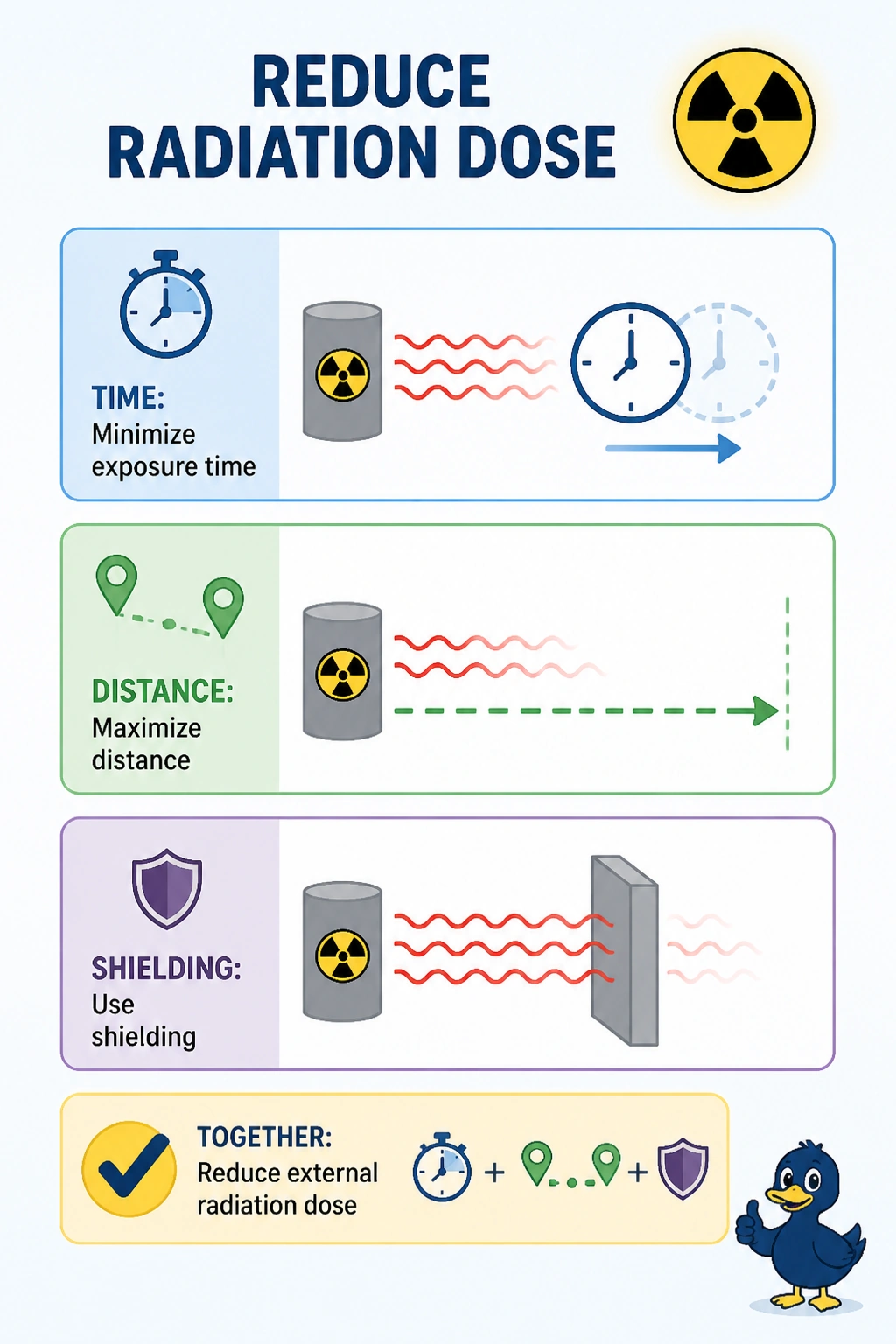
External ionizing radiation exposure from a sealed gamma-ray source is controlled through Minimizing exposure time, maximizing distance, and using shielding. Dose rises linearly with time, drops sharply with distance under the inverse-square law, and is attenuated by high-density barriers such as lead, steel, or concrete. Increasing ventilation airflow and wearing leather gloves addresses airborne particulates or mechanical abrasion, neither of which blocks penetrating gamma photons. Using qualitative fit testing and air-purifying cartridges protects against inhaling gases, vapors, or aerosols, whereas sealed-source radiography presents an external whole-body photon hazard rather than an inhalation exposure. Applying barrier creams and washing hands before eating helps prevent dermal absorption or accidental ingestion of unsealed chemicals, but provides no protection against external gamma rays. As a caveat, always pair these three controls with calibrated survey meters and personal dosimetry to verify boundary dose rates. Operationally, establish barricaded exclusion zones with warning signs and confirm source retraction with a survey meter after every shot.
Prefer to study offline? Printable PDF study book + test engine ($7.50, unofficial). These questions stay free here.