
During a fire-brigade training session at a chemical plant, an instructor demonstrates how a dry-chemical extinguishing agent stops a flammable-liquid fire faster than cooling with water alone, without displacing all oxygen in the room. Which component of the fire tetrahedron does the dry-chemical agent primarily disrupt?
Select an answer to reveal the explanation.
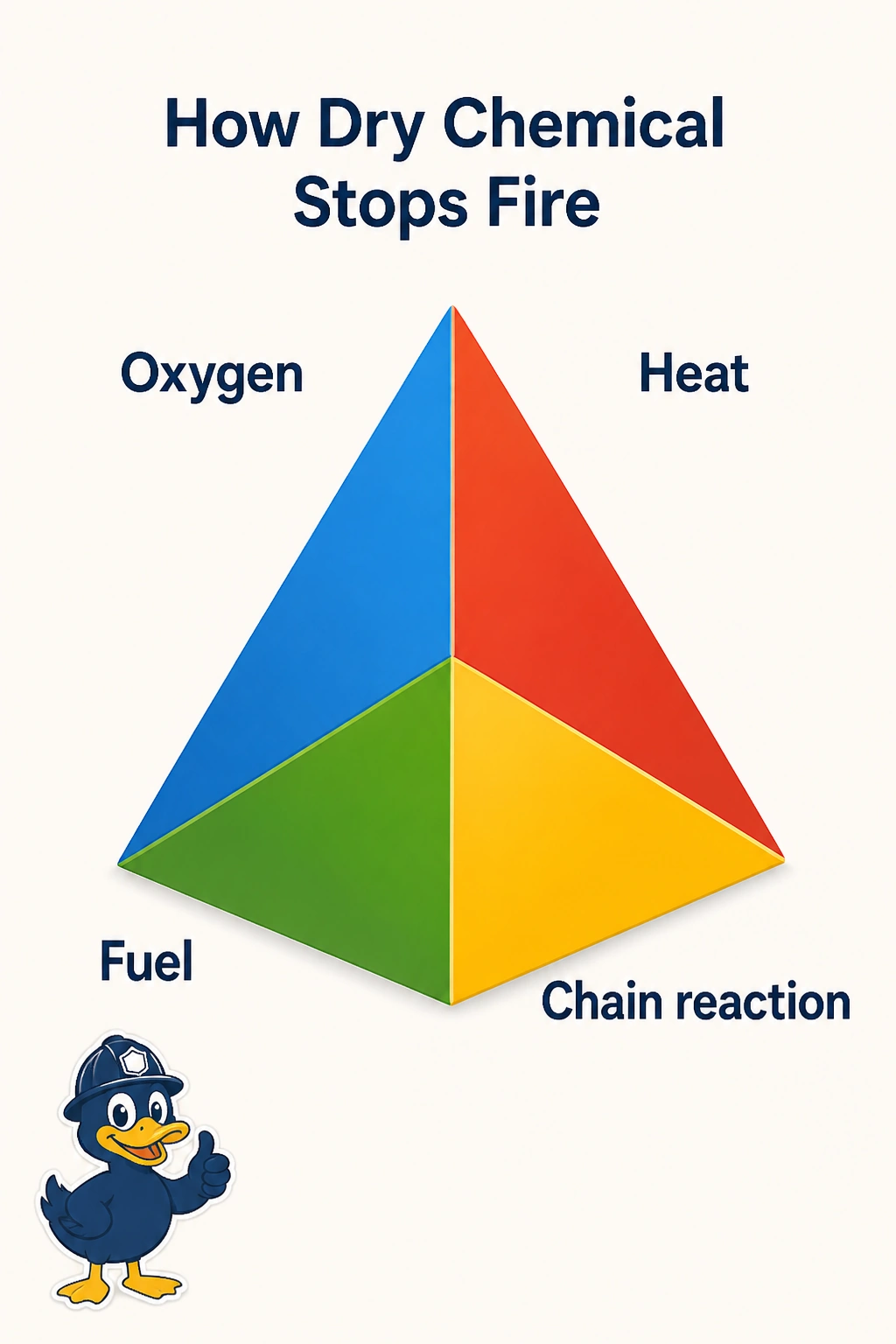
Short Explanation
You can remember that dry-chemical powder acts on the fire tetrahedron’s chemical chain reaction. It does not need to displace the room’s oxygen or cool every drop of fuel, so keep your focus on what sustains the flame.
Full Explanation
Dry-chemical agents extinguish flammable-liquid fires primarily by interrupting the uninhibited chemical chain reaction sustaining combustion. They scavenge free radicals in the flame zone, causing combustion to collapse rapidly without displacing all the oxygen in the room. Reducing the ambient oxygen concentration around the burning liquid surface is not the primary action of dry-chemical powder; that describes oxygen-displacement approaches such as carbon dioxide or inert-gas flooding. Slowing the physical vaporization rate of the liquid fuel inside the pan is also not its primary role; foam blankets can suppress vapors, while water can cool fuel below its flash point. Blocking radiant heat transfer from adjacent structural steel columns concerns thermal shielding or water-curtain cooling for exposure protection, not the chemical flame-knockdown mechanism. One caveat is that dry-chemical agents provide little cooling or vapor-sealing effect, so hot metal surfaces can reignite spilled fuel after the powder cloud settles. As a practical check, verify that Class B dry-chemical extinguishers are paired with cooling or vapor-securing procedures when hot process equipment is nearby.
Prefer to study offline? Printable PDF study book + test engine ($7.50, unofficial). These questions stay free here.