
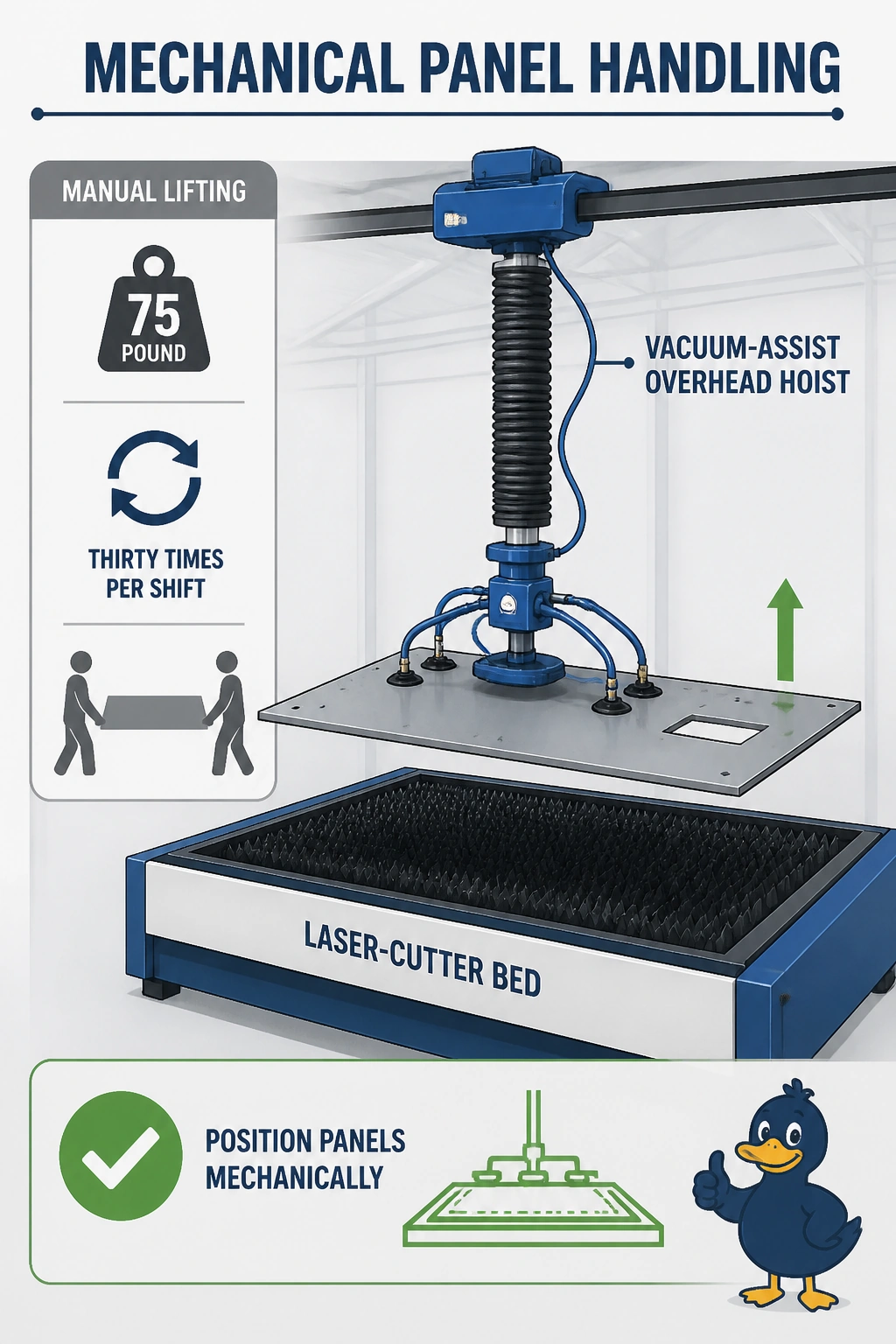
Metal fabrication operators manually lift 75-pound steel sheets from floor pallets onto a laser-cutter bed thirty times per shift, resulting in frequent lumbar strain. Which ergonomic intervention most effectively addresses the hazard?
Select an answer to reveal the explanation.
Short Explanation
When a 75-pound steel sheet has to move thirty times a shift, coaching better lifting posture is like handing someone a raincoat in a hurricane—it never changes the force hitting your spine. The trap is relying on belts, rotation, or technique cues instead of engineering the manual weight out of the job.
Full Explanation
Installing a vacuum-assist overhead hoist so operators can position panels mechanically without manual lifting applies an engineering control at the top of the hierarchy, transferring the 75-pound gravitational load from the worker's lumbar spine to mechanical equipment. By eliminating forceful manual lifting and awkward reach over the laser bed, the hoist removes the primary biomechanical stressor driving disc compression and muscle strain. Instructing pairs of workers to bend their knees and keep their backs straight during manual lifts relies purely on administrative training and fails to reduce the excessive weight or awkward horizontal reach around wide sheets. Issuing elastic back support belts to all press operators at the start of each shift is ineffective because NIOSH evidence does not support back belts as personal protective equipment for preventing injury in uninjured workers. Rotating operators every four hours between two different heavy sheet-loading presses merely spreads the same high-force lumbar hazard across more employees without giving muscle groups recovery time. As a caveat, any mechanical assist must have sufficient reach, cycle speed, and ergonomic pendant controls so operators do not bypass it under production pressure. Operationally, verify hoist vacuum-cup grip capacity, inspect vacuum gauges before each shift, and confirm operators use the hoist for every sheet transfer.
Prefer to study offline? Printable PDF study book + test engine ($7.50, unofficial). These questions stay free here.