
Quality inspectors at a precision electronics plant lean forward with their necks bent over flat workbenches for six hours per shift to read tiny solder joints under dim overhead room lights. Which engineering control best addresses the root cause of their neck and upper-back strain?
Select an answer to reveal the explanation.
Short Explanation
When workers hunch forward to see fine detail, their bodies are trying to make up for a poorly designed visual environment. Don't fall into the trap of coaching posture alone; fix the lighting and viewing angle so your inspectors can work upright comfortably.
Full Explanation
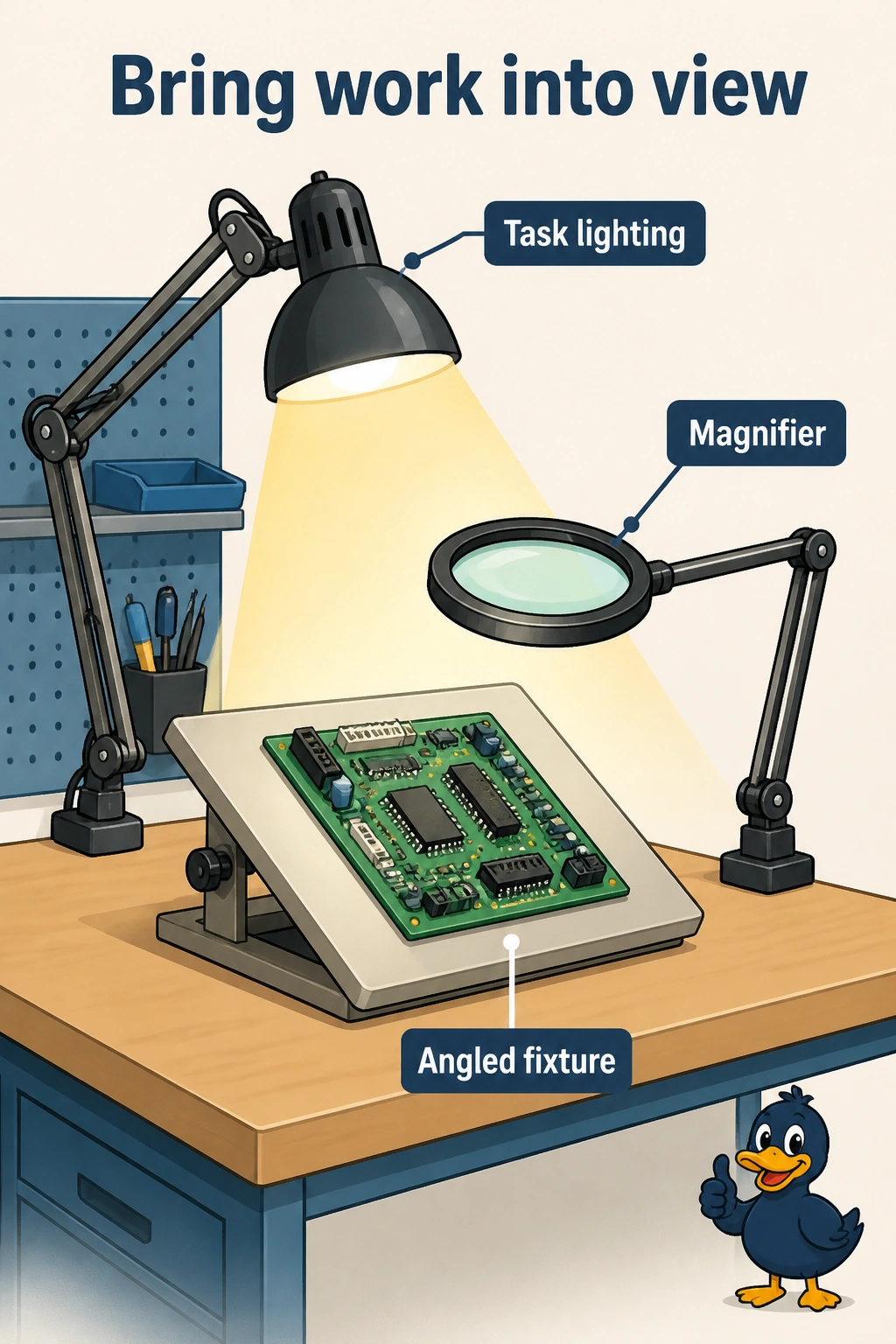
The most effective ergonomic solution is to Install adjustable task lighting, magnification, and angled fixtures to bring work into neutral view. Visual demands drive posture: when targets are small or poorly lit, workers involuntarily flex their necks and lean forward to shorten focal distance, creating sustained static loading on the cervical spine and trapezius muscles. Raising and tilting the workpiece while improving illumination and magnification eliminates the visual bottleneck so the head stays balanced over the shoulders. Choosing to Issue padded cervical neck collars to support workers during long shifts treats a symptom with a restrictive device that can weaken muscles and interfere with work. Choosing to Rotate inspectors to another flat-bench visual task every two hours fails to remove the awkward neck flexion because both tasks share the same poor geometry. Choosing to Train inspectors to consciously remind themselves to sit upright relies on willpower against a physical visual barrier, which fails as soon as concentration shifts to the product. As a caveat, excessive glare from poorly positioned task lights can create new eye strain, so use diffused, adjustable fixtures. Operationally, conduct an illumination and viewing-angle check at each station and verify that inspectors can read defects while keeping their ears aligned over their shoulders.
Prefer to study offline? Printable PDF study book + test engine ($7.50, unofficial). These questions stay free here.