
An automotive parts assembly line requires workers to stand while reaching overhead, twisting their torsos, and squatting intermittently to install underbody brackets. Which ergonomic assessment tool is specifically designed to evaluate whole-body postural risks, including legs, trunk, and neck?
Select an answer to reveal the explanation.
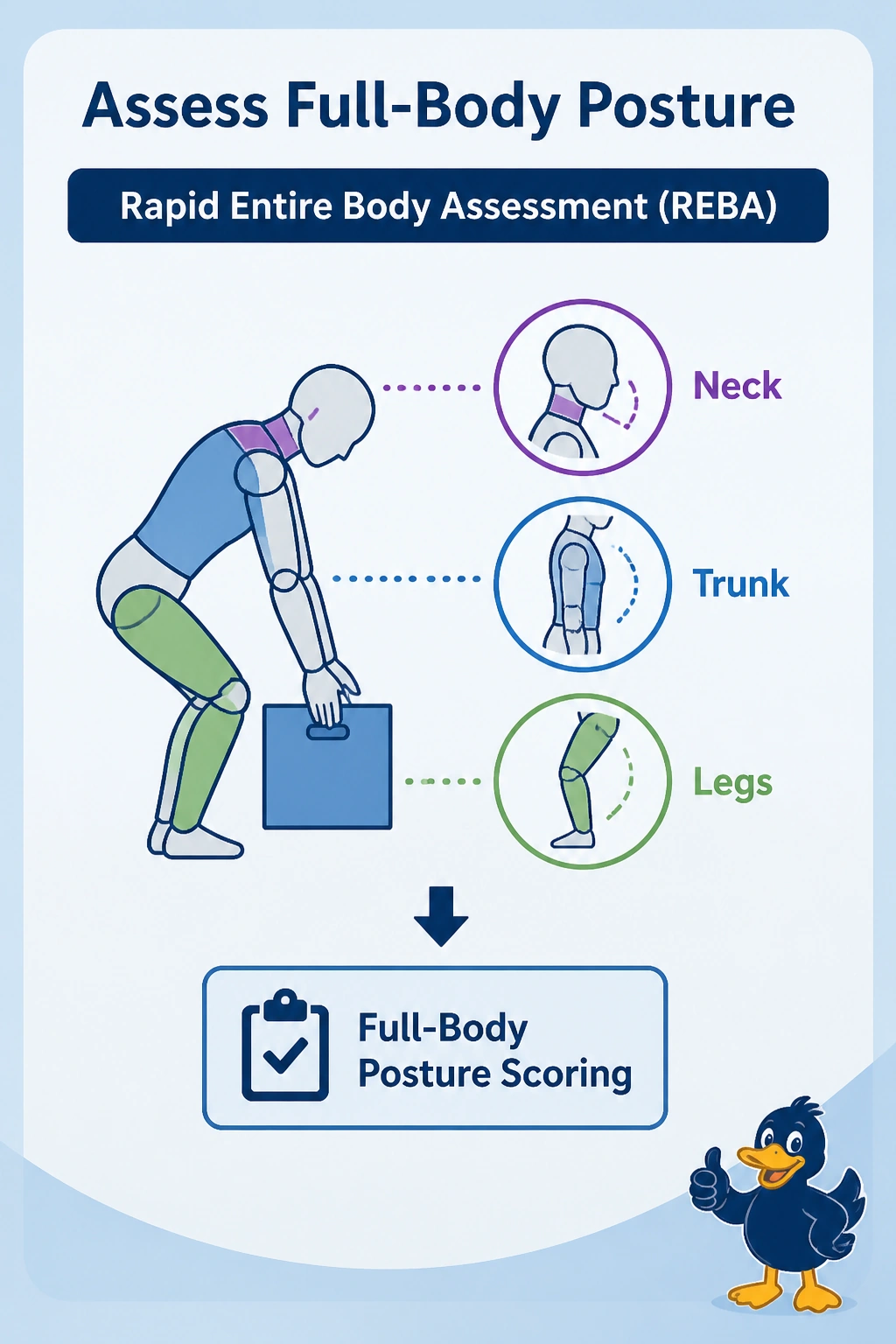
Short Explanation
When workers squat, twist, and reach overhead at the same time, you need an assessment tool that captures the whole body rather than just the arms. The trap is using RULA, which scores the trunk but does not score squatting legs, instead of REBA.
Full Explanation
Evaluating overhead reaches combined with torso twisting and squatting requires Rapid Entire Body Assessment (REBA) for full-body posture scoring. REBA assigns postural scores to the neck, trunk, legs, upper arms, lower arms, and wrists, then combines them with load, coupling, and activity factors to produce an action level for dynamic, whole-body tasks. By contrast, Rapid Upper Limb Assessment (RULA) for seated workstation tasks focuses primarily on the neck, trunk, and upper extremities and lacks the lower-body scoring needed for standing or squatting work. Similarly, Revised NIOSH Lifting Equation for two-handed manual lifting tasks calculates a Recommended Weight Limit for lifting and lowering, not multi-posture assembly work. Likewise, Snook Psychophysical Tables for maximum acceptable push and pull forces establish weight and force benchmarks for material handling rather than scoring awkward joint angles. As a caveat, REBA is a screening tool that prioritizes interventions rather than a medical diagnostic. For an operational check, video-record several assembly cycles, score the worst-case and most frequent postures in REBA, and target engineering redesigns for any high-risk action levels.
Prefer to study offline? Printable PDF study book + test engine ($7.50, unofficial). These questions stay free here.