
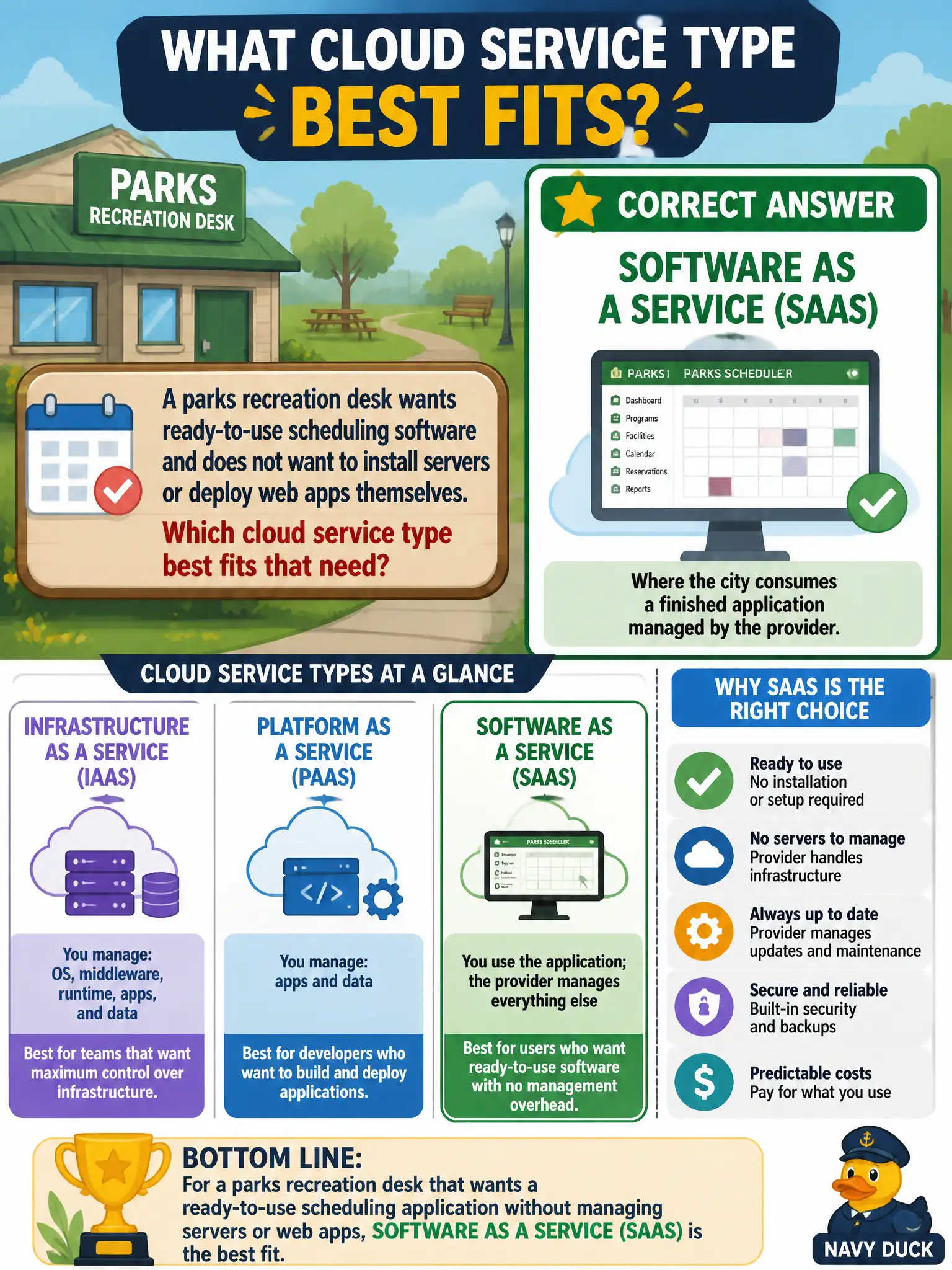
A parks recreation desk wants ready-to-use scheduling software and does not want to install servers or deploy web apps themselves. Which cloud service type best fits that need?
Select an answer to reveal the explanation.
Short Explanation
Picture buying a finished playground set instead of lumber and tools — SaaS is the finished application. The vendor runs the servers and ships the software; the city just signs in and uses it. That is the opposite of standing up VMs or writing your own web app.
Full Explanation
Ready-to-use scheduling software with no city-owned servers or custom web deployments maps to Software as a Service. In SaaS, the provider hosts the finished application, applies patches and feature updates, and exposes the product through a browser or client. The parks recreation desk consumes the service rather than assembling an application stack, which is exactly the consume-finished-app pattern AZ-900 emphasizes when contrasting cloud service types.
Infrastructure as a Service fails this need because IaaS supplies virtual machines, storage, and networking that the city must still configure, harden, and patch before any scheduling product exists. Platform as a Service also fails the stated goal: even though PaaS removes much operating-system burden, it is still a build-and-host model for custom code, not a finished recreation scheduler delivered as a product. A private on-premises appliance that the vendor never updates fails on two fronts—it reintroduces local hardware ownership and removes the continuous-update benefit that makes cloud SaaS attractive for desk staff.
Exam caveat: SaaS still leaves the customer responsible for identity governance, data classification, and acceptable-use configuration inside the product; "provider managed" does not mean zero municipal accountability for who can book facilities or export citizen data.
Operational check: before purchasing, confirm the SaaS tenant supports the city's identity provider for single sign-on, review data residency and retention settings for reservation records, and verify that export or archival paths exist so recreation history survives a later vendor change.