
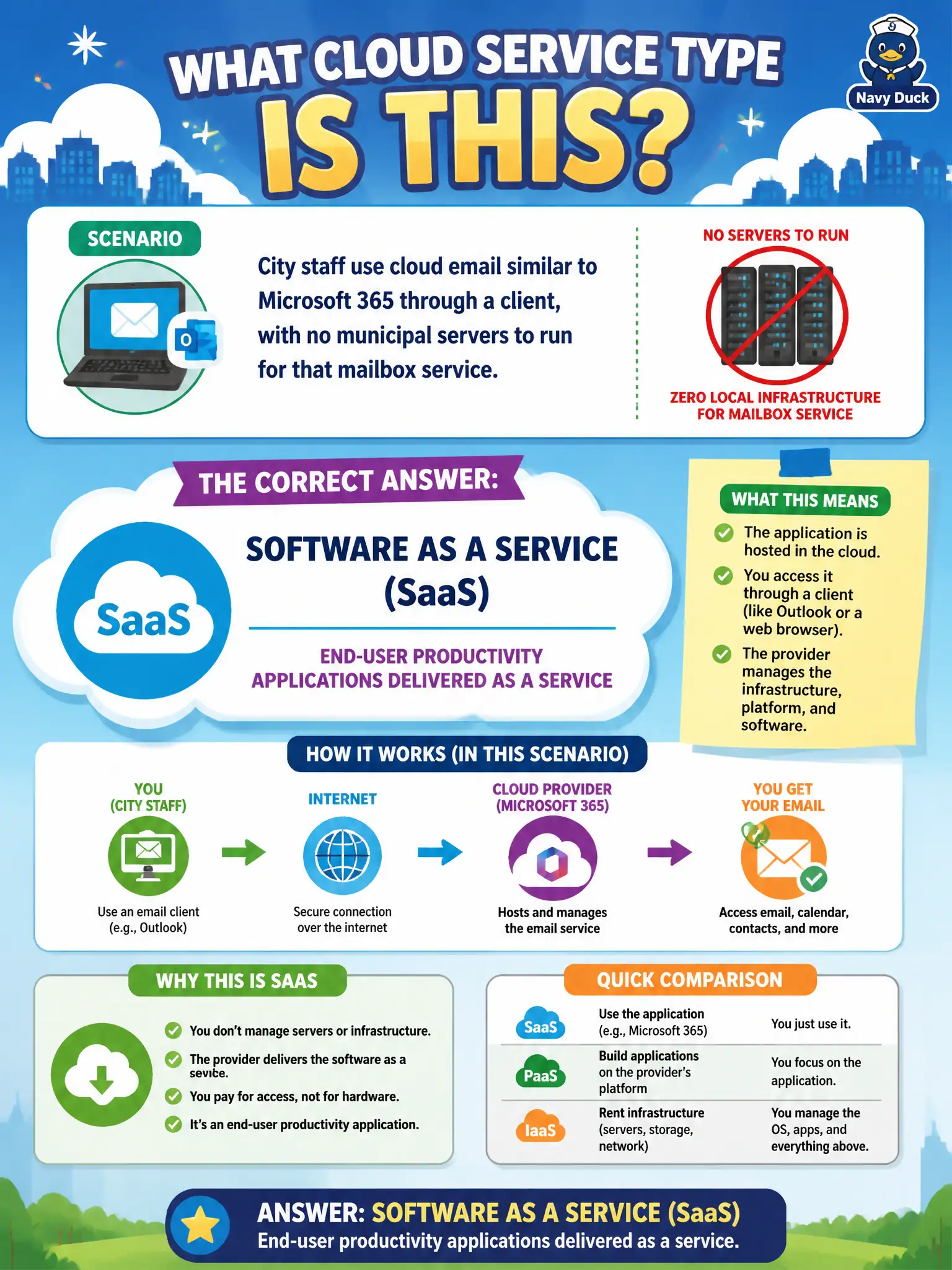
City staff use cloud email similar to Microsoft 365 through a client, with no municipal servers to run for that mailbox service. Which service type should candidates identify?
Select an answer to reveal the explanation.
Short Explanation
City email that just works in Outlook or the web — without standing up mailbox servers — is classic SaaS. Productivity suites like Microsoft 365 are the poster child. If the city still ran the Exchange boxes end to end, that would not be the SaaS picture.
Full Explanation
Cloud email similar to Microsoft 365, used through a client with no municipal servers to run for that mailbox service, is Software as a Service—end-user productivity applications delivered as a service. That is the standard AZ-900 SaaS example candidates are expected to recognize quickly. Staff consume mailboxes; the city does not operate the mailbox servers end to end. IaaS would imply city-managed servers for the mailbox workload, which the scenario explicitly avoids and which would reintroduce patching and capacity chores. PaaS container hosts patched like guest OS VMs describe platform or infrastructure duties, not finished mailbox suites for end users. On-premises Exchange-only appliances with no cloud service model sit outside SaaS and keep the municipality in the server business. Exam caveat: identifying Microsoft 365–style email as SaaS does not mean every Microsoft cloud service is SaaS—IaaS and PaaS remain separate types for other municipal workloads. Operational check: verify mailbox administration is tenant and service administration (users, licenses, retention, access) rather than operating municipal mailbox servers, and document that split for staff training. In study guides, pair Microsoft 365–style email with SaaS and keep VM and App Service examples available so candidates do not collapse all Azure into one type.