
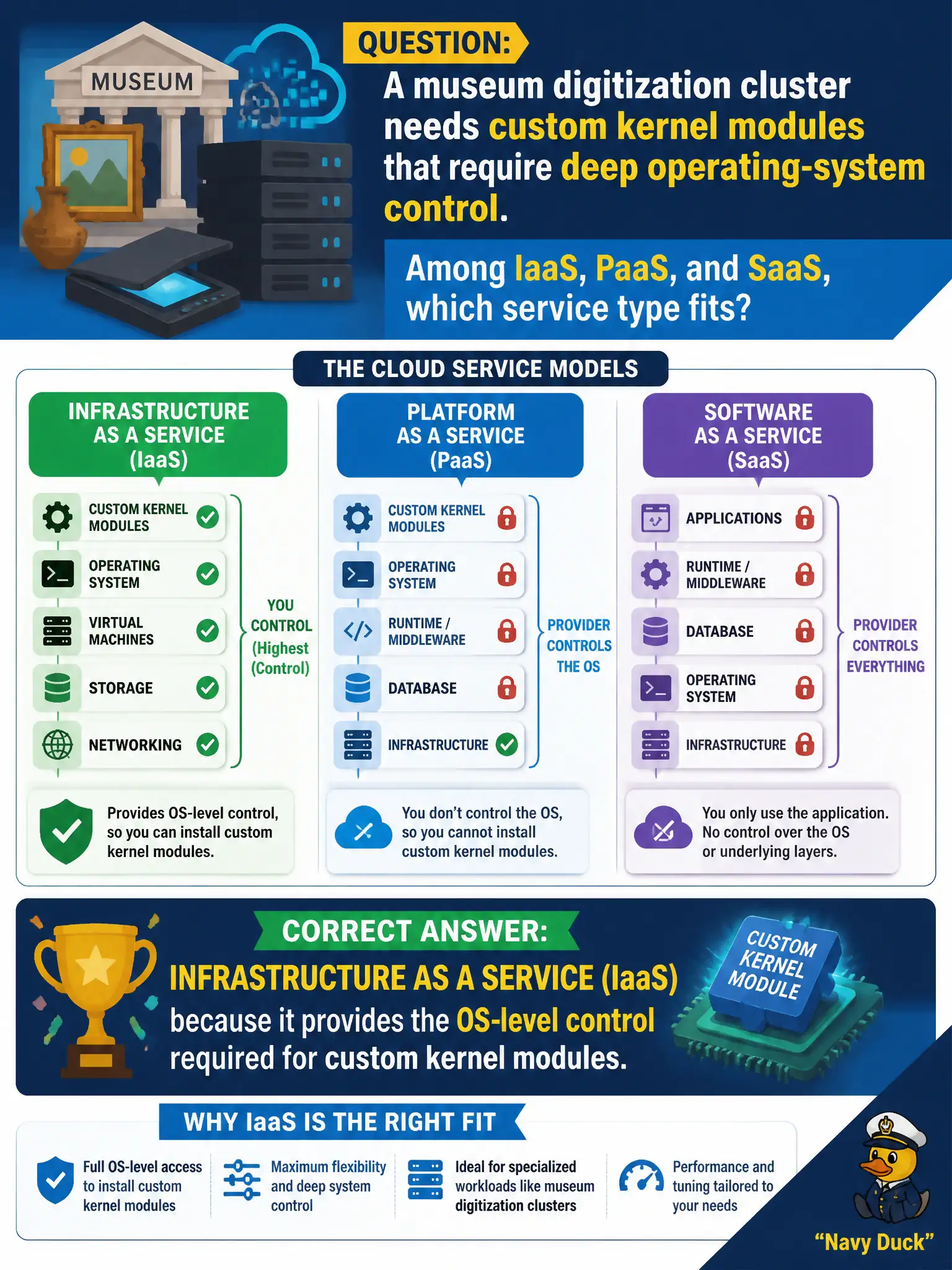
A museum digitization cluster needs custom kernel modules that require deep operating-system control. Among IaaS, PaaS, and SaaS, which service type fits?
Select an answer to reveal the explanation.
Short Explanation
Custom kernel modules are a 'we need the OS hood open' requirement — that points to IaaS. PaaS and SaaS deliberately keep you away from that depth. Mailboxes and collaboration suites will not load your museum’s drivers.
Full Explanation
Custom kernel modules require deep operating-system control, which Infrastructure as a Service provides through customer-managed virtual machines. That control—installing drivers and kernel components the platform would otherwise hide—is why IaaS fits a museum digitization cluster with specialized kernel needs. Among IaaS, PaaS, and SaaS, only IaaS is designed for that depth of OS ownership. SaaS email does not ship arbitrary kernel modules with mailboxes and offers no OS access for museum imaging hardware support. PaaS web apps deliberately abstract the OS and do not expose full kernel installs for customer driver work; platforms optimize for application deployment, not custom kernels. SaaS collaboration suites likewise disallow arbitrary kernel drivers and are finished productivity applications. Exam caveat: IaaS control comes with IaaS responsibility—kernel modules increase support, stability, and security burden on the customer, including patch and compatibility testing. Operational check: validate that the chosen VM image and privileged access process allow controlled kernel-module installation, and record who approves, tests, and patches those modules after host or guest updates.