
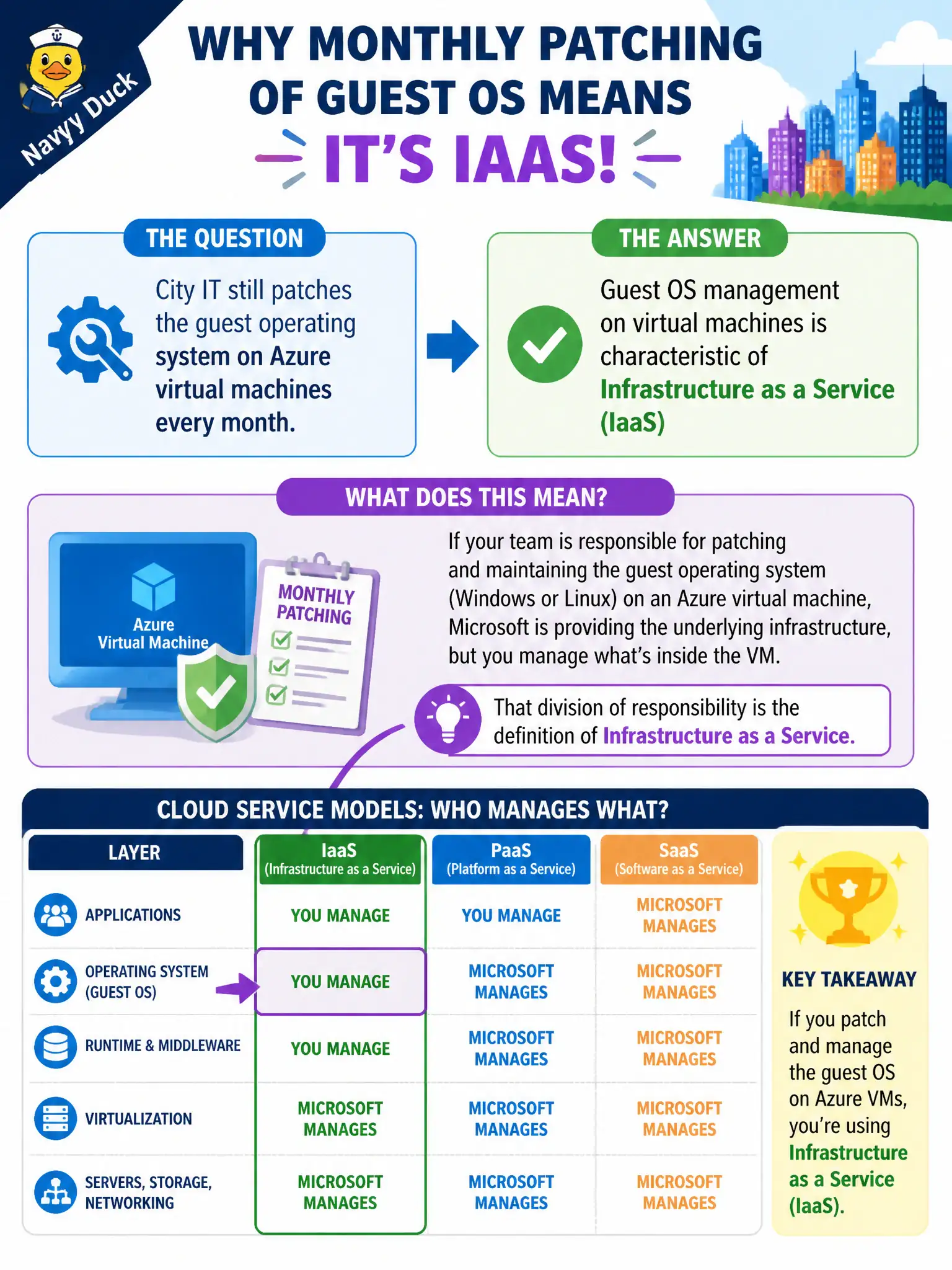
City IT still patches the guest operating system on Azure virtual machines every month. What does that ongoing duty indicate about the service type?
Select an answer to reveal the explanation.
Short Explanation
If your team is still patch Tuesday on the guest OS, you are living in IaaS land. On VMs, that OS duty stays with the customer. SaaS would not hand you the guest OS to patch.
Full Explanation
Guest OS management on virtual machines is characteristic of Infrastructure as a Service. Under shared responsibility for IaaS, the provider manages the physical hosts and fabric while the customer patches and hardens the guest operating system and applications—so monthly guest OS patching on Azure VMs signals IaaS clearly. That ongoing duty is the fingerprint of the service type in this item. Pure SaaS does not hand customers a guest OS to patch; claiming only SaaS has guest OS patches reverses the model. Providers do not always patch guest OS on every VM for the customer—that duty typically remains with the customer on IaaS unless a different managed offering is in use. Patching guest OS does not mean the city purchased physical servers; VMs remain virtualized cloud infrastructure billed as a service. Exam caveat: PaaS and SaaS shift more OS and runtime duty to the provider—do not generalize IaaS guest patching to all cloud service types on the exam. Operational check: maintain a patch calendar for VM guest OS images and confirm ownership is assigned to city IT, not assumed to be “Microsoft’s automatic job,” with evidence retained for auditors. Treat guest OS images as customer-owned configuration: baseline hardening, patch windows, and reboot change control stay on the municipal side for IaaS VMs.