
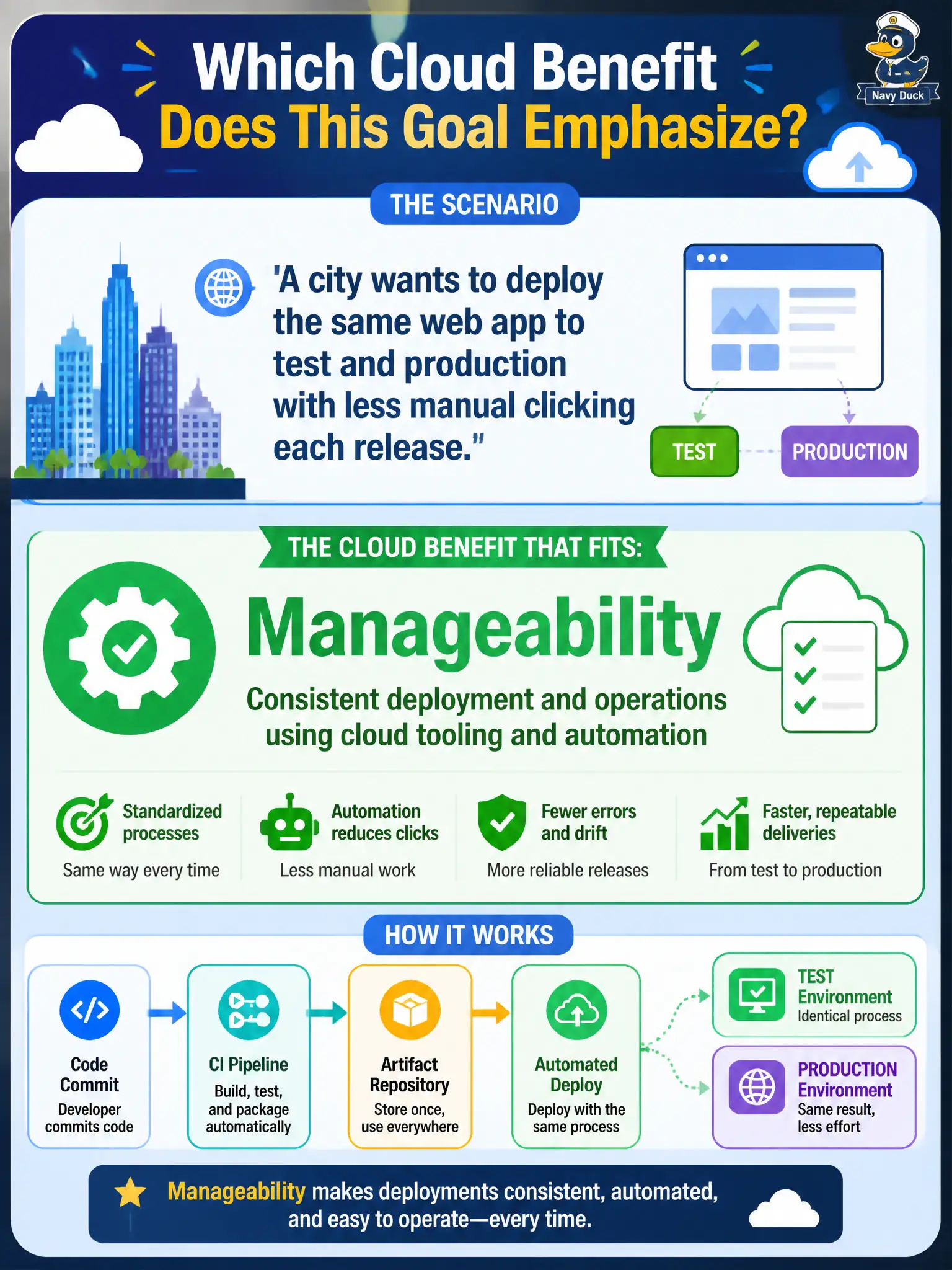
A city wants to deploy the same web app to test and production with less manual clicking each release. Which cloud benefit does that goal emphasize?
Select an answer to reveal the explanation.
Short Explanation
Same app, two environments, fewer mouse marathons — that is manageability waving hello. Cloud tooling and automation help keep test and prod deployments consistent. Hand-building unique snowflakes every time is the opposite of the benefit.
Full Explanation
Manageability includes consistent deployment and operations using cloud tooling and automation so the same web app can reach test and production with fewer error-prone manual clicks each release. Templates, pipelines, and repeatable portal or CLI deployments embody that benefit at fundamentals depth and reduce configuration drift between environments. The municipal goal is sameness with less clicking—not more unique hand-built servers. Buying duplicate physical web servers for every release train reintroduces CapEx, lead time, and manual variance. Disabling templates so each environment is clicked together uniquely works against consistency and amplifies human error. Treating production as the only place automation is allowed leaves test environments brittle, increases drift, and trains teams on processes they will not use when it matters. Exam caveat: manageability is not identical to agility or elasticity—here the focus is operational consistency and reduced manual deployment toil across environments. Operational check: compare a recent test-versus-production release for manual steps and configuration drift; reduce unique click-paths with shared templates or scripts and re-check drift on the next release.