
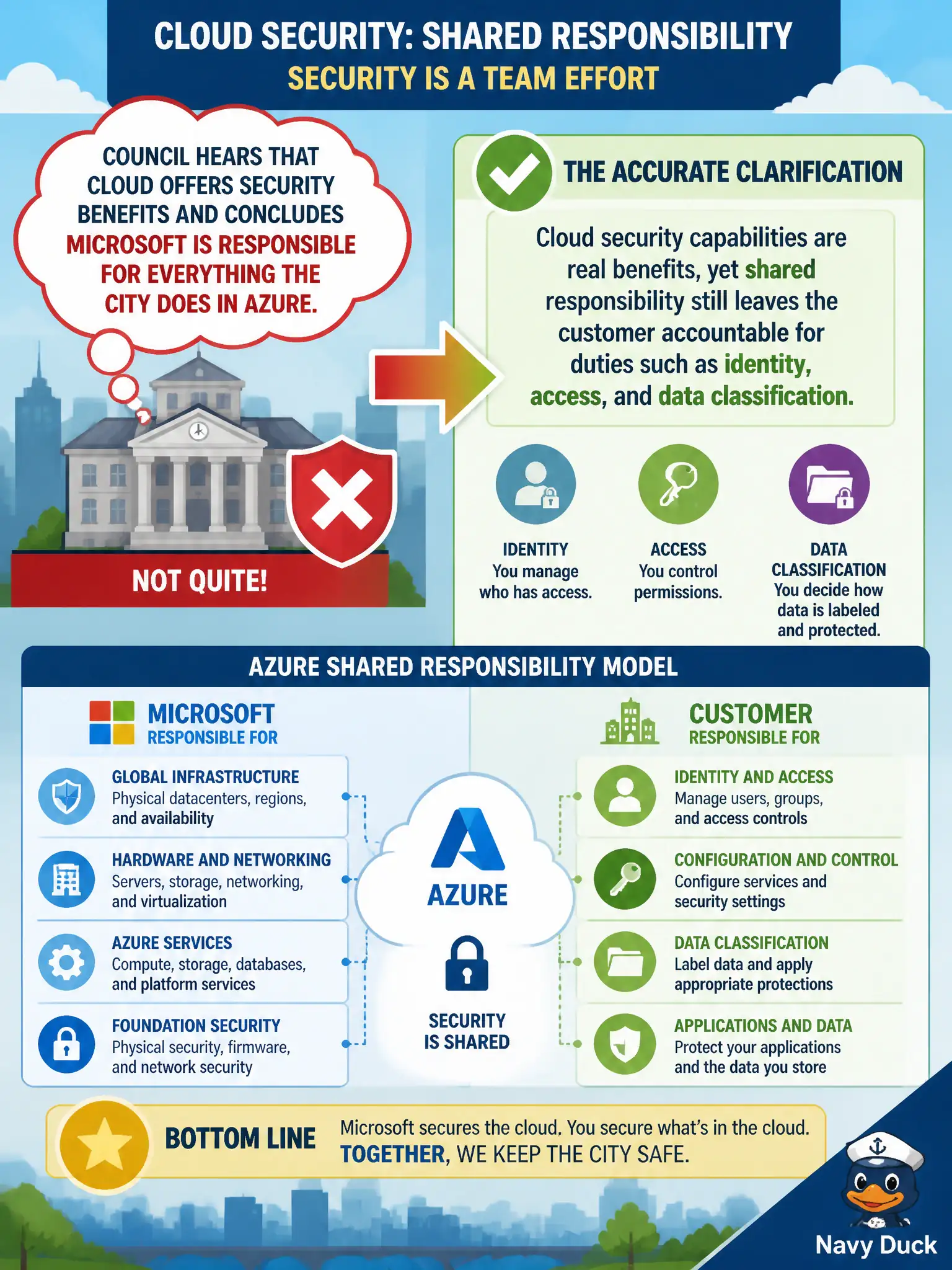
Council hears that cloud offers security benefits and concludes Microsoft is responsible for everything the city does in Azure. Which clarification is accurate?
Select an answer to reveal the explanation.
Short Explanation
Security features in the cloud are like better locks and cameras on the building — helpful, but you still decide who gets keys and what goes in the safe. Shared responsibility does not vanish because Microsoft runs big datacenters. Benefits and customer duties travel together.
Full Explanation
Azure Fundamentals pairs security-and-governance benefits with the shared responsibility model. Provider investments and platform capabilities are real benefits—identity platforms, policy controls, and compliance tooling among them—yet the customer remains accountable for duties such as identity, access control, and data classification that vary by IaaS, PaaS, and SaaS. Council’s leap from “cloud has security benefits” to “Microsoft is responsible for everything” collapses that distinction. Shared responsibility does not disappear once any cloud service is used—that myth is a common exam trap. Security benefits do not mean the customer never configures identity or data protections; those are typically customer-owned and misconfiguration remains a leading risk. Claiming only the customer owns physical datacenter cameras while the provider owns all data classification reverses typical boundaries: providers own facility physical security in public cloud, while customers usually own classifying and protecting their data. Exam caveat: benefit language and responsibility language must both stay true on the same question—do not let one cancel the other. Operational check: for a representative Azure workload, list customer-owned controls (identities, RBAC, classification) versus provider-owned facility and fabric controls and brief council with that split.