
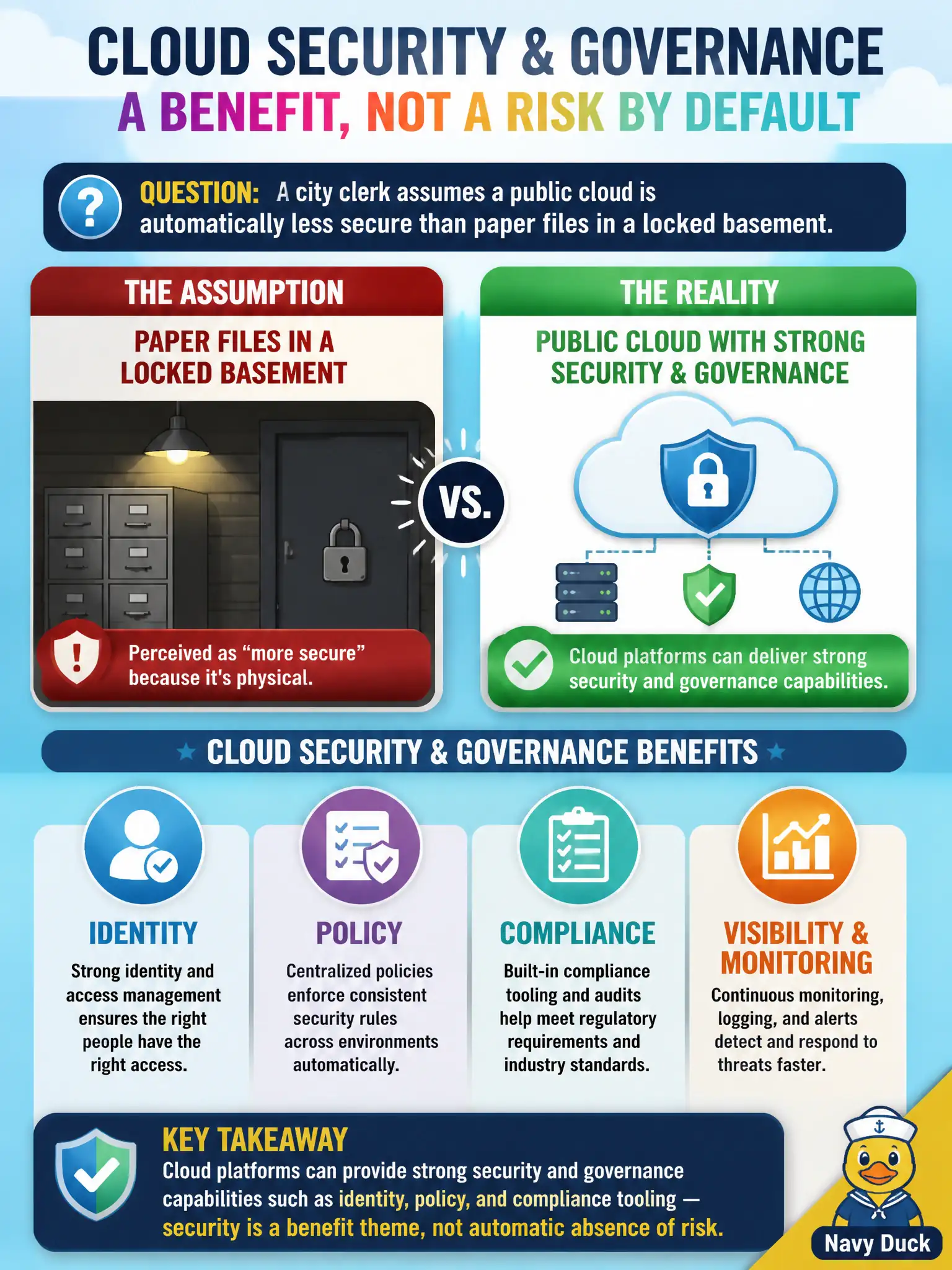
A city clerk assumes a public cloud is automatically less secure than paper files in a locked basement. Which statement best reflects a cloud security-and-governance benefit?
Select an answer to reveal the explanation.
Short Explanation
The locked basement feels safer because you can see the door — but cloud providers pour huge investment into security and governance tooling. The benefit is those capabilities, not a magic wand that erases every risk. Customers still share responsibility; cloud is not automatically weaker than paper in a vault.
Full Explanation
Security and governance are recognized cloud benefit themes: platforms offer identity, policy, compliance, and related capabilities that many municipalities could not fund alone. That benefit is about stronger tooling and provider-scale investment—not a claim that risk vanishes or that paper in a locked basement is automatically safer than a well-governed cloud estate. The city clerk’s assumption that public cloud is automatically weaker ignores both provider investment and customer-configurable controls. Public cloud does not remove all customer security duties; shared responsibility still assigns identity, access, data classification, and configuration work to the customer depending on service type. Claiming only on-premises basements can meet compliance ignores certified cloud offerings, regional choices, and customer-controlled compliance tooling. Restricting security benefits to SaaS email alone is false—infrastructure and platform services also expose security and governance capabilities for workloads beyond mail. Exam caveat: AZ-900 expects you to affirm security as a benefit while still remembering shared responsibility; do not treat “security benefit” as “provider owns everything.” Operational check: map which identity and policy controls the city owns versus the provider for each workload class before assuming basement paper is the safer default.