
A city relies on cloud provider resiliency features and regional options for disaster readiness. How should that be framed as a cloud benefit at fundamentals depth?
Select an answer to reveal the explanation.
Short Explanation
Disaster readiness is having more than one fire station on the map. Cloud regions and resiliency features give cities options to keep services alive when something big goes wrong. Call that reliability—not a deep dive into a specific backup SKU.
Full Explanation
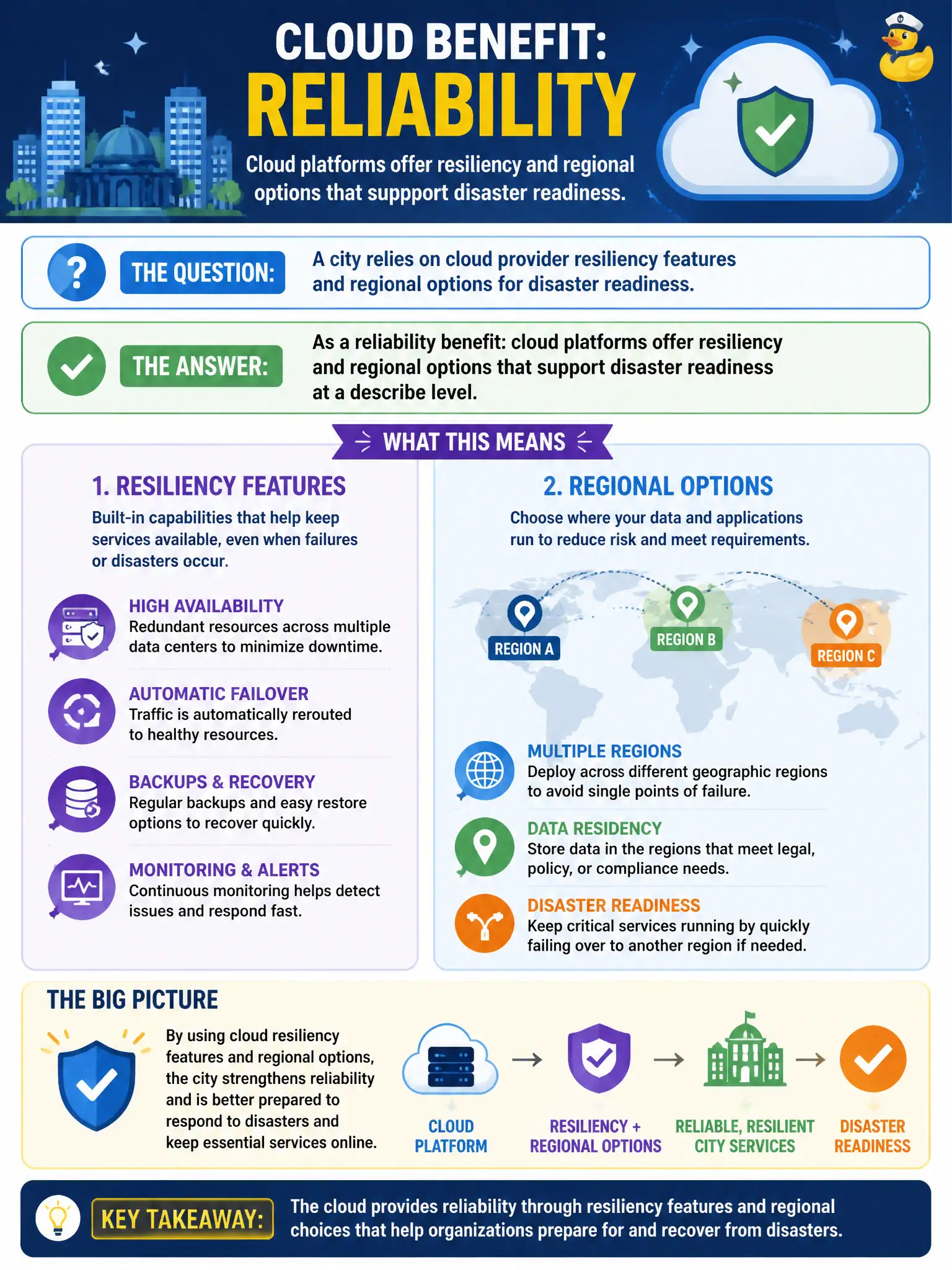
Relying on cloud provider resiliency features and regional options for disaster readiness is framed at fundamentals depth as a reliability benefit: platforms offer resiliency and regional choices that support keeping services available when something large goes wrong. Describe the idea—multiple regions, resiliency features—without turning the item into a full backup-product admin lab.
Treating the topic as a restore-runbook administration exam exceeds AZ-900 describe scope. Claiming cloud removes any need to think about failures or recovery oversells the platform; customers still choose architectures and test readiness. Filing it as an AI-900 generative-models topic misplaces the domain entirely.
Exam caveat: regional options enable disaster readiness strategies; they do not automatically replicate every workload or replace the city’s responsibility to design what must fail over and to verify recovery assumptions.
Operational check: for one critical civic app, document which region hosts production, what secondary region or resiliency feature is designated for major incidents, and the last date a failover or restore drill was run—keeping the evidence at reliability-benefit level rather than deep backup tooling trivia.