
Staff confuse reliability with security. How should those cloud benefit categories be separated?
Select an answer to reveal the explanation.
Short Explanation
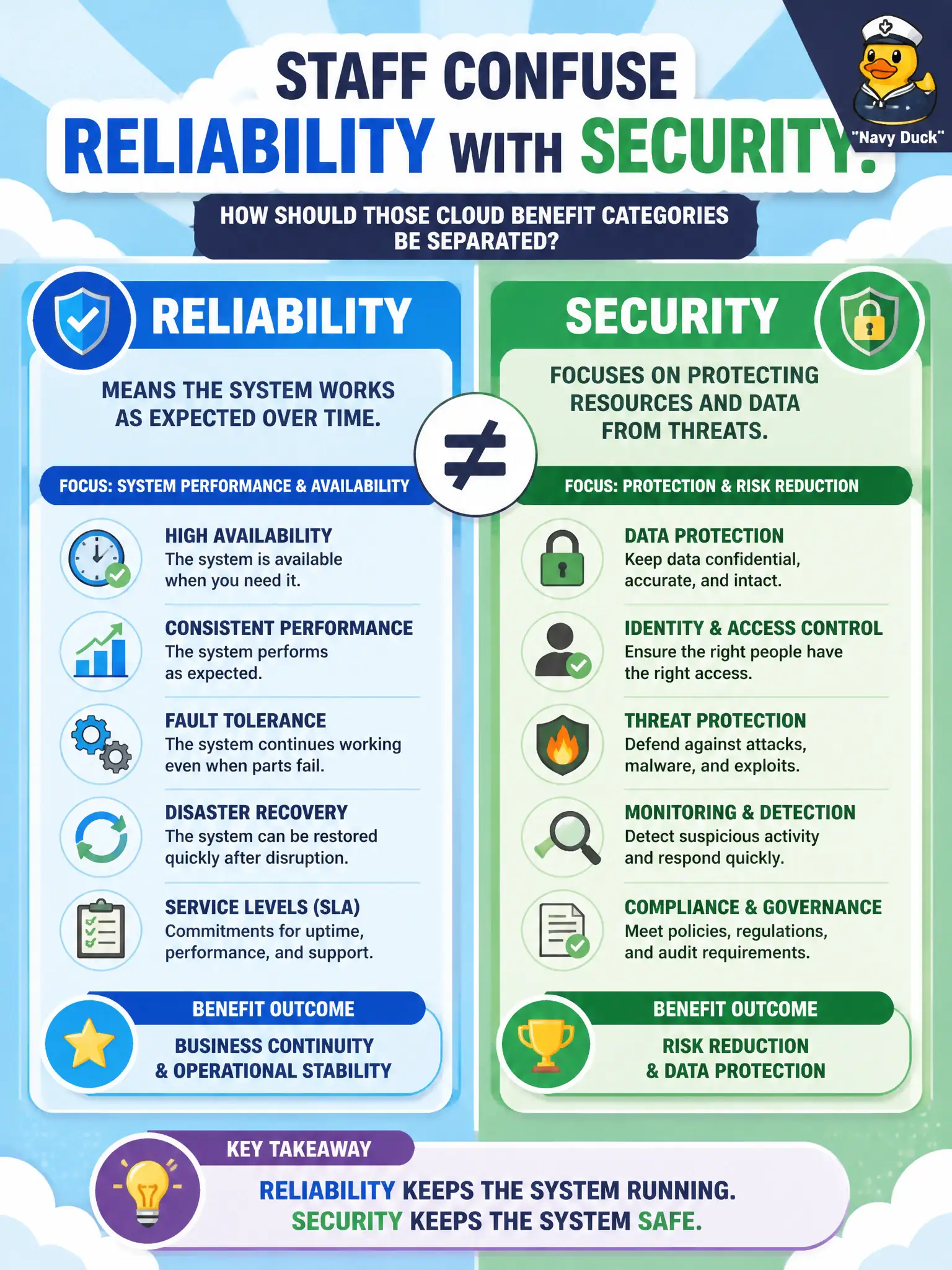
Reliability is “does the plow show up every snow day?” Security is “can random people steal the keys to the garage?” Both matter for city IT, but they answer different questions—do not mash them into one buzzword.
Full Explanation
Reliability and security are distinct cloud benefit categories. Reliability means the system works as expected over time—uptime, consistent correct operation, resilience. Security focuses on protecting resources and data from threats—identity, encryption, threat detection. City staff should not mash does-it-stay-up with can-someone-steal-the-keys.
Treating reliability and security as identical terms that always mean encryption only collapses two pillars into one incomplete idea. Saying security replaces reliability so uptime targets are never discussed erases SLA and availability conversations. Claiming reliability means ignoring threats because available systems cannot be attacked is dangerously wrong.
Exam caveat: the categories interact—an attack can cause downtime, and an outage can create operational risk—but AZ-900 still expects you to classify benefits separately when a question asks you to separate them.
Operational check: in architecture one-pagers, keep two columns—Reliability (HA, backup, SLA) and Security (identity, network controls, data protection)—and refuse single bullet answers that only mention encryption when the stakeholder asked about uptime, or only uptime when they asked about threats.