
A county compares running everything on one big server versus using cloud scale-out. Which cloud benefit favors adding instances rather than only growing a single box?
Select an answer to reveal the explanation.
Short Explanation
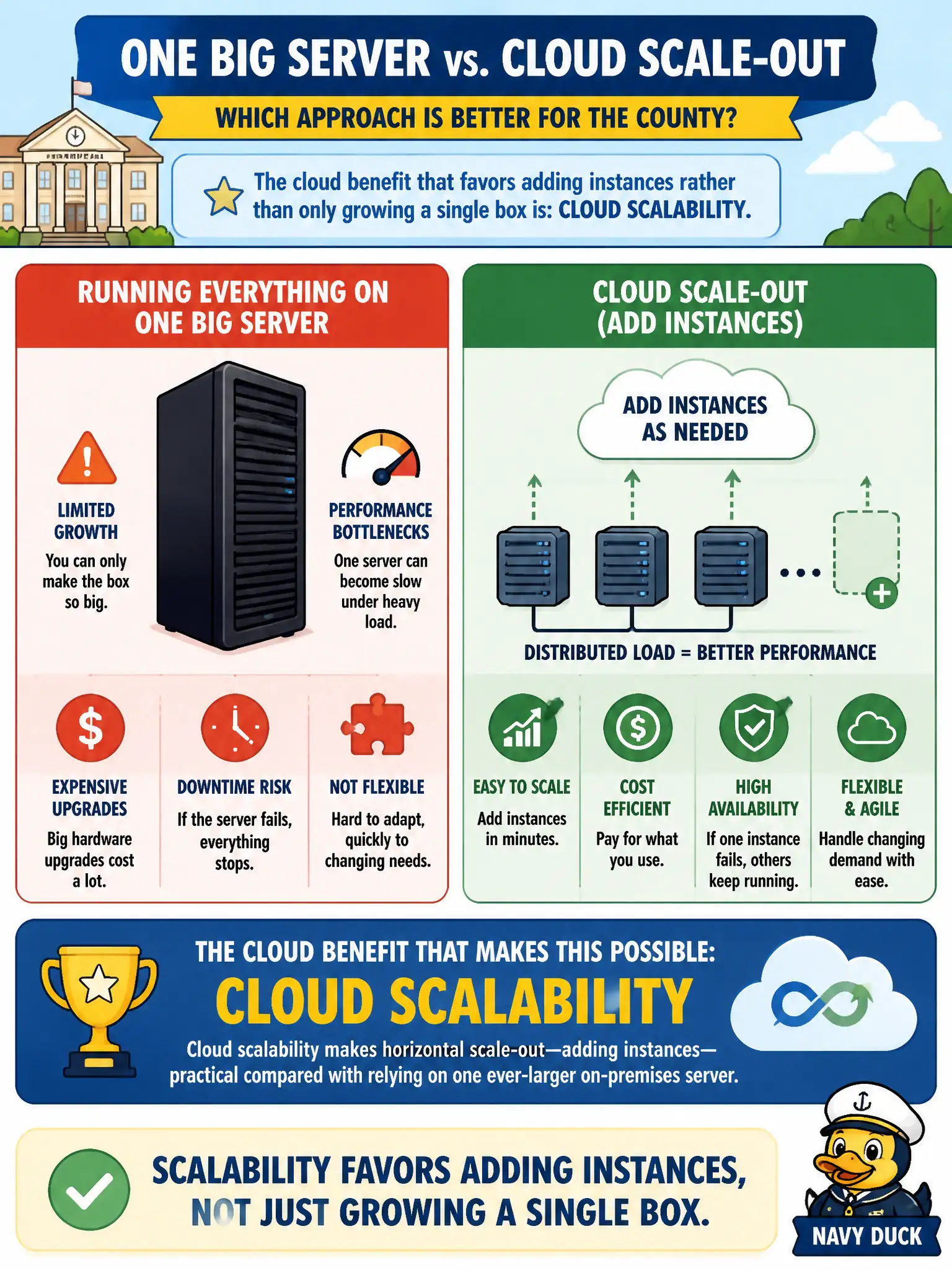
One giant server is a single circus tent—if it rips, the show stops, and buying a bigger tent takes forever. Scale-out is more tents side by side. Cloud makes adding those extra tents far easier than waiting on hardware purchasing.
Full Explanation
Cloud scalability makes horizontal scale-out—adding instances—practical compared with relying on one ever-larger on-premises server. For the county, that favors spreading load across multiple instances rather than endlessly growing a single box that remains a bottleneck and a single point of failure. More smaller workers behind a load distributor usually beat one giant circus tent for both growth and blast-radius control.
Claiming cloud forbids scale-out and only allows a single VM worldwide is false. Assuming one big on-premises server always scales infinitely with no procurement delay ignores hardware lead times and physical limits. Saying scale-out is unrelated to scalability and only applies to desktop printers misuses the benefit category.
Exam caveat: scale-up still exists and can be valid for some workloads; the teaching point here is that cloud makes scale-out far more accessible than traditional single-server growth, not that vertical scaling never happens. Pick the pattern that matches the app’s constraints.
Operational check: for a candidate county app, compare a plan that only increases one VM’s size against a plan that adds instances behind a load balancer; note procurement time, failure blast radius, and Friday peak behavior—then choose the scale-out path where multiple instances are practical and document why.