
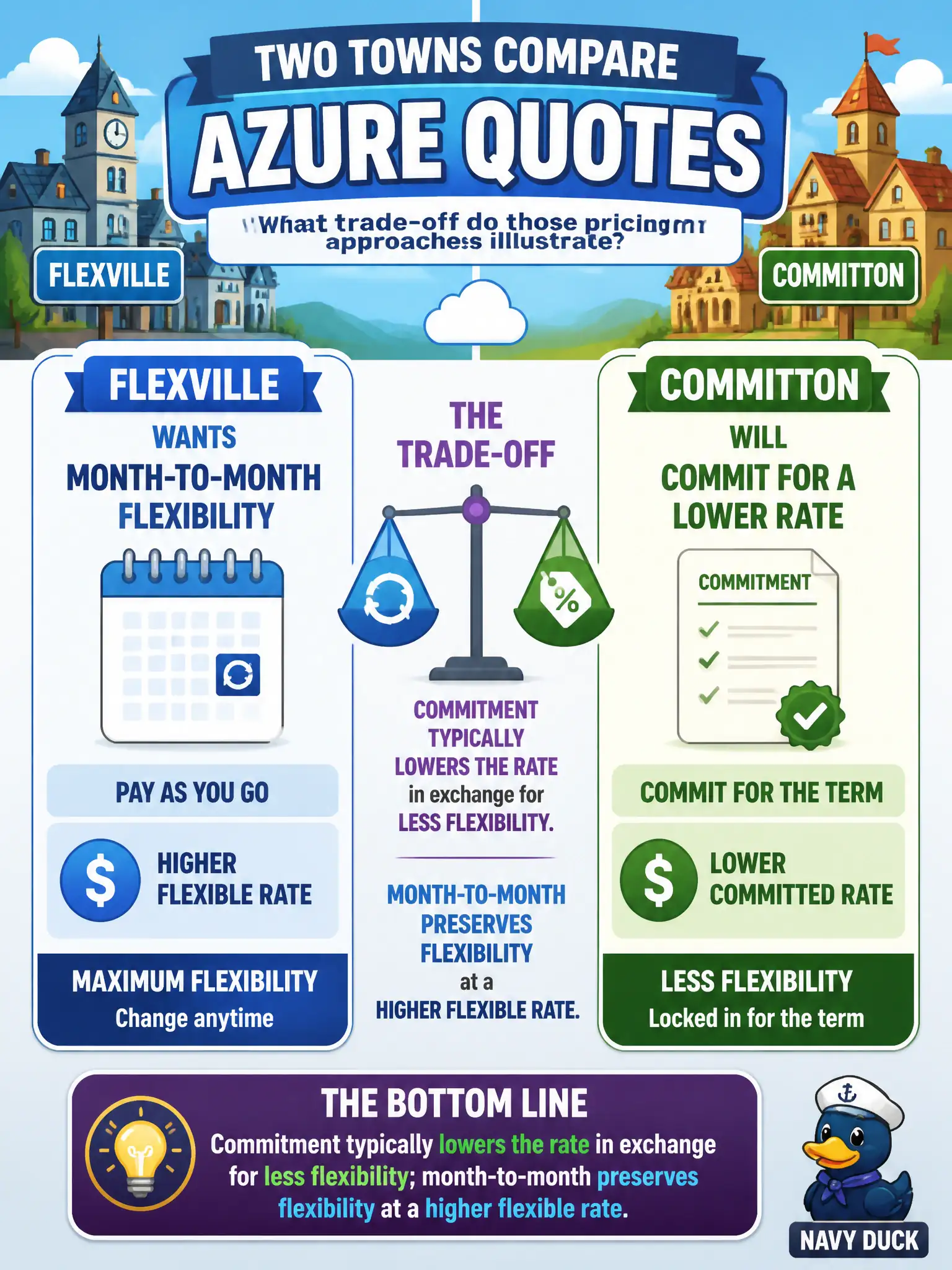
Two towns compare Azure quotes: one wants month-to-month flexibility, and the other will commit for a lower rate. What trade-off do those pricing approaches illustrate?
Select an answer to reveal the explanation.
Short Explanation
One town wants the cancel-anytime gym membership; the other wants the cheaper annual plan. Same gym, different deal. Cloud pricing works that way too—you trade freedom to change for a better rate, or keep freedom and pay the flexible price.
Full Explanation
Month-to-month (flexible) pricing preserves the ability to change, stop, or resize without a long commitment, usually at a higher flexible rate. Commitment pricing typically lowers the rate in exchange for agreeing to a term and reduced freedom to abandon that capacity plan. The two towns illustrate that classic trade-off: flexibility versus discount—not two identical deals.
Claiming commitment always increases flexibility while also raising the hourly rate reverses both sides of the trade-off. Saying month-to-month and commitment discounts are identical with no trade-off denies the core comparison. Restricting flexibility-for-discount trades to on-premises CapEx purchases alone misses that cloud pricing models embody the same idea without buying hardware.
Exam caveat: the lower rate from a commitment only helps if the town actually uses what it committed to; unused reservations or wrong-size commitments can leave a town paying for capacity it does not consume—discount is conditional on fit.
Operational check: for each town’s candidate workloads, score predictability (hours per month, stable size) versus change likelihood (seasonal apps, pilots). Recommend commitment only where predictability is high, and keep month-to-month for volatile or short-lived services.