
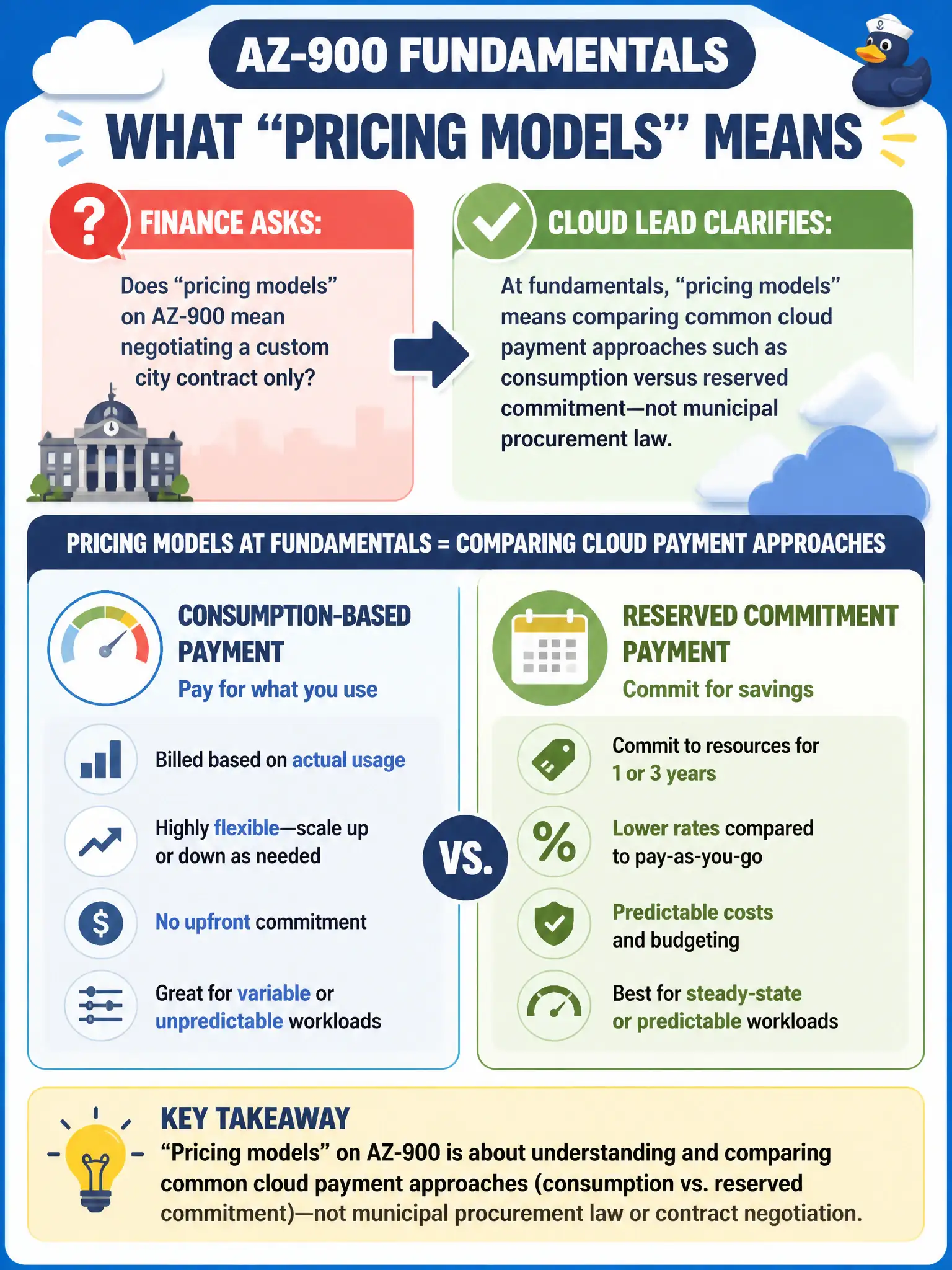
Finance asks whether “pricing models” on AZ-900 means negotiating a custom city contract only. What should the cloud lead clarify?
Select an answer to reveal the explanation.
Short Explanation
The exam is talking about how the cloud bills—metered use versus committing for a discount—not how City Hall runs an RFP. Keep the finance story in the procurement office; keep the AZ-900 answer on consumption versus commitment.
Full Explanation
On AZ-900, pricing models means understanding common cloud payment approaches—especially consumption or pay-as-you-go versus reserved or commitment pricing—and the flexibility-versus-discount trade-off. It is not a lesson in municipal procurement law, sealed-bid RFPs, or drafting a custom city contract. The cloud lead should steer finance toward those cloud billing concepts while leaving procurement process questions to the city’s purchasing office.
Treating AZ-900 pricing models as only sealed-bid RFP procedures and council ordinances confuses exam vocabulary with local government purchasing process. Requiring candidates to write a custom Azure Enterprise Agreement from scratch exceeds fundamentals describe-level scope. Claiming the term excludes pay-as-you-go and reserved options removes the very approaches the exam compares.
Exam caveat: real cities may still negotiate enterprise agreements or use marketplace offers; those exist in the wild, but the fundamentals exam focuses on conceptual models (consumption versus commitment), not negotiation tactics or contract legalese.
Operational check: in the next finance briefing, open with a one-slide contrast of pay-as-you-go versus reserved commitment for a known city workload, explicitly label that slide as AZ-900 pricing models, and park RFP timeline questions in a separate procurement follow-up so the exam concept and City Hall process stay distinct.