
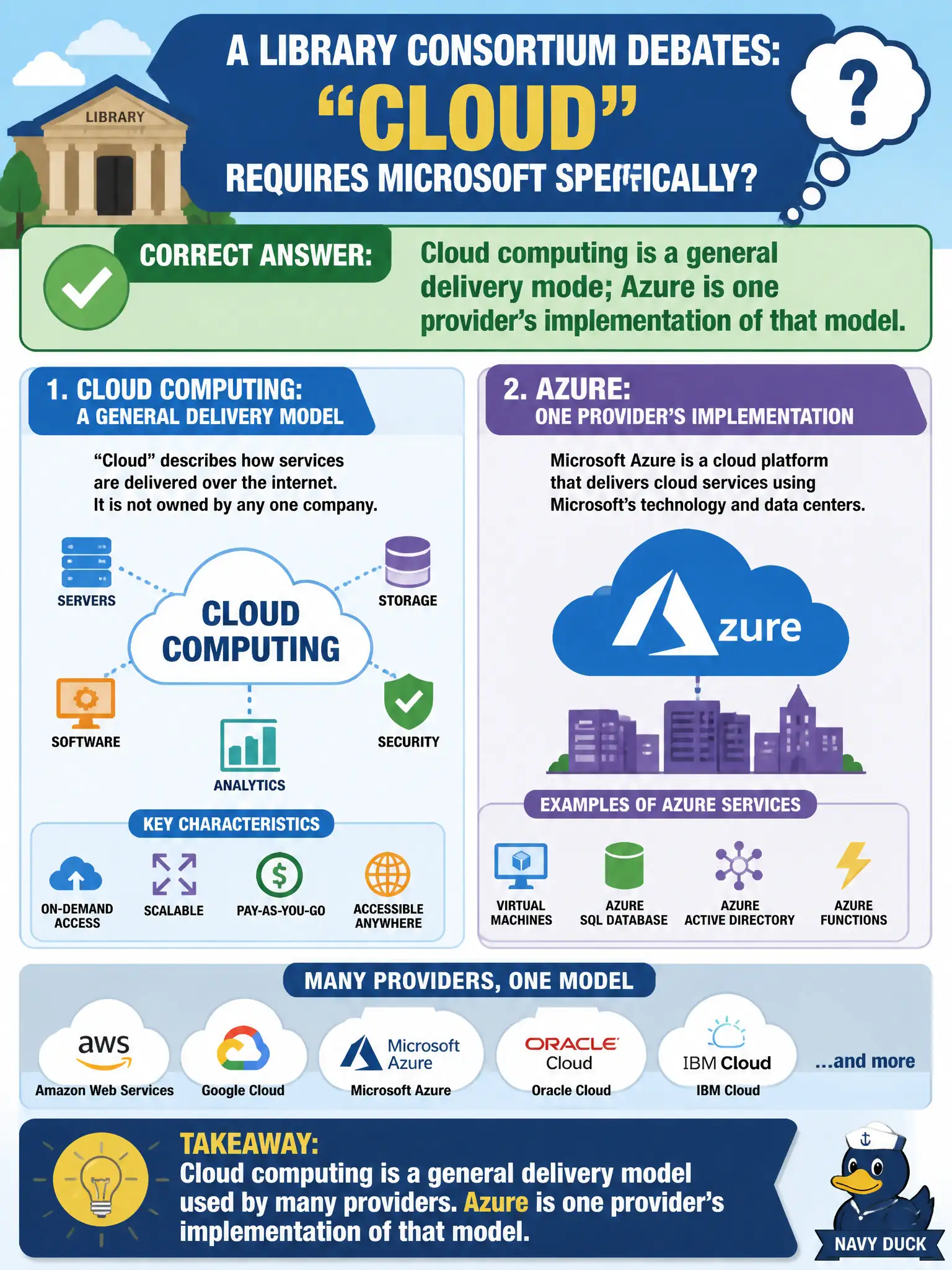
A library consortium debates whether "cloud" requires Microsoft specifically. Which statement is correct?
Select an answer to reveal the explanation.
Short Explanation
"Cloud" is the recipe; Azure is one restaurant cooking it. Other providers follow the same general model. AZ-900 studies Microsoft's implementation, but the definition itself is bigger than one logo.
Full Explanation
Cloud computing is a general industry delivery model for IT resources as services. Azure is Microsoft’s public-cloud implementation of that model, which is why AZ-900 studies Azure deeply without equating the word “cloud” with Microsoft alone. A library consortium can correctly say cloud exists as a concept independent of any single logo, while still choosing Azure as its provider.
Treating cloud computing as a Microsoft trademark that cannot describe non-Azure services is historically and conceptually wrong. Requiring Azure and Microsoft 365 together invents a packaging rule; organizations can use cloud services without that specific pairing. Equating cloud only with on-premises Hyper-V clusters branded by Microsoft confuses virtualization products with the cloud service model.
Exam caveat: exam content is Azure-centric, but definition questions still expect “general model versus one provider’s implementation.” Operational check: in architecture discussions, separate “are we adopting cloud characteristics?” from “which provider implements them?” so procurement debates do not redefine the fundamentals terms. For municipal libraries comparing proposals, keep the vocabulary straight: cloud characteristics describe the delivery approach; Azure branding describes whose control plane and regions you will use. Training for AZ-900 emphasizes Microsoft’s implementation details after that conceptual separation is clear, so boards do not treat “cloud” and “Azure” as interchangeable words when evaluating non-Microsoft options or hybrid identity designs.