
A city DevOps team redeploys the same ARM template to a resource group after a small configuration drift. What benefit of infrastructure as code with ARM does this illustrate?
Select an answer to reveal the explanation.
Short Explanation
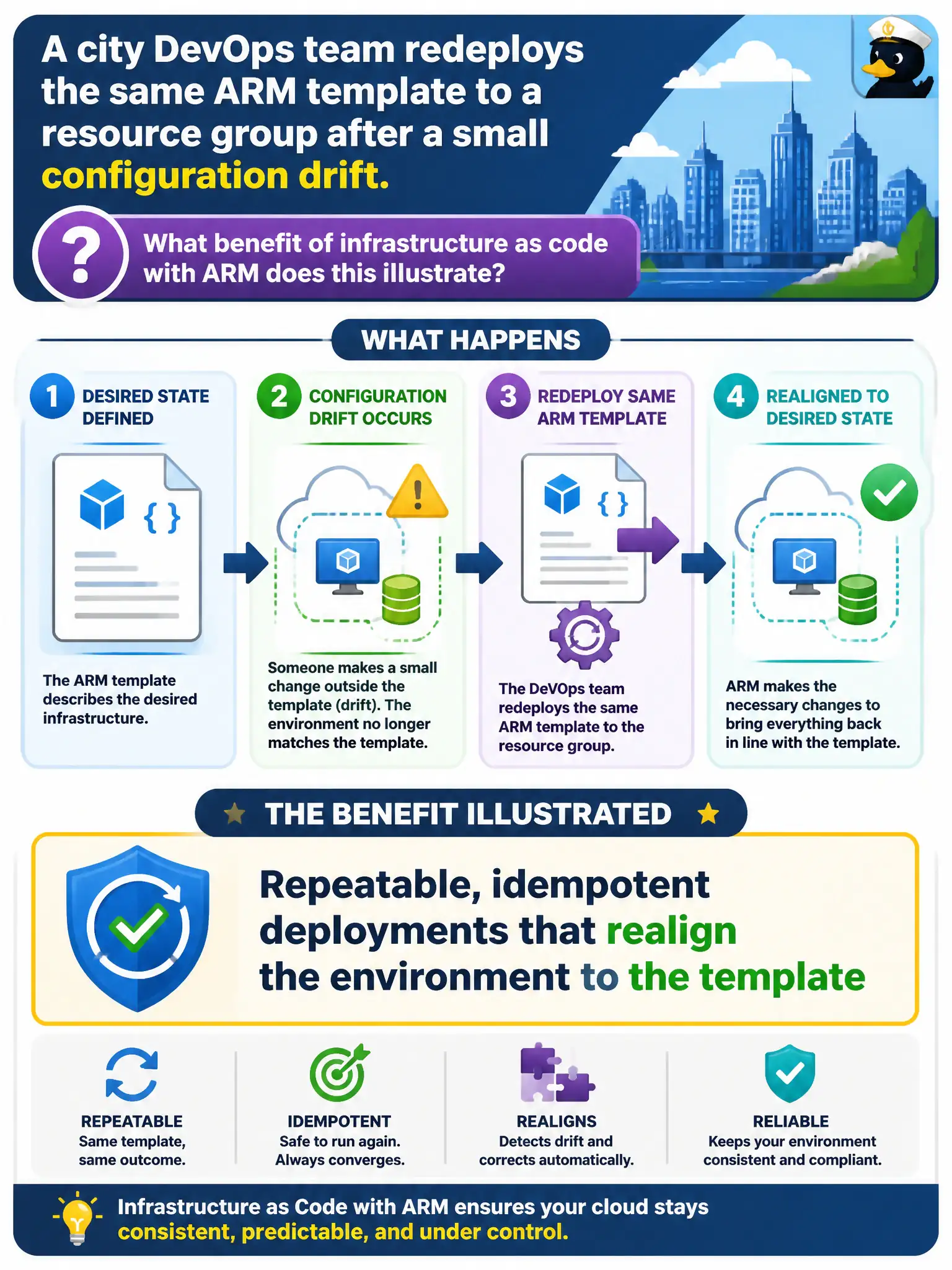
Redeploying the same template is like resetting the stage to the script. If someone tweaked a setting by hand, ARM brings the environment back in line with what the template says should be there.
Full Explanation
Redeploying the same ARM template after configuration drift illustrates repeatable, idempotent infrastructure as code. The city DevOps team declares the desired state once; each deployment asks Azure Resource Manager to bring the resource group back in line with that declaration. Hand-tweaked settings that drifted from the approved municipal baseline are corrected without rebuilding everything from scratch or inventing a new process per environment.
Automatic deletion of every resource Azure Advisor marks as unused fails because Advisor recommendations do not equate to template redeploy behavior, and templates do not mass-delete Advisor findings by default. Replacement of Microsoft Entra ID with local accounts on each redeploy fails because identity is orthogonal to ARM template idempotency and Entra ID remains the cloud identity plane. Guaranteed exemption from Azure Policy for templated resources fails because Policy still evaluates templated resources; IaC does not grant a free pass from governance.
Exam caveat: "idempotent" on AZ-900 means reapplying the same template converges to the same declared state—it does not mean Azure ignores deletes you intentionally put in a template or that Policy stops evaluating the result.
Operational check: change a setting manually in the portal, redeploy the unchanged template, and confirm the property returns to the template value while unrelated resources outside the template scope remain untouched.