
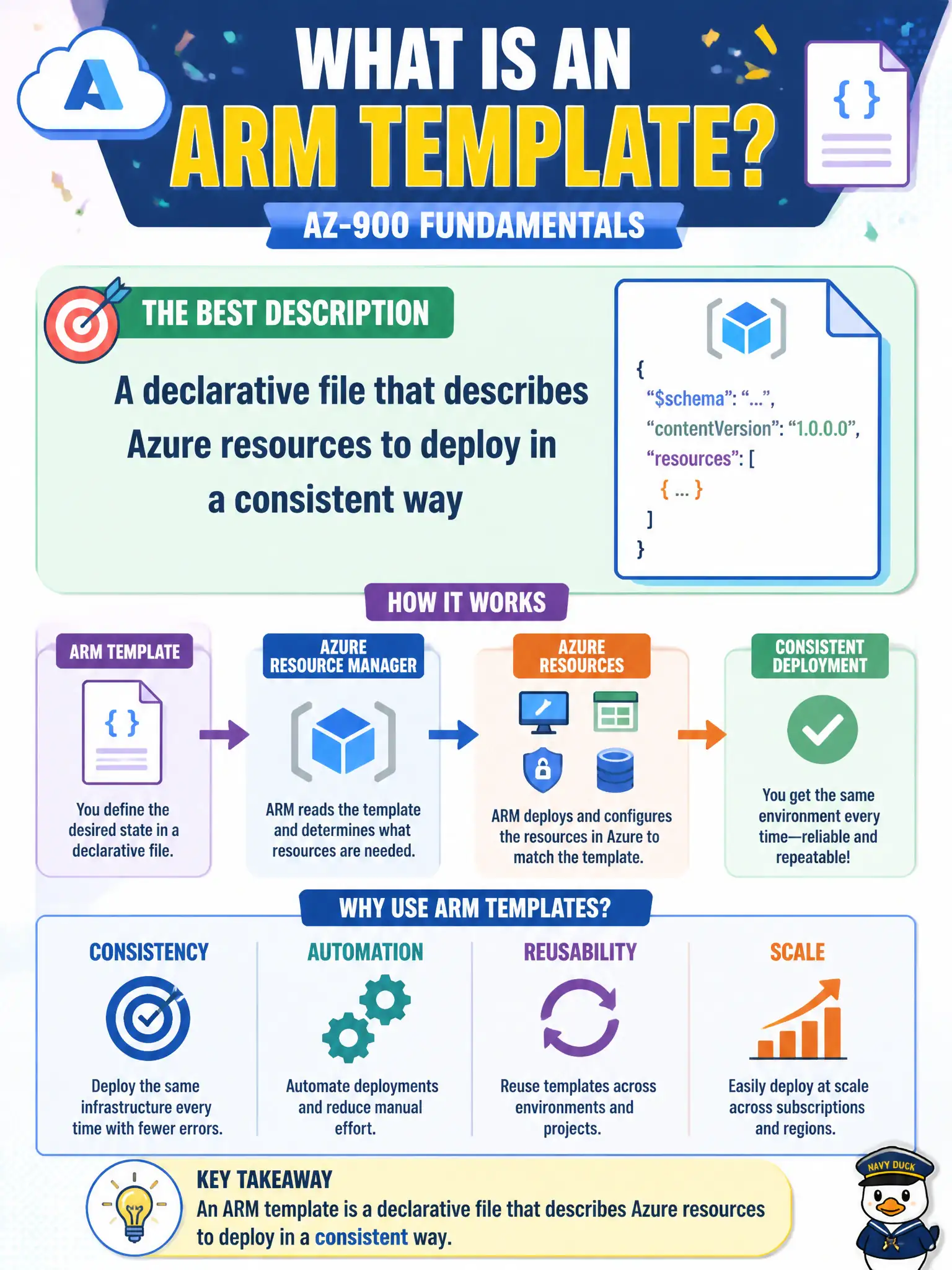
During AZ-900 review, a county trainee asks what an ARM template is mainly for at the fundamentals level. What is the best description?
Select an answer to reveal the explanation.
Short Explanation
At fundamentals depth you only need the big idea: an ARM template is a written description of what to build. Azure reads that description and creates the resources—you are not expected to author a full production template on the exam.
Full Explanation
At AZ-900 fundamentals depth, an ARM template is best described as a declarative file that states which Azure resources should exist and how they relate, so Azure can deploy them consistently across environments. The city or county team expresses desired state—resource types, names, properties, dependencies—and Azure Resource Manager creates or updates to match. That description-first model is the core idea the exam expects, not deep authoring skill.
Calling it a script that must be rewritten uniquely for every Azure region fails because templates are reusable definitions; parameters and location properties allow the same file to target different regions without rewriting from scratch. Treating it as a Microsoft support ticket format used only during platform outages fails because templates are deployment artifacts, unrelated to Service Health or support cases. Calling it a billing invoice export fails because Cost Management and billing exports track charges; they do not define infrastructure to deploy.
Exam caveat: AZ-900 may mention Bicep or Terraform in broader infrastructure-as-code conversation, but the fundamentals framing for ARM templates remains "declarative consistent deployment," not syntax memorization.
Operational check: open a sample template or deployment history in the portal for a municipal resource group and verify you can see which resources the last declarative deployment intended to create—reinforcing that the file is a deployment description, not a ticket or invoice.