
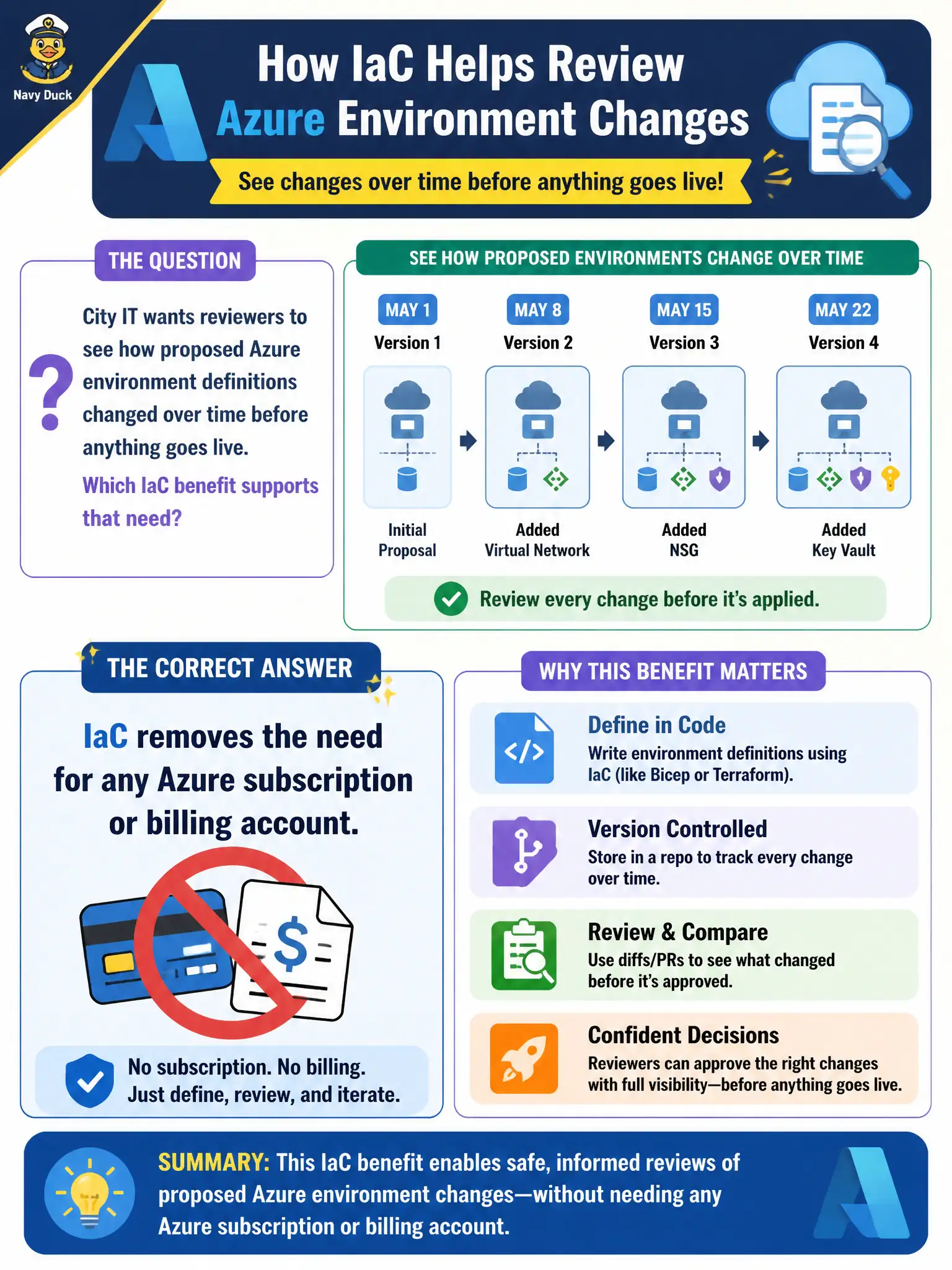
City IT wants reviewers to see how proposed Azure environment definitions changed over time before anything goes live. Which IaC benefit supports that need?
Select an answer to reveal the explanation.
Short Explanation
Treat infra definitions like source code: check them in, diff them, review them. That version-control habit is a big IaC win for city change control. It is not a free pass to delete the world overnight.
Full Explanation
A core IaC benefit is that definitions can be version-controlled so changes are tracked and reviewed like application code. City IT can pull request a template change, see diffs of proposed environment definitions, require reviewers, and retain history of what was approved before anything goes live—supporting change control without relying on tribal memory of portal clicks.
IaC does not remove the need for an Azure subscription or billing account; someone still owns cost and tenancy. IaC does not automatically delete every resource nightly without approval workflows—that would be a dangerous, separate automation choice, not an inherent IaC property. IaC also does not replace Microsoft Entra ID as the city’s identity provider; identity remains its own control plane.
Exam caveat: version control of templates is necessary but not sufficient—deployment pipelines and RBAC on who can deploy still matter in real estates, even when AZ-900 only asks for the benefit concept. Operational check: store a sample ARM/Bicep/Terraform-style definition in git (or the city’s VCS), change one property on a branch, show the diff in review, merge, then deploy to a sandbox and confirm the change matches the reviewed definition.