
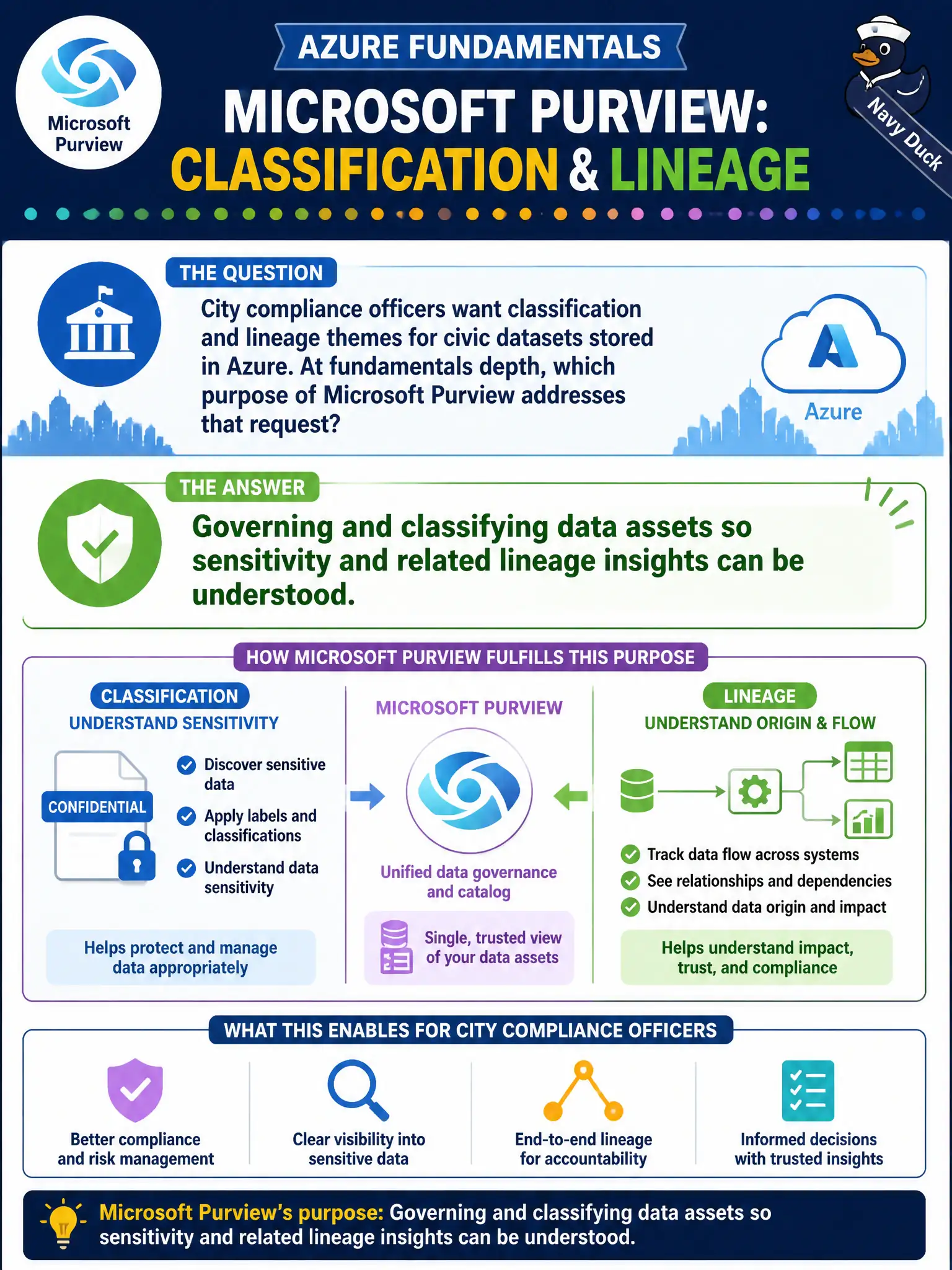
City compliance officers want classification and lineage themes for civic datasets stored in Azure. At fundamentals depth, which purpose of Microsoft Purview addresses that request?
Select an answer to reveal the explanation.
Short Explanation
Classification is putting a sensitivity sticker on the dataset; lineage is tracing where it came from and where it went. Purview’s lane is that data-governance story. ExpressRoute and Entra ID solve connectivity and identity instead.
Full Explanation
Microsoft Purview supports governing and classifying data assets so organizations can understand sensitivity and related lineage-style insights about how data moves and relates across the estate. City compliance officers asking for classification and lineage themes on civic datasets are describing that data-governance purpose: label sensitivity meaningfully and gain visibility into relationships that matter for audits and incident response—not spin up unrelated Azure networking or identity products.
Provisioning ExpressRoute circuits per dataset confuses private connectivity with data classification. Replacing Microsoft Entra ID as the city’s directory is an identity redesign Purview does not perform. Automatically creating resource locks on every blob container is a Resource Manager lock pattern for change control, not Purview classification.
Exam caveat: AZ-900 stays at purpose-level recognition; detailed lineage graph administration and classifier tuning are administrator skills outside the fundamentals exam’s expected depth. Operational check: for one civic dataset in a catalog (or documented Purview sample), confirm a sensitivity classification is visible and that ownership or related asset links are recorded so compliance can explain both “how sensitive” and “where it connects” during the next audit interview.