
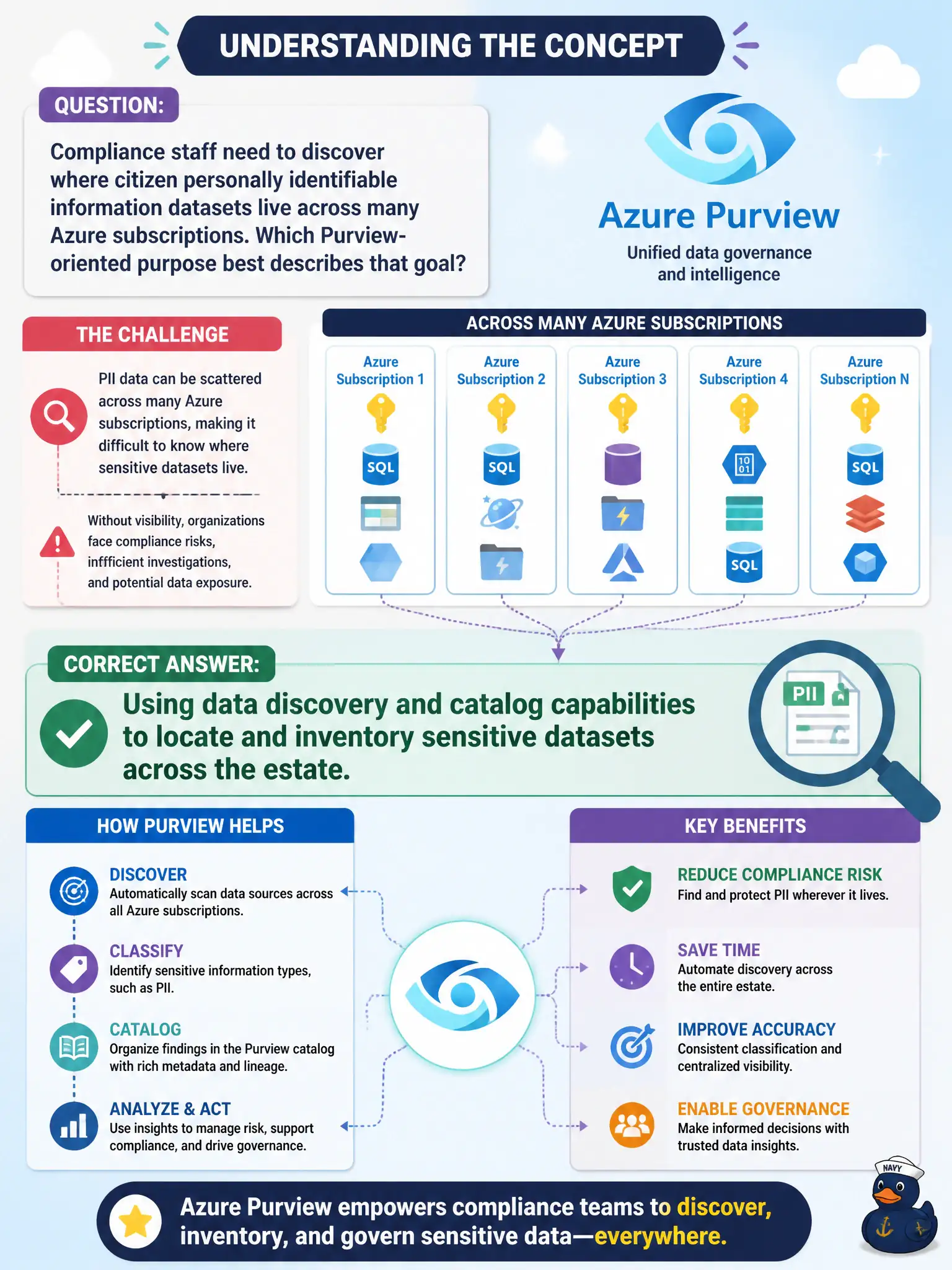
Compliance staff need to discover where citizen personally identifiable information datasets live across many Azure subscriptions. Which Purview-oriented purpose best describes that goal?
Select an answer to reveal the explanation.
Short Explanation
Finding where the citizen PII actually sits is a catalog-and-discovery problem. Purview’s value here is mapping the data estate—not spinning up more zones or rewriting ARM. Once you know where it lives, governance conversations get real.
Full Explanation
At fundamentals depth, a core Microsoft Purview purpose is helping organizations discover and catalog data assets—including sensitive citizen personally identifiable information—across subscriptions and connected sources. Compliance staff who need to locate where those datasets live are asking for discovery and inventory visibility so governance, retention, and access conversations can target the right stores instead of guessing.
Deploying availability zones under every storage account improves resiliency design; it does not invent a catalog of where PII sits. Authoring ARM templates that recreate databases nightly is infrastructure-as-code automation, not data discovery. Assigning Contributor RBAC so auditors can delete unused disks grants destructive management rights and is the opposite of careful PII inventory work.
Exam caveat: discovering that a dataset exists is not the same as remediating access or encryption—Purview-oriented discovery feeds a compliance program; RBAC, encryption, and Policy still do the enforcement work. Operational check: after any catalog or discovery exercise, produce a short inventory of candidate PII stores (storage accounts, databases, analytics workspaces), map each to an owning bureau, and verify that at least one high-sensitivity item has a named owner and a follow-up ticket rather than remaining an unnamed find.