
A municipal data office needs one place to catalog datasets, sensitivity labels, and governance visibility across Azure data estates. Which service’s purpose in Azure best matches that need?
Select an answer to reveal the explanation.
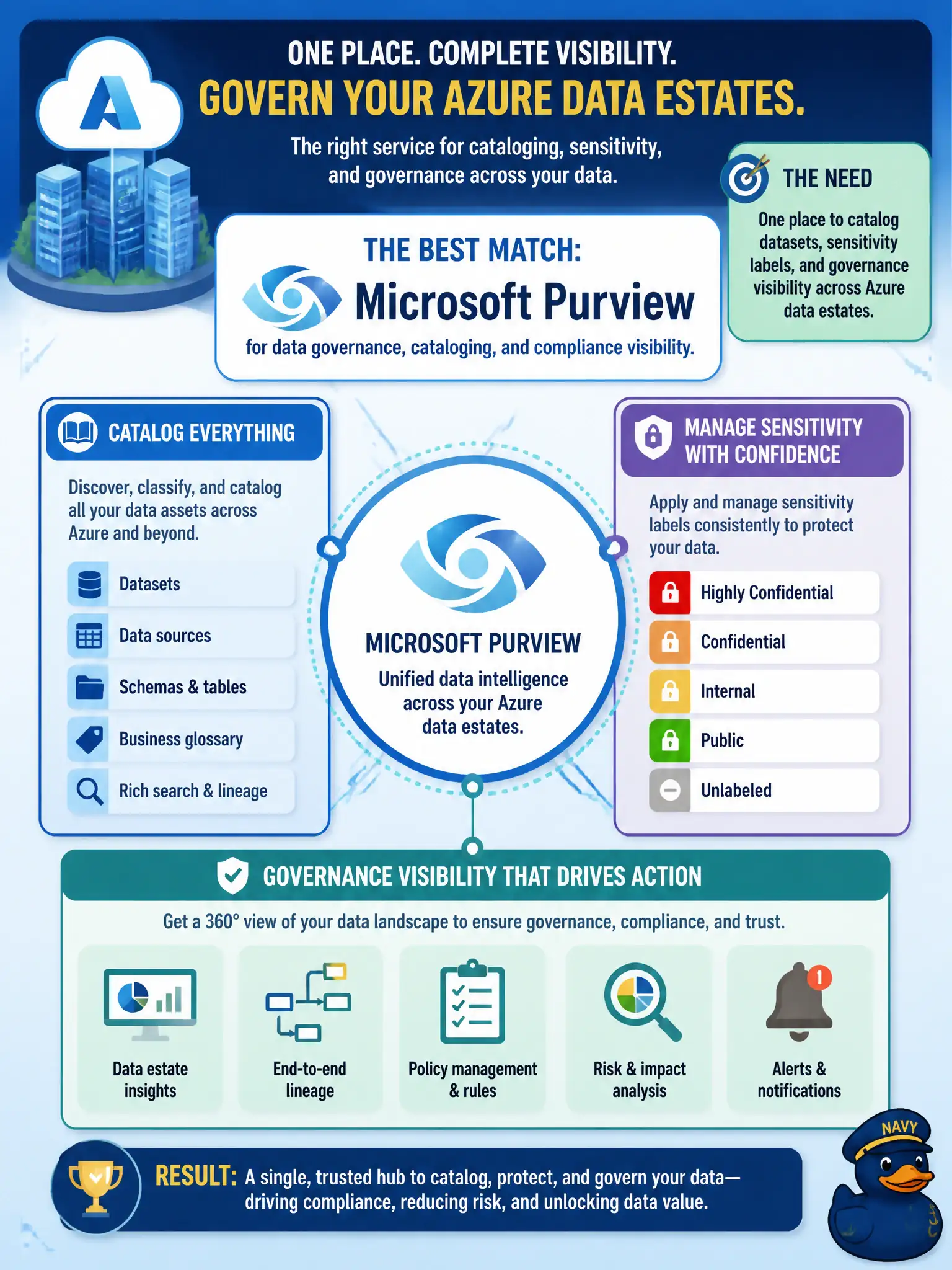
Short Explanation
Think of Purview as the city’s map of what data it has and how sensitive it is—not the warehouse that stores every file. Catalog, classify, govern: that is the Purview lane. VMs and ExpressRoute do different jobs.
Full Explanation
Microsoft Purview is the Azure-aligned service family whose fundamentals purpose is data governance: cataloging data assets, applying classification and sensitivity themes, and improving compliance visibility across the city’s data estate. A municipal data office that needs one place to see which datasets exist, how sensitive they are, and how governance policies relate to them is describing Purview’s lane—not a general-purpose compute or network product.
Hosting a catalog database on Azure Virtual Machines might store a custom inventory, but VMs alone do not provide Purview’s governed catalog, classification, and compliance-visibility model. Azure Bastion is secure RDP/SSH into VMs over the portal; it is not a data-classification browser. Azure ExpressRoute is private connectivity into Azure and does not classify citizen records in transit.
Exam caveat: AZ-900 expects you to recognize Purview’s purpose at a describe level; deep scan configuration, source registration details, and product SKU distinctions are beyond the fundamentals exam. Operational check: in a non-production subscription that already has sample datasets registered (or in Microsoft Learn sandboxes covering Purview concepts), open the data catalog view and confirm you can locate at least one asset with a sensitivity-oriented classification rather than only a storage account name in the portal.